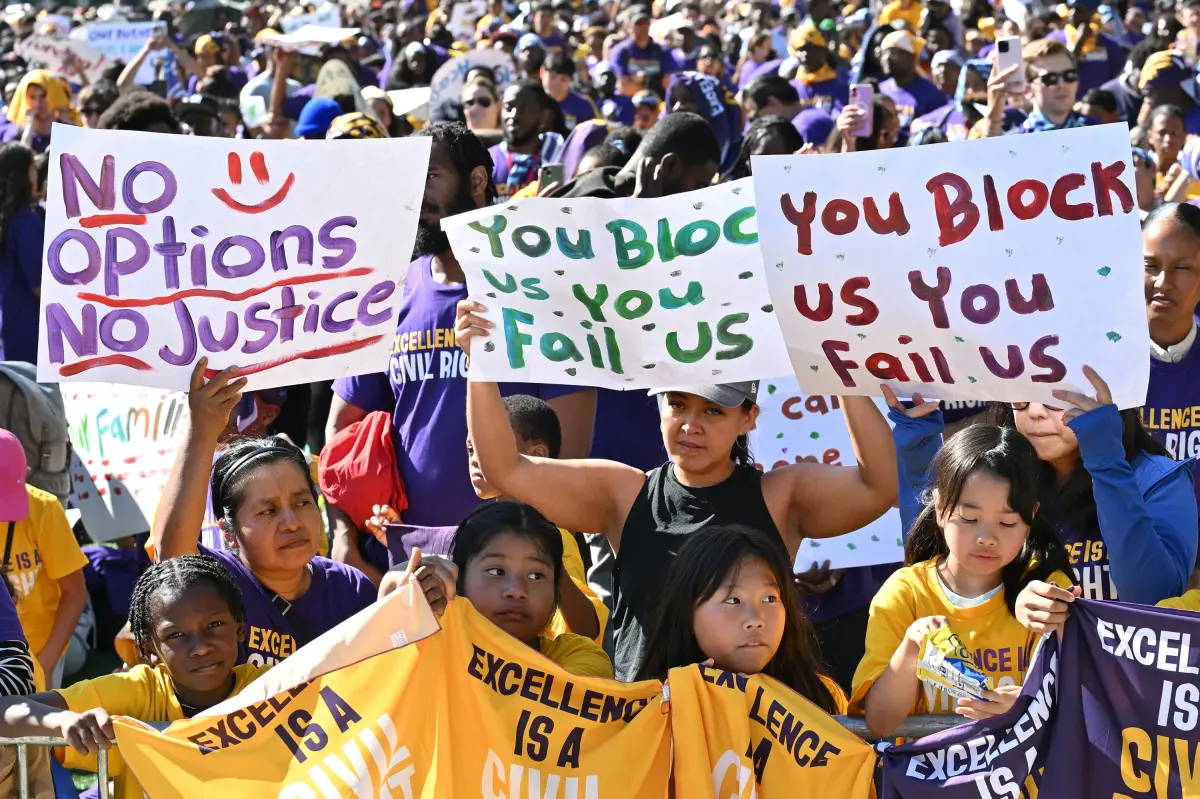

Nearly two-thirds of New York voters support lifting the state’s cap on charter schools, paving the way for more campuses to open in New York City, according to a poll released by a new charter-school advocacy organization.
The survey, conducted by HarrisX and SKDK for Great Public Schools New York, found that 64% of voters favor raising or eliminating the cap. Just 22% oppose the change, while 14% remain undecided.
Supporters outnumber opponents by a 3-to-1 margin statewide.
Respondents were asked whether they supported lifting the cap after hearing that “when one charter school closes, its license to operate can’t be used by another school — so the total number of schools shrinks.”
Among suburban and upstate voters, 63% backed raising the cap, compared with 19% who opposed it. The remaining respondents were unsure, according to the survey of 4,478 registered voters.
Charter schools receive public funding but are privately operated. They generally offer longer school days and school years than traditional public schools. Most charter educators are not unionized, while teachers in traditional public schools are represented by unions that wield significant influence in New York’s heavily Democratic state and city governments.
Created under state law in 1998, New York City now has 286 charter schools serving 152,000 students — roughly 15% of the city’s public-school population. On the state’s standardized reading and math exams, charter students often outperform their peers in traditional public schools.
Still, Gov. Kathy Hochul and the state Legislature agreed in 2023 to allow only 14 additional charter schools to open in New York City after a contentious battle with anti-charter teachers unions.
The city has reached its charter-school cap, meaning Albany must raise or remove the limit before additional licenses can be issued.
Teachers unions and their legislative allies oppose expanding the cap, arguing that charter schools divert money from traditional public education despite their popularity among families.
Mayor Zohran Mamdani opposed charter-school expansion during his campaign for City Hall last year.
Even so, 72% of parents whose children attend traditional public schools support raising the cap to give families more options. Support also reached 69% among Black and Hispanic voters, 62% among white voters and 57% among Asian voters, the poll found.
The survey showed support for lifting the cap across party lines: 59% of Democrats, 74% of Republicans and 62% of independents favored the policy.
Voters were also asked a broader question: “Based on what you know now, do you support or oppose the expansion of public charter schools in New York?”
Responses were similarly positive, with 63% of New York City voters supporting expansion, along with 54% of voters elsewhere in the state.
The poll further asked: “How important is it for families to have multiple public school options available, including charter schools?”
In New York City, 77% of respondents said having a charter-school option was extremely or very important. That view was shared by 54% of suburban and upstate voters.
Researchers also presented respondents with the statement: “Parents should be empowered to choose the best public school for their child, whether it is a traditional or charter school.”
An overwhelming 91% of city voters agreed, as did 87% of respondents in the rest of the state.
For the 2027 legislative session in Albany, GPSNY plans to make lifting the charter-school cap and increasing public funding its top priorities. The group will urge Hochul and her Democratic colleagues in the Legislature to support both measures.
Former Mayor Mike Bloomberg, a longtime supporter of charter schools, is contributing $1 million to help launch the organization’s lobbying campaign. His daughter, Emma, sits on GPSNY’s advisory board.
Charter-school educators and parents said more children should have the chance to enroll in these schools.
“One of the greatest things about my son’s school is the educators here do not sit here and let you think about what your kid can’t do,” said Violet Stevens, a parent at New York City Autism Charter School in East Harlem. “The first thing they ask is, ‘What do you want your kid to accomplish?’”
“I can’t imagine where my son would be, or where our family would be with my son’s diagnosis, if it weren’t for NYC Autism Charter Schools.”
Tresha Ward, CEO of Prospect Charter Schools in Brooklyn and a member of the GPSNY advisory board, also endorsed the organization’s mission.
“For every problem in the education system, the public charter school sector has developed a solution,” Ward said. “What’s missing is the power to enact change, and we believe GPSNY will help bring the New York community together to increase access to a high-quality public education.”
The poll’s margin of error is 1.5 percentage points for the full sample and is larger for individual subgroups.


