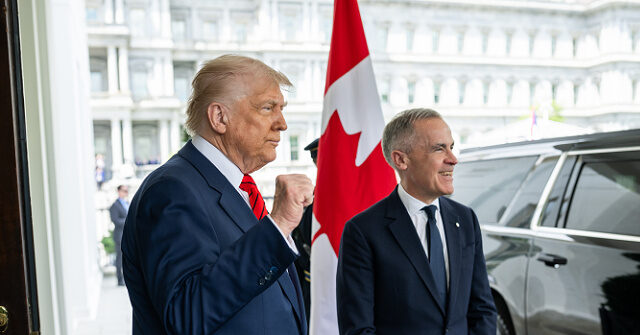

Canadian Prime Minister Mark Carney’s reported shift toward China and Europe is drawing criticism from opponents who warn it could weaken the country’s economy. His increasingly adversarial stance toward the Trump administration has now coincided with a review of Canada’s traditionally close security partnership with the United States.
The Washington Post reported Friday that Secretary of War Pete Hegseth had issued a memo restricting certain aspects of the U.S.-Canada defense relationship. The report offered few details, citing officials who spoke on condition of anonymity.
– News contacted the Pentagon and received a statement from Chief Pentagon Spokesman Sean Parnell, who said:
The Department of War is taking steps to ensure its engagements with Canada advance tangible U.S. defense objectives and ultimately support a reinvigorated defense relationship. DoW is prioritizing opportunities for bilateral cooperation that strengthens the defense of our Homelands and shared hemisphere, while supporting Canada’s ability to meet NATO obligations. This guidance does not impact defense intelligence cooperation, our binational NORAD command, or our cooperation through NATO.
Canada’s well-documented reorientation away from Washington and toward Beijing is raising security concerns on both sides of the border.
Carney said 10 days ago that the United States posed a greater security threat than China, remarks that triggered concern in both countries. Supporters in Canada argued that he misspoke, but the prime minister has not offered further clarification.
FIND OUT MORE: Cardiologist Dr Andrea Tordini Reveals 2-Minute Exercise to Lower Blood Pressure Without Pills
During an October event with – News, Department of Homeland Security Secretary Markwayne Mullin said the northern border was “becoming more of a problem.” He added that vulnerabilities along the lengthy U.S.-Canada border required additional security attention.
Carney’s outreach to China comes after the two nations resumed military discussions earlier this year for the first time in eight years, even as tensions between their governments continued.
Two weeks before the November midterm elections, the U.S. Embassy in Ottawa published a fact sheet detailing instances in which Canadian officials allegedly dismissed concerns about possible interference in U.S. elections. Several Canadian ministers and premiers publicly outlined efforts to influence American politics in government documents and public remarks.
For instance, Industry Minister Mélanie Joly met with Democratic leaders in Boston and Chicago and told the media that the Canadian government was targeting products in Republican-led states.
– News was among the first outlets to report that Maia Johnson, a former staffer for Hillary Clinton and Joe Biden, had been hired for prominent positions in Carney’s government.
The Trump administration has pushed to rebalance trade with Canada, arguing that a revised relationship could benefit both countries. Although an agreement once appeared within reach, Carney’s government has since pulled back, according to critics, weakening the economic ties between the neighboring nations. Meanwhile, President Trump’s assertion of the “Donroe Doctrine” in the Western Hemisphere has added to tensions, with Carney and his government increasingly pursuing policies at odds with Washington.


