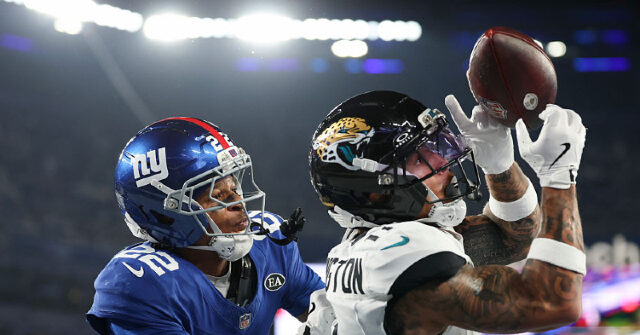

What constitutes a catch? That question has confounded NFL officials for years, and it is likely to remain a source of debate for at least another week.
The latest controversy unfolded Sunday afternoon at MetLife Stadium, where Jaguars wide receiver Parker Washington made an end-zone catch against the Giants that appeared, to many watching, to be an obvious touchdown.
Here’s a closer look.
As CBS rules analyst Gene Steratore explained in the video, Washington briefly bobbled the pass before regaining control. He then planted his right foot in bounds, followed by his left, and never appeared to lose possession.
Despite that, the on-field ruling was an incompletion. The play went to review, but the original decision was upheld.
During the postgame pool report, Vice President of Instant Replay Mark Butterworth was asked to explain why the play was not ruled a touchdown.
“So, when his right foot touches the ground first, it’s not determined that he has control of the ball at that moment?” asked Pat Leonard of the New York Daily News.
Butterworth replied, “He needs to maintain control of the ball throughout the process of the catch.”
Butterworth said officials determined that Washington lost control when he hit the ground.
MUST READ: Georgia Officer Shoots 13-Year-Old After Stop Tied to Shooting
But the video appears to tell a very different story.
The footage seemingly provides “clear and obvious” evidence that Washington had possession when his right foot landed, when his left foot landed and throughout his contact with the ground.
The decision quickly drew criticism from fans, many of whom directed their frustration at the officiating crew.
“Bullshit. The evidence was clear. Shame on the league,” one fan wrote.
“Ppl are failing to realize that not only did he get 2 feet inbounds.. his right knee and shin was also inbounds before going out of bounds lol. It was clear and obvious it was a touchdown,” wrote another.
“Then why have officials and replay. If they can’t over turn a call based on evidence versus what was called on the field in the blink of an eye. This proves that all the cameras and reviews are pointless. We still on 2026 can’t prove what a catch is,” another opined.
The NFL’s long-standing emphasis on the call made on the field has often limited the impact of replay, and that issue came into sharp focus for the Jaguars. Replay is supposed to provide officials with a fresh, detailed look at a play—using multiple angles and slow motion—to determine what actually happened.
Instead, requiring replay officials to account for the original ruling while imposing an artificially high standard of “indisputable” evidence has made controversial decisions even harder to understand.
Unless that standard is changed, replay will continue to feel pointless in moments like this.