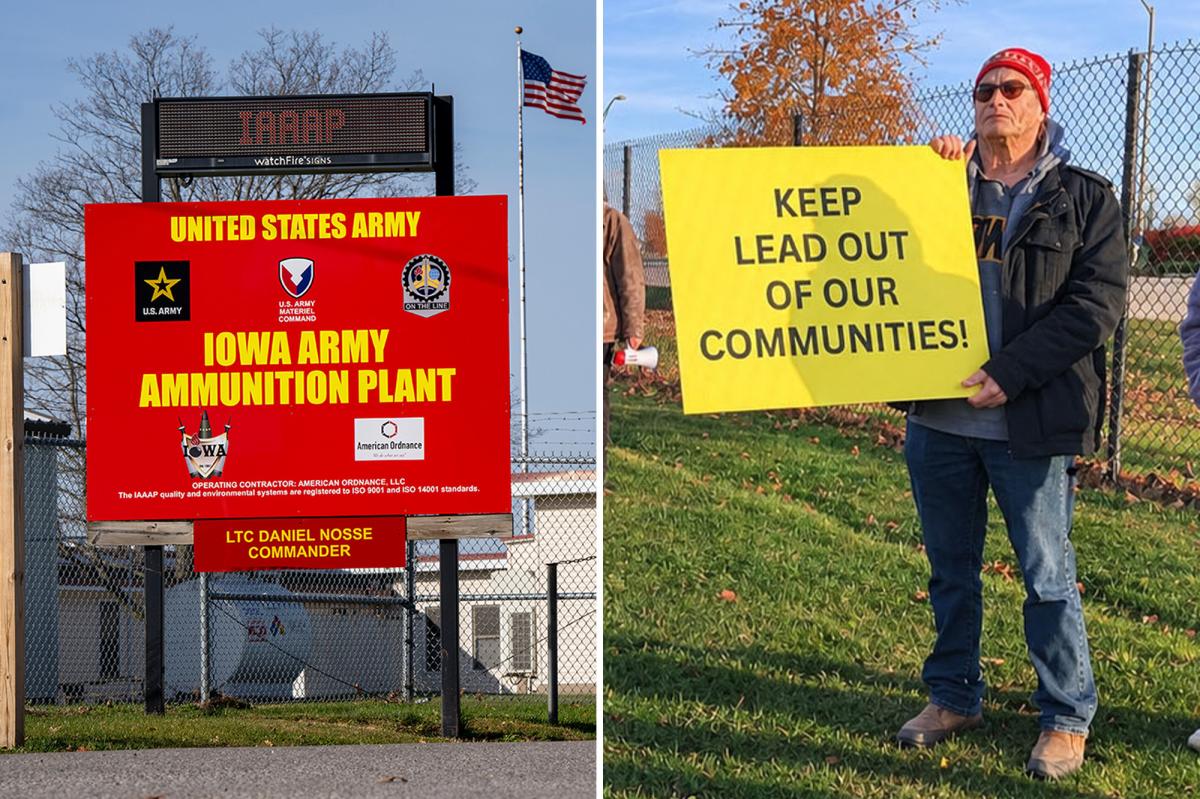

President Donald Trump said Monday that he would defer to a federal appeals court on whether the administration can proceed with plans to detonate several tons of deteriorating bomb-making material at an Iowa ammunition plant.
The Army originally scheduled the controlled explosion of 68 barrels of lead azide for Friday. However, widespread concern over possible health and environmental consequences has prompted officials to move the date three times. The latest plan called for the detonation on Wednesday, when officials said weather conditions were expected to be most favorable.
The Army did not immediately respond to a request for comment on Trump’s social media statement. Environmental groups filed a lawsuit last week seeking to block the operation and secured a stay from the appeals court while it considers the validity of an emergency permit issued by the U.S. Environmental Protection Agency.
Trump said he would prefer to eliminate the volatile material as quickly as possible, arguing that a controlled detonation would present the safest option. “At the same time, have ordered the military not to do so until such time as the 8th Circuit agrees that we can go forward, and am further making this decision fully subject to the incoming Gov.-elect Rob Sand agreeing to the operation,” Trump said in a statement.
Trump said the administration would be unable to proceed if Sand and the court oppose the plan. He also said he would hold the incoming governor responsible for “any and all death or destruction caused by this very unfortunate, and long-term, situation.”
Sand said Sunday on social media that decisions made earlier had left officials with no safe or easy path forward. “No good options exist and the situation is more dangerous and unpredictable than it ever should have been,” he wrote.
He questioned why a contract intended to remove the explosive threat was canceled, why officials took no action afterward and “why we are rushing to demolition now in late November.”
“The safety of Iowans should be the top priority of everyone involved,” Sand said. “All relevant federal, state and local government resources should be focused on protecting everyone that could be impacted.”
DON’T MISS: Trump Orders Army to Halt Planned 10,000-Pound Toxic Explosion
Residents near Middletown, home to the ammunition plant, have been sealing windows and doors as a precaution against lead dust that could be released during the blast. People living farther away have also expressed concern online about how changing winds could affect the direction of any resulting plume.
Officials acknowledge that lead is toxic. They have advised residents to remain indoors during the detonation and wash outdoor surfaces with water afterward to reduce exposure to potentially contaminated particles.
In court documents filed over the weekend, Army Col. Aaron Teller, a specialist in munitions emergency response, said the reduced liquid volume inside the barrels makes the contents more vulnerable to freezing. That, in turn, increases the sensitivity of crystals that have formed along the inside rims and beneath the lids.
“Even a small amount of friction can break the crystal formation, causing an explosive chain reaction,” Teller said in a declaration submitted to the court.
Workers at the Iowa Army Ammunition Plant discovered several dozen barrels of deteriorated lead azide in March. The material is used in munitions manufacturing, and crystallization had created an unstable and potentially deadly hazard. In response, the Army brought together specialists in munitions chemistry, engineering and environmental safety to develop a response plan.
EPA records show that officials considered alternatives, including using other chemicals to neutralize and decompose the contents of the barrels. Authorities ultimately said manipulating the drums would create a greater risk of an accidental and potentially fatal explosion.
Environmental organizations dispute that assessment. In court filings, they argued that officials had not fully examined other options and faulted the government for withholding additional information from the public.
Officials maintain that the danger of an uncontrolled explosion is increasing, especially as temperatures fall. They warned that the chemicals could detonate as forecasts call for temperatures below 30 degrees Fahrenheit, or minus 1 degree Celsius, in the coming days.


