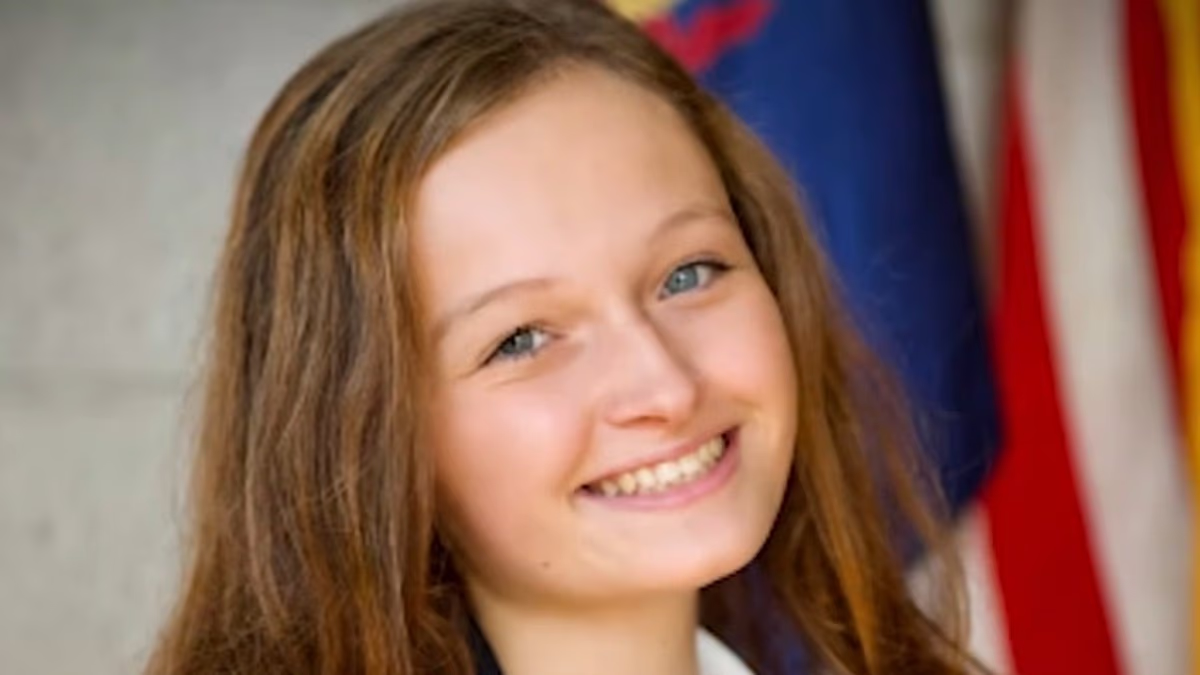
A Pennsylvania teenager who died at 18 from an inoperable brain tumor could become the first Gen Z saint after U.S. Catholic bishops endorsed a move to advance her canonization cause.
Maria Middleton, who died in 2020, took a significant step toward sainthood last week when the U.S. Conference of Catholic Bishops voted to move forward with her cause for beatification and canonization.
The vote followed a petition from Philadelphia Archbishop Nelson Perez, who pointed to the teenager’s remarkable faith throughout her battle with cancer.
Middleton was 16 when doctors diagnosed her with an inoperable brain tumor.
“It was devastating. It was a nightmare. It was a no-way-out situation,” her mother, Susan Middleton, told ABC7.
Even after her diagnosis, the Bucks County teenager continued to live fully. While undergoing cancer treatment, she traveled to Uganda on a mission trip.
Her parents, Susan and Brian Middleton, remember her as a fun-loving teenager who enjoyed Taylor Swift, dancing, making jokes and spending time with her pets.
Alongside those familiar teenage passions, however, was a profound religious devotion that her family believes made her extraordinary.

A Pennsylvania teenager who died at 18 from an inoperable brain tumor could become the first Gen Z saint

Maria Middleton, who died in 2020, moved closer to sainthood last week after the U.S. Conference of Catholic Bishops voted to advance her cause

In the six years since her death, visitors from around the world have traveled to her grave at the Shrine of Our Lady of Czestochowa
“Our favorite Maria quote: ‘…you don’t have to be weird to be holy,’” Brian told ABC7. “She was in every way normal, but she had this extraordinary faith and pursuit of virtue.”
As the family prayed for her, people around the world joined them in praying for the teenager.
After Maria’s death, her parents found a collection of writings that revealed more about her spiritual life.
Among those writings were two words she had penned before her death: “Think hope.”
Those words later became the title of a book about her life.
Since her death six years ago, visitors from across the globe have made their way to her grave at Pennsylvania’s Shrine of Our Lady of Czestochowa.
Her parents are now beginning to absorb the possibility that their daughter could eventually be declared a saint.
“We’re sort of living in a space somewhere between heaven and earth,” Brian told ABC7.
“Sainthood is attainable. God created us to be saints,” Susan said.
Churches throughout the region have issued notices inviting anyone with information or personal accounts about Maria to come forward before a formal investigation begins.
The bishops’ vote is only an initial stage. Vatican approval is still needed before church officials can formally examine her writings.
Canonization would also require evidence of two miracles attributed to her intercession.
If the cause ultimately succeeds, Middleton could become the fourth American-born saint and the first saint from Generation Z.
She would follow Carlo Acutis, who recently became the Catholic Church’s first Millennial saint.
Acutis was born in Westminster on May 3, 1991, to a wealthy family that returned to Milan just a few months later.
The teenager was canonized by the Catholic Church after two miracles were formally recognized.
The first, recognized in 2020, involved the reported healing of a child with pancreatic disease.
After a Brazilian mother prayed to Acutis for her son’s recovery and kissed a relic containing a piece of his clothing, the boy told her immediately after Mass that he felt better.
Subsequent medical tests showed that the boy’s pancreas was healthy, having completely healed and returned to a normal condition.

The bishops’ vote is an early stage in a process that still requires Vatican approval before Maria Middleton’s writings can be examined
The second miracle was recognized in 2024. It involved a Costa Rican woman who suffered a brain hemorrhage after falling from her bicycle in Italy and was reportedly healed after her mother prayed at Acutis’s tomb.
That same day, the woman—whom doctors believed had little chance of surviving her injuries—began breathing without assistance.
By the following day, she could walk on her own. Doctors who examined the case said the evidence of the hemorrhage had vanished.
More than one million people are estimated to have visited the Italian hilltop town of Assisi, where the teenager’s body lies preserved in wax.
Acutis’s body, dressed in a tracksuit and sneakers, was exhumed in 2019 and placed in a glass tomb, where it has remained on display.
Born to an Italian mother and a half-English, half-Italian banker father, Acutis developed a deep faith despite his parents not being especially devout.
He grew up in Milan, attended Mass every day and became known for showing kindness to bullied children and people experiencing homelessness. He brought sleeping bags and food stored in Tupperware containers to those in need.

A woman holds a picture of Carlo Acutis as Pope Leo XIV leads a Holy Mass for the canonization of the British-born Italian boy, who became the first Millennial Catholic saint on September 7, 2025
Acutis’s compassion for poor and vulnerable people was so striking that, even as a child, he inspired adults to join the Catholic Church. Among them was his Hindu au pair, Rajesh Mohur, who converted to Catholicism.
In Milan, Acutis managed his parish website and later worked on the website of a Vatican-based academy, using both platforms to share Catholic teachings.
At 11, he became fascinated by accounts of wine allegedly turning into blood in Croatian castles and stories of Colombian priests halting advancing tsunamis by raising reliquaries—containers used to hold and protect religious relics.
He researched those accounts and published them on a website he designed to document miracles and the lives of saints.
His mother, Antonia Salzano, said her son had a “special relationship” with God from an early age, even though their family was not religious.
At 7, Acutis wrote: “My life plan is to be always close to Jesus.”
He maintained that commitment throughout his short life, which ended in 2006 after he developed blood cancer.


