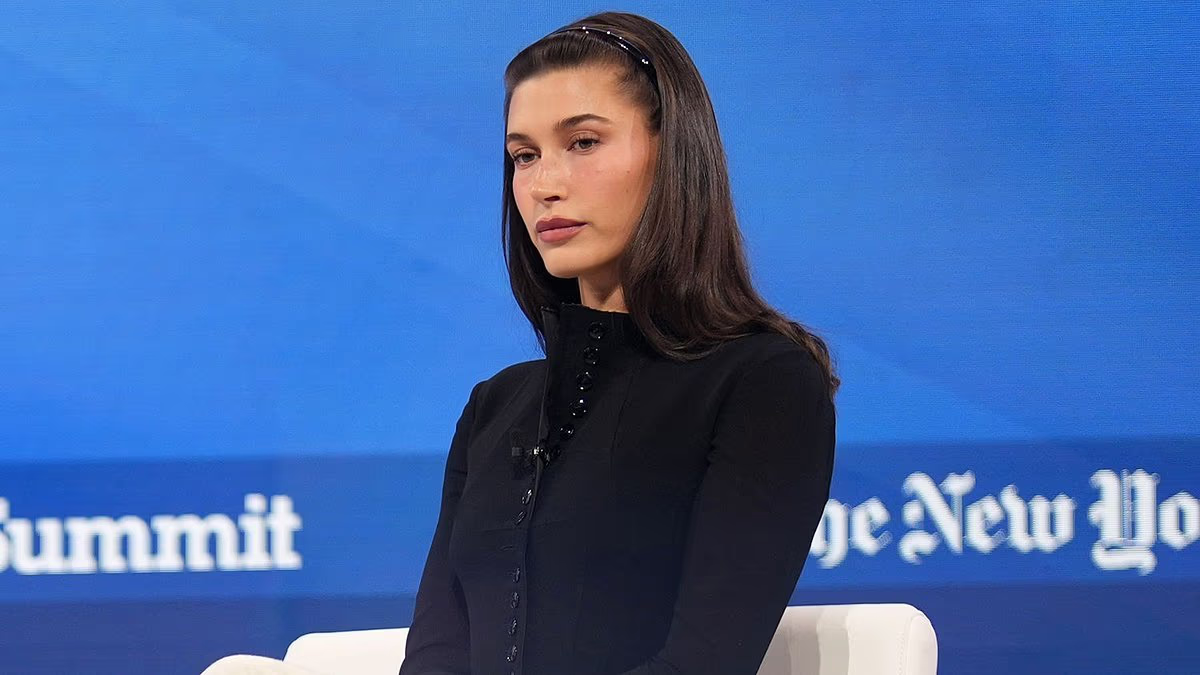

A year after selling her skincare company in a deal valued at $1 billion, Hailey Bieber appeared to have reached a new stage of her career: a place on the same stage as some of the world’s most powerful business figures.
The 30-year-old model and entrepreneur joined Elon Musk, OpenAI chief Sam Altman and New York mayor Zohran Mamdani as a featured speaker at last week’s DealBook Summit. Her appearance, however, quickly became one of the event’s most heavily discussed moments.
Hosted by The New York Times, the conference seemed to inspire Bieber’s fashion choice. She wore a spring 1998 Yohji Yamamoto jacket previously worn by Carolyn Bessette-Kennedy at a prominent Manhattan charity event, pairing it with a white midi pencil skirt in a similar style.
Bessette-Kennedy was known for avoiding interviews and speaking sparingly in public, a restraint that helped cement her reputation for cool sophistication. Bieber’s decision to echo her style without matching that silence became an ironic talking point after the interview.
During her conversation with New York Times business reporter Andrew Ross Sorkin, Bieber faced a level of online ridicule more commonly associated with a spectacularly failed product launch. Entrepreneurs typically use the DealBook stage to explain their innovations; Bieber appeared to introduce one of her own when she used the word “optimistical.”
Social media users quickly turned the interview into a debate about her business credentials. Some questioned whether her success reflected genuine entrepreneurial ability or was largely the result of her appearance, family connections and celebrity marriage to Justin Bieber.

Hailey Bieber’s DealBook Summit interview with New York Times reporter Andrew Ross Sorkin became the subject of widespread online mockery

Bieber told Andrew Ross Sorkin that people had told her to kill herself in online comments every day
A source familiar with the couple’s situation told Our News Outlet that Bieber was more affected by the backlash than she had publicly acknowledged.
“Hailey is feeling the pressure more than she would ever want to admit,” the source said. “The reaction to the interview has made her increasingly self-conscious, even if she still does not fully understand why people responded so strongly.”
The source added that Bieber and her husband had spent so long living within a wealthy celebrity bubble that they could struggle to see how their comments might sound to the wider public.
“There is a degree of entitlement that comes with their world. They are multimillionaires who have been surrounded by the same people for years, so it can be difficult for them to recognize how things appear from the outside.”
The interview focused largely on Bieber’s sale of rhode to e.l.f. Beauty last August. The agreement reportedly included $600,000 in cash, $200 million in e.l.f. stock and a further $200,000 in performance-based payments.
Asked about the company’s identity, Bieber relied on the language often associated with influencer-led brands. She said rhode had always felt “really authentic” to her and that she wanted customers to connect with it as an extension of her personality and interests.
“We talk a lot at rhode about building a world,” she said. “I wanted to create an entire experience around the brand, from the products and packaging to the visual identity, storytelling and the way we invite the audience in.”
Bieber said she remained passionate about developing brands but suggested that her role with rhode could eventually change as the company entered its next phase.
Born Hailey Rhode Bieber, she is the daughter of actor Stephen Baldwin and Brazilian graphic designer Kennya Deodato, as well as the niece of actor Alec Baldwin. Named after Halley’s Comet, she first became known as a teenage model for labels including Ralph Lauren, Tommy Hilfiger and Guess before launching rhode in 2022.
Within three years, rhode was reportedly generating roughly $212 million in annual sales. The brand’s rapid rise was supported by Bieber’s enormous online following, which includes about 59 million Instagram followers and 19.5 million on TikTok.

“For Justin, who always feels under attack, seeing Hailey upset makes him upset,” a source close to the couple said
Her profile grew further in 2015, when she began dating Canadian pop star Justin Bieber. The couple held wedding ceremonies in 2018 and 2019, and welcomed their son, Jack Blues, in 2024.
The couple are evangelical Christians and attend Churchome, a non-denominational megachurch with a large celebrity following in Hollywood.
Sorkin described Bieber as a self-professed “skincare junkie” and suggested that rhode may have started almost by chance. He then asked whether she had ever imagined selling the business for $1 billion, phrasing the question as whether that figure had been “on the bingo card.”
Her answer drew immediate attention online. Bieber said $1 billion was the minimum figure she had once decided would make her consider selling.
“A billion dollars was the number I said I wouldn’t sell it for less than,” she said. “It felt crazy. It was like shooting for the stars, stars, stars, stars, stars.”
When Sorkin asked how she had arrived at that ambition, Bieber replied: “You have to have a certain sense of optimistical delusion, I think.”
The unusual word became one of the interview’s biggest viral moments. Bieber also used the term “realness” while discussing the criticism that social media can intensify insecurity among young people.
“I can only try to come from a place of realness and authenticity as much as possible,” she said. “I struggle with looking at people online and feeling insecure.”
Bieber acknowledged that she found social media unhealthy but said she was completely addicted to it. Sorkin then asked about digital filters and the way users alter their appearance online, a topic that appeared to leave him searching for firmer ground with his guest.
MORE STORY: Daily Mail Analysis Reveals Best and Worst Maternity Hospitals in England
He also raised the backlash she received after saying she disliked “over-consumption.” Critics argued that the remark was difficult to reconcile with her work as an influencer and beauty entrepreneur, whose business depends on persuading consumers to purchase products.
“That was definitely the wrong word for what I was trying to describe,” Bieber admitted.
The interview followed several recent moments that had also attracted criticism. During an appearance on French television program Quotidien last month, Bieber appeared to describe her husband as French. Justin Bieber is Canadian, though he has French-Canadian ancestry through his mother.
The comment spread rapidly online, with critics calling it an especially American mistake to make while appearing on television in France.
Bieber said she had also faced cruel treatment over her relationship with Justin, including comments linked to his former girlfriend Selena Gomez. She recalled visiting a Starbucks where employees had reportedly placed two tip jars, one carrying her name and another associated with Gomez.

Bieber’s agreement to sell rhode to e.l.f. Beauty reportedly included cash, company stock and future performance-related payments
“I had people telling me to kill myself in the comments every single day,” Bieber told Sorkin. “There was a period when people were shouting at me in the street and putting up tip jars at Starbucks of me versus another person.”
She said the treatment had made her wonder whether people would be better off if she were no longer around. The comments prompted some viewers to question the way she described the impact of online abuse, while others argued that celebrity harassment should not be dismissed simply because the target remains wealthy and visible.
Critics also pointed to the contradiction between Bieber’s complaints about social media and her continued use of it to promote herself and her lifestyle.
Ten weeks earlier, she had shared an image from a Brazilian magazine cover showing her lying unclothed on a beach. Days before the summit, she marked her 30th birthday by posting a selfie in a revealing green top fastened with gold ties.
During a quick-fire segment, Sorkin asked Bieber what she had most recently searched about herself online. She paused before saying she generally searched her name to find out whether anything damaging had been reported that day.
“We’ll see after this interview,” Sorkin replied.
The exchange proved prophetic. Bieber’s supporters accused Sorkin of being overly skeptical and asking questions designed to embarrass her, although others defended him as a journalist doing his job at a serious business conference.
Much of the online reaction centered on the impression that Bieber had been unprepared. Critics said she had been given an unusual opportunity to explain how she built a successful beauty company, yet often answered in broad influencer-style phrases rather than offering detailed insight into the business.
One common criticism was that the language might have worked in a lifestyle interview but sounded out of place at a New York Times business summit.
Her use of “optimistical” attracted particular attention. One commenter on X wrote: “We’re just handing out a billion dollars to people who use words like optimistical.”
Others pushed back, arguing that Sorkin’s interview should not be compared with friendlier celebrity formats such as Call Her Daddy. “Not every interview is like Call Her Daddy, where you get questions from someone acting like your best friend,” one X user wrote. “This is The New York Times.”
Our News Outlet has contacted Bieber’s representatives for comment. Bieber has previously acknowledged that criticism affects her deeply, and the backlash appeared unlikely to make for a relaxing Thanksgiving holiday.
She did respond to the criticism over “optimistical,” posting an image from Dictionary.com defining it as a variation of “optimistic,” along with a reference to the word’s use in a 1900 book about the Boer War. The attempt to settle the debate did little to stop the jokes.

Bieber echoed Carolyn Bessette-Kennedy by wearing a spring 1998 Yohji Yamamoto jacket to the DealBook conference
The source close to the couple said Bieber was upset by suggestions that she had appeared unintelligent or unprepared, but took some comfort from the fact that her critics could not deny the success she had achieved.
“Hailey is hurt that people think she was unprepared and are calling her dumb,” the source said. “But she is also encouraged by the fact that, if she were as incapable as some people claim, she would not have reached this position in the first place.”
The source added that criticism had become a recurring part of Bieber’s public life and that she intended to respond by focusing on her future work and her faith.
“She doesn’t like the treatment she receives, but it is something she will always have to deal with. She has to keep moving forward and continue trying to make an impact. She believes everything will eventually be all right.”
The source said Justin Bieber had also been affected by his wife’s distress. “Justin often feels that he is under attack, so seeing Hailey upset makes him upset,” the source said. “She is usually the person who helps him through his own difficult moments. He is trying to support her and respect what she is feeling.”
Sorkin ended by asking what Bieber now understood at 30 that her 21-year-old self would have wanted to know. She said she would have advised her younger self to stop trying to control every outcome and trust that things would eventually work out.
Her critics, meanwhile, suggested that a little more control over her DealBook interview might have produced a very different result.


