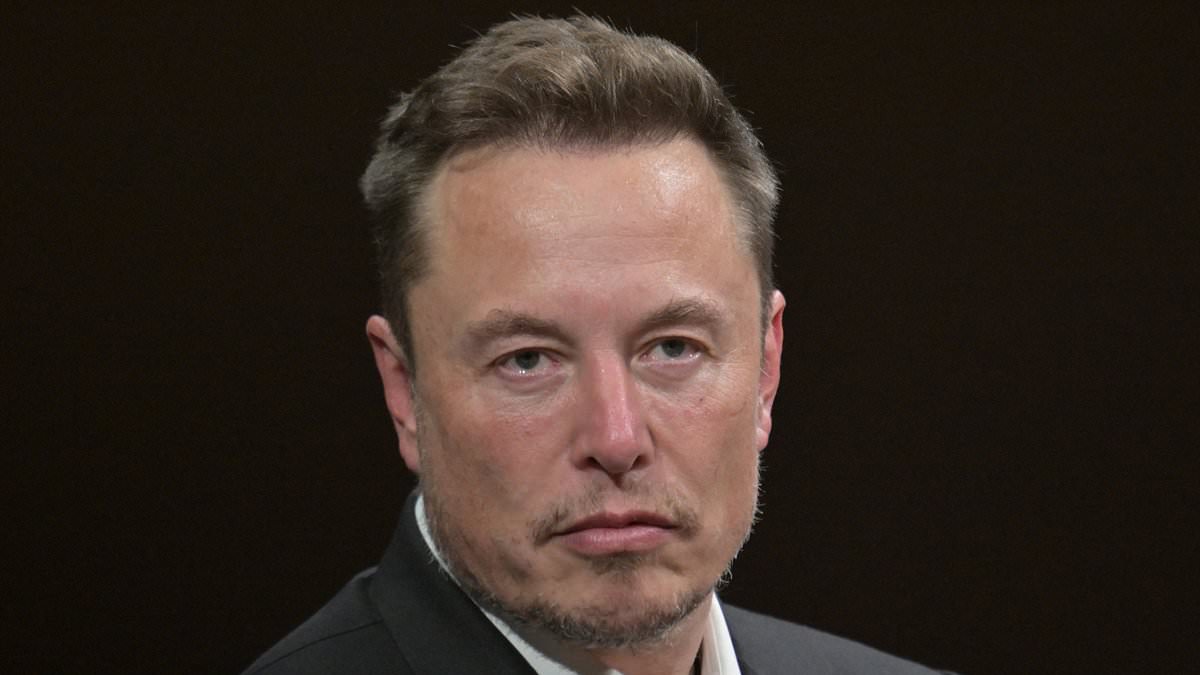

Elon Musk, the world’s wealthiest individual, has issued a cautionary note about Australians “disappearing” due to a sharply declining birth rate.
Musk, who is a father to 14 children, made this statement in reaction to news of Australia’s birth rate hitting an all-time low.
He responded to a post by Katie Miller, a right-wing podcaster, on X—the social media platform he owns—by stating, “They are disappearing.”
This recent comment echoes a remark Musk made in April when he suggested that “Australians are becoming an endangered species.”
Australia’s birth rate dipped below the replacement level of 2.1 children per woman nearly five decades ago.
According to the most recent figures from the Australian Bureau of Statistics (ABS), the birth rate reached an unprecedented low of 1.48 children per woman in 2024.
The birth rate peaked at 3.55 children per woman in 1961
Despite the decline in births, Australia’s population continues to grow by 1.6 per cent each year.
Elon Musk (above) said Australians are ‘disappearing’ due to low birth rates
Three quarters of that growth is attributed to immigration.
The country’s population officially ticked past 28million last Tuesday, according to the ABS Population Clock which estimates births, deaths and net migration.
There were 292,318 registered births in 2024, a 1.9 per cent increase from 2023, and the median age for mothers was 32.1 years and 33.9 years for fathers.
‘Since 1976, Australia’s total fertility rate has been below replacement level (about 2.1 births per woman),’ the Australian Institute of Family Studies said.
‘Replacement level is the level at which a population is replaced from one generation to the next without immigration.’
Miller posted a clip from 7News on X, writing: ‘Australia’s fertility rate has plummeted.
‘They’ve hit the lowest rate in history at 1.48 – well below the 2.1 replacement rate.
‘The average age of mothers was 25 in 1971, and now it’s 32. This is a human catastrophe.’
New data showed birth rates hit a record low of 1.48 children per woman in 2024
The segment heard from author Tanya Williams, who penned A Childfree Happily Ever After.
She said it was a ‘great thing’ for women to know they’re not required to have children, it’s a personal choice.
‘I saw what the traditional life looked like and I decided it just wasn’t for me,’ she said.
‘I think it’s just been a really great thing for women in general to know that they have got a choice and there are women out there like them that don’t necessarily want to have children.’
Mother-of-two Gabby Campbell said that while she’d ‘love to have a third’ she couldn’t because the costs of raising a third child would be ‘too expensive’.
As well as a drop in birth rates, women have begun having children later in life since the introduction of the contraceptive pill in 1961.
The percentage of women who had children at 30 years or older was 15 per cent before 1981 and reached 53 per cent in 2020.
In contrast, nearly half of all mothers had their first child while aged between 20 and 24 from 1961 to 1971.

Birth rates have steadily decreased and women have chosen to have their first child later in life since the contraceptive pill was introduced in 1961
‘This reflects the trend of women delaying having a first child,’ the AIFS said.
‘The fall in the fertility rates for those in their teens and twenties has also been influenced by social changes such as increased participation in formal schooling and tertiary education by young people, women’s increased labour force participation and changes in family-related values and attitudes.’
The total fertility rate was expected to fall to 1.45 children per woman by the end of 2025 and to 1.42 by the end of 2026, according to the Centre for Population.
The centre then expects the birth rate to rise to 1.62 children per woman by the end of 2032.


