
Share this @internewscast.com
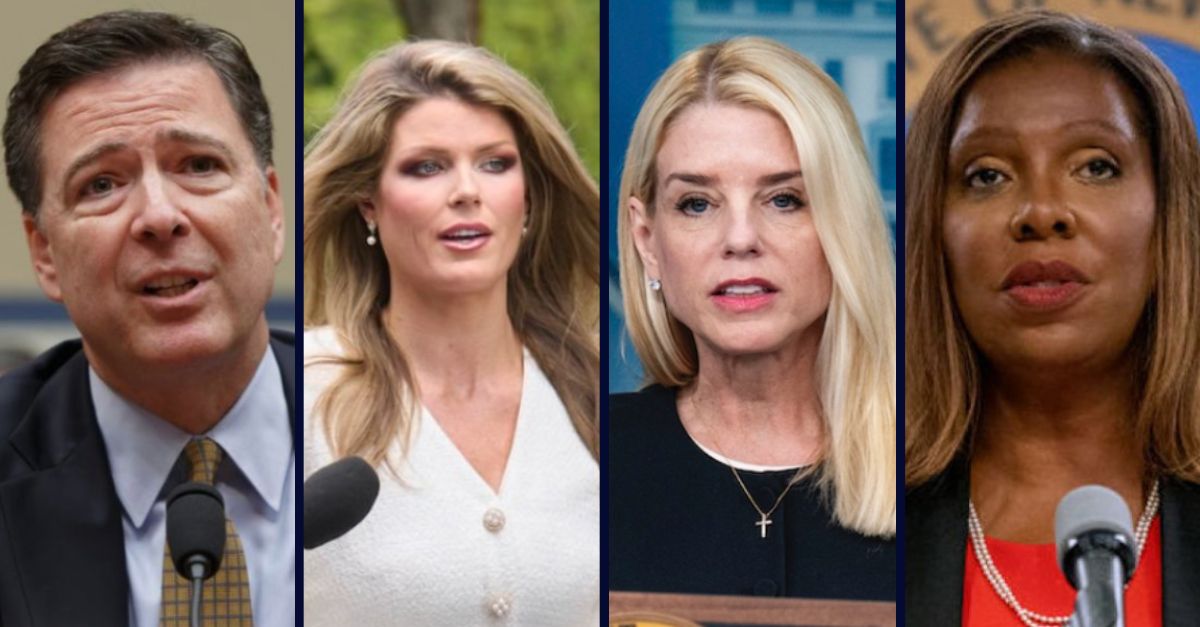
Left to right: FBI Director James Comey testifies on Capitol Hill in Washington before the House Oversight Committee to explain his agency”s recommendation to not prosecute Hillary Clinton on July 7, 2016 (AP Photo/J. Scott Applewhite, File). Lindsey Halligan, special assistant to the president, speaks with a reporter outside of the White House, Wednesday, Aug. 20, 2025, in Washington. (AP Photo/Jacquelyn Martin). U.S. Attorney General Pam Bondi speaks at a press briefing with U.S. President Donald Trump in the James S. Brady Press Briefing Room in the White House in Washington, DC on Friday, June 27, 2025 (Annabelle Gordon/Sipa USA)(Sipa via AP Images). New York Attorney General Letitia James speaks during a press conference regarding former US President Donald Trump and his family’s financial fraud case on September 21, 2022 in New York (photo by YUKI IWAMURA/AFP via Getty Images).
In a significant development, the chief judge overseeing Lindsey Halligan’s jurisdiction for the past four months has taken steps to fill a key legal position. On Tuesday, the court’s clerk was instructed to advertise in various newspapers, inviting lawyers to express interest in becoming the U.S. Attorney for the Eastern District of Virginia. This move comes merely a week after the Department of Justice staunchly defended Halligan in court once again.
The directive to seek candidates was issued by Chief U.S. District Court Judge M. Hannah Lauck, who was appointed by President Barack Obama. The order, based on 28 U.S.C. § 546(d), declared that Halligan’s office is officially “vacant.” This mirrors the situation when Alina Habba’s interim role as U.S. Attorney approached its end in July. The announcement is available here.
The court’s order elaborates on the process to appoint an Interim U.S. Attorney for the Eastern District of Virginia until the Senate confirms a permanent appointee. The order highlights that the interim term limit of 120 days has elapsed since September 22, following U.S. Attorney General Pam Bondi’s appointment of Halligan.
According to the statute, if such an appointment expires, the district court has the authority to appoint a U.S. Attorney to serve until the vacancy is permanently filled.
The selection of Halligan, previously an insurance lawyer and neophyte prosecutor, has been under scrutiny. Her appointment by Pam Bondi led to the dismissal of criminal cases against former FBI Director James Comey and New York Attorney General Letitia James. A federal judge criticized Bondi’s retroactive attempt to legitimize Halligan’s interim position as an “ineffective” solution to the issue of repeatedly extending temporary appointments for a role requiring Senate approval.
Senior U.S. District Judge Cameron McGowan Currie, appointed by Bill Clinton, underscored in her dismissal order that the authority to appoint an interim U.S. Attorney for the Eastern District of Virginia rests with the district court until a presidential nominee is confirmed by the Senate.
As the DOJ is in the process of appealing those high-profile case dismissals, the issue of Halligan’s title on court filings two weeks ago caught the attention of U.S. District Judge David J. Novak, a Donald Trump appointee.
Novak ordered the government to answer why Halligan had identified herself on an indictment as U.S. attorney “despite a binding Court Order” by Currie, which “found that the ‘appointment of Ms. Halligan as Interim U.S. Attorney violated 28 U.S.C. § 546 and the Appointments Clause of the U.S. Constitution.’”
A week later, the DOJ said the judge’s question amounted to an “inquisition” and a “gross abuse of power.”
“The order launching this quest reflects a fundamental misunderstanding,” the DOJ said, “and flouts no fewer than three separate lines of Supreme Court precedent on elementary principles like the role of federal courts, the effect of district court rulings, and the nature of our adversarial system.”
Bondi’s DOJ maintained the adverse ruling did “not prohibit, or render factually false” that Halligan “is the United States Attorney,” because Currie’s dismissal was “not an independent declaratory judgment” and “did not purport to enjoin Ms. Halligan from continuing to oversee the office or from identifying herself as the United States Attorney in the Government’s signature blocks.”
“This Court appears to be under the misimpression that because Judge Currie’s rationale for dismissing the indictments was her conclusion that Ms. Halligan was unlawfully appointed, the United States must acquiesce to that rationale in all other cases or else it is ‘ignor[ing]’ Judge Currie’s orders,” the DOJ went on, accusing Novak of wrongly raising the prospect of potential “attorney discipline” and making a “rudimentary legal error” in calling the dismissal “binding.”
Now the district court is moving ahead by directing the clerk to “publish a vacancy announcement on the Court’s website,” which has already occurred in Virginia Lawyers Weekly and in several newspapers, including the Richmond Times-Dispatch, The Washington Post, and The Virginian-Pilot.
“If a person wishes to be considered for possible appointment under 28 U.S.C. § 546(d) as the Interim United States Attorney for the Eastern District of Virginia, that person shall complete and submit to the Clerk of the Court within 21 days (i.e. no later than February 10, 2026) the Confidential Expression of Interest in Serving as the Interim Court-Appointed United States Attorney for the Eastern District of Virginia,” the order concluded.
Before Habba’s interim term expired, a New Jersey district court appointed then-First Assistant U.S. Attorney Desiree Grace as her replacement. But Bondi, claiming “rogue judges” had overstepped, swiftly fired Grace, accepted Habba’s resignation, and then installed Habba right back into the top role as acting U.S. attorney by default through the vacant office of the first assistant U.S. attorney and as a special attorney with office oversight powers.
A federal judge in Pennsylvania sitting by designation later ruled that Habba was unlawfully appointed, which a three-judge panel on the 3rd U.S. Circuit Court of Appeals affirmed.
Although Habba resigned in December, the DOJ just last week sought a rehearing by the full — en banc — 3rd Circuit.
It raises the question of whether Bondi will, before the clock strikes midnight, once again apply the repeatedly failed Habba approach to Halligan’s situation and blame “rogue judges,” but as of early Tuesday afternoon the AG has not yet reacted.
Novak on Tuesday issued an order that “hereby strikes the words ‘United States Attorney’ from the signature block on the Indictment, as well as all other Government filings” in the DOJ’s case against Davante Aandrell Jefferson.
The order “further bars Ms. Halligan from representing herself as the United States Attorney in any pleading or otherwise before this Court until such time as she may lawfully hold the office either by Senate confirmation or appointment by this Court pursuant to 28 U.S.C. § 546(d), should either occur,” the judge specified, also noting that Halligan’s DOJ employment is “no safe haven from the ethical rules of this Court, regardless of her state bar membership.”
“That bar shall become effective at 12:01 a.m. on January 21, 2026, and shall apply to any filings submitted thereafter; The Court further orders that Ms. Halligan shall provide a copy of this Memorandum Order to the Attorney General and Deputy Attorney General, since they appear as signatories on her Response,” Novak stated, before adding in an uppercut.
“In short, this charade of Ms. Halligan masquerading as the United States Attorney for this District in direct defiance of binding court orders must come to an end,” the judge said, with a footnote parting shot: “For the avoidance of any doubt, this bar does not prevent Ms. Halligan from entering an appearance or signing her name to pleadings in this Court as a ‘Special Attorney,’ whatever that title may mean.”