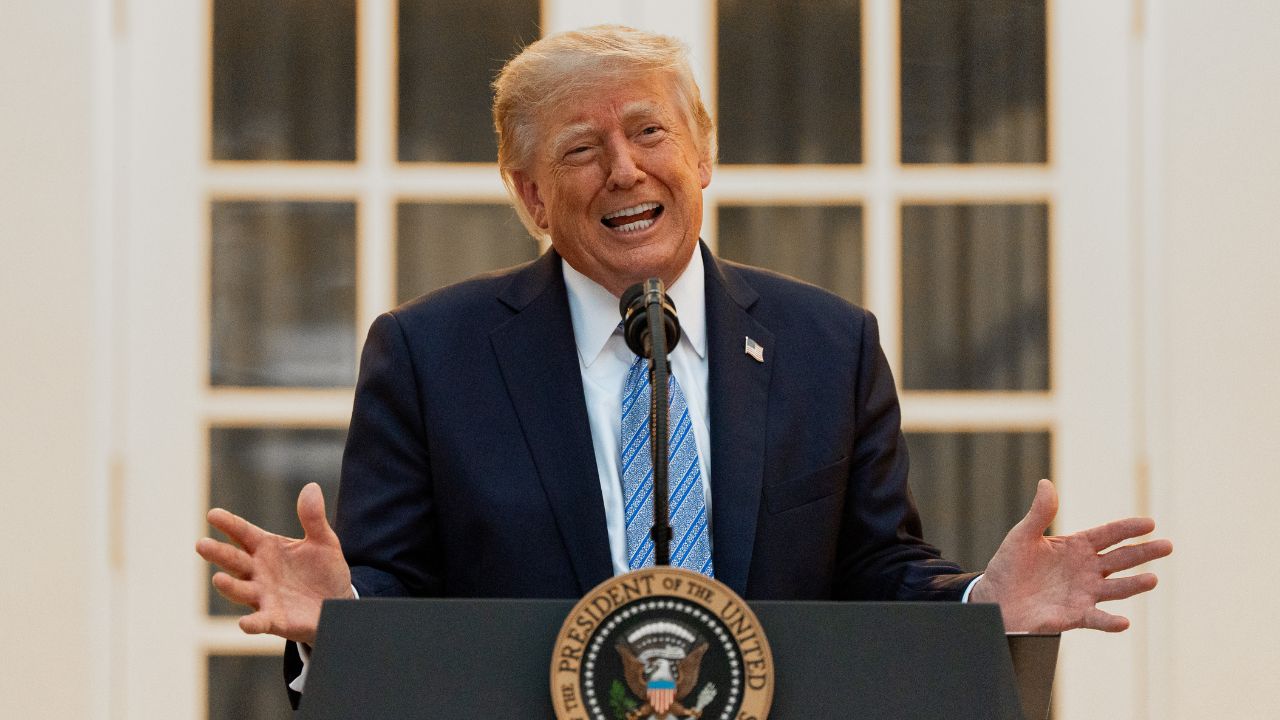
President Donald Trump delivers remarks during a dinner in the White House Rose Garden on Thursday, Sept. 17, 2026, in Washington. (AP Photo/Alex Brandon)
A federal appeals court has ruled that the Trump administration’s repeatedly challenged practice of deporting immigrants to countries where they are not nationals violates federal law.
The 55-page decision requires that noncitizens receive effective notice and a meaningful chance to raise claims that they could face persecution or torture before the Department of Homeland Security sends them to a third country.
The case began in March 2025, when several detained men challenged the Department of Homeland Security’s controversial deportation policy. The dispute escalated after the agency tried to send eight men to South Sudan, even though none of them were Sudanese nationals. Following a series of judicial orders, the men were held at a U.S. military base in Djibouti, an East African country.
The case has since taken several procedural turns, altering its posture without changing the central legal question ultimately presented to the U.S. Court of Appeals for the 1st Circuit.
In April, U.S. District Judge Brian E. Murphy, appointed by President Joe Biden, ruled that the third-country deportation policy violates a “bedrock principle” of due process. He issued a declaratory judgment on behalf of the class-action plaintiffs and set aside the policy as unlawful.
The litigation generated a steady succession of orders—six from the district court and two from an appeals court—as the Trump administration continued pursuing third-country removals. Murphy repeatedly criticized the government, clarifying and reinforcing his directives and expanding the class covered by the case after immigrants were sent to El Salvador twice despite orders from another judge.
The district judge also found himself at odds with the U.S. Supreme Court. The administration asked the high court for a stay in May 2025, and a majority granted it the following month. Murphy later said that stay did not affect a remedial order he issued after concluding that the government had violated multiple court directives. In July 2025, however, the Supreme Court majority overturned that remedial order in a decision opposed by Justice Sonia Sotomayor.
Murphy issued his comprehensive ruling on the merits in February of this year. The Trump administration then sought an emergency stay from the 1st Circuit in March while it pursued an appeal, and the appellate court granted the request.
The appeals court has now ruled on the substance of the dispute, concluding that the policy violates the Administrative Procedure Act, the federal law that governs how agencies exercise their authority.
“[T]he [policy] conflicts with the statutory and regulatory provisions governing fear-of-persecution claims insofar as it authorizes third-country removals without the provision of effective notice and a meaningful opportunity to assert such claims,” the opinion states. “The [policy] is therefore unlawful under the APA.”
The panel rejected the administration’s effort to bypass the existing rules, procedures and safeguards that apply when immigrants claim they fear persecution or torture under federal law.
“This argument assumes what the class disputes: that the duly enacted statutes and regulations applicable to fear-of-persecution claims leave room for the ‘more streamlined’ third-country removal process that the [policy] authorizes, i.e., removals without notice and a meaningful opportunity to assert fear-of-persecution claims,” the court explained.
The judges then addressed the issue in greater detail:
But the question in this case is not whether, if the government were starting from scratch, it could by statute or regulation lawfully adopt the streamlined process for third-party removals contemplated by the Guidance; the question is whether that process is consistent with the applicable statutes and regulations that presently govern fear-of-persecution claims. As the district court properly concluded, it is not. The statute and regulations prescribe hearing-related procedures for fear-of-persecution claims with no exception for third-country removals.
“We reject DHS’s efforts to create such an exception from whole cloth,” the opinion adds.
The appellate panel did not rule on the district court’s due process finding, which had driven much of the lower court’s analysis. Instead, it said the statutes and regulations alone resolved the case.
“In reading these requirements into the relevant statutory and regulatory provisions, we do not imply doubt about the merits of the district court’s due process analysis, whose force only bolsters our conclusion that this situation calls for application of the constitutional-avoidance canon,” the judges wrote.
In a footnote, the panel also questioned the fundamental assumptions behind the administration’s third-country deportation policy.
“[W]e have some difficulty seeing how a receiving country can credibly provide blanket assurances that all removed noncitizens will not be persecuted or tortured there unless it intends to provide them with some sort of affirmative protection against rogue agents and non-state actors, who can be persecutors within the meaning of [one federal law], and torturers within the meaning of the [other federal laws].”
The post ‘We reject DHS’s efforts’: 1st Circuit blocks Trump admin’s 3rd-country deportation policy as ‘unlawful’ under numerous federal statutes first appeared on Law & Crime.


