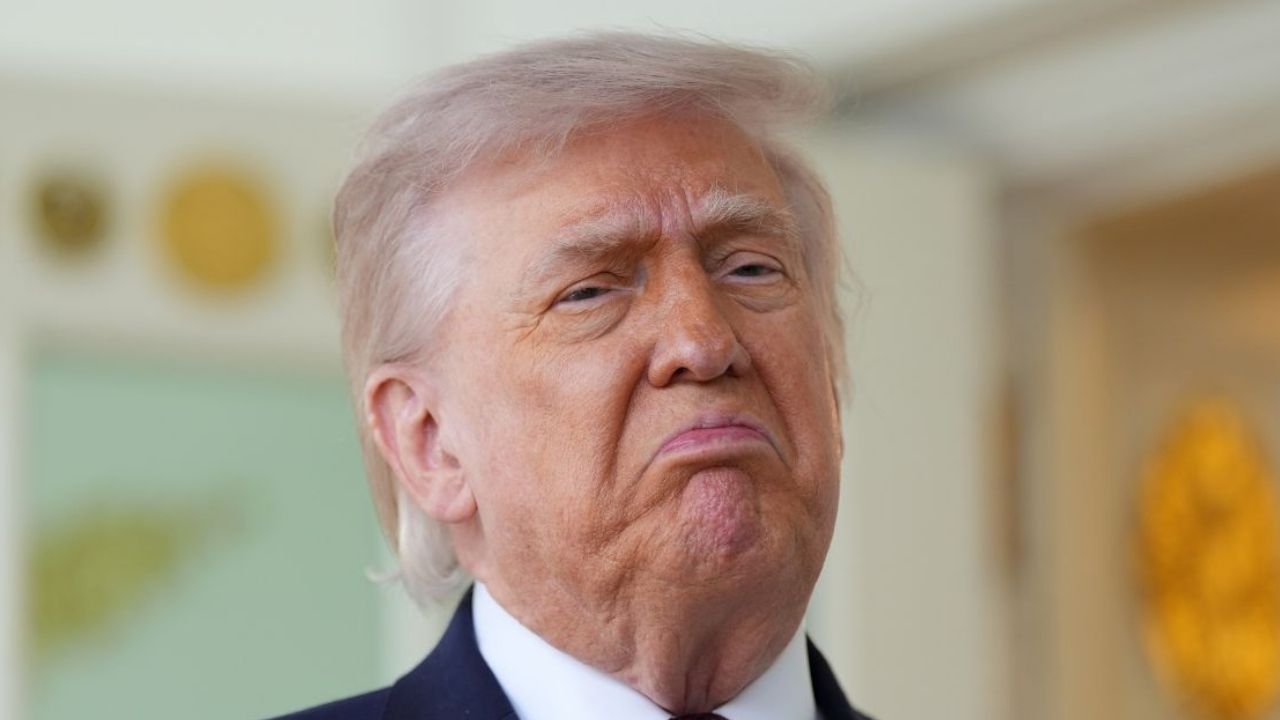

President Donald Trump speaks outside the Oval Office of the White House on Monday, April 13, 2026, in Washington (AP Photo/Alex Brandon).
President Donald Trump has again fallen short in his effort to move his long-running New York City criminal case out of state court and into the federal system, after a Manhattan federal judge rejected his latest bid.
“The grounds for a second removal cited by Defendant, Donald J. Trump, are neither new nor legally sufficient,” the judge wrote in a 35-page order issued Friday. “He has failed to show good cause and diligence. His motion for leave to file a second notice of removal is denied.”
Trump has repeatedly tried, both before and after his conviction on 34 felony counts, to shift the local prosecution into federal court. Each attempt has failed.
The federal fight before U.S. District Judge Alvin Hellerstein, who was appointed by President Bill Clinton, began in May 2023 when Trump first filed a notice seeking removal.
After an intense round of briefing and motions, Hellerstein ruled against Trump in July 2023 and returned the matter to New York Supreme Court in New York County, the official name of Manhattan’s trial-level court.
Trump’s appeals did not change the outcome. In May 2024, the 45th president was convicted. By late August 2024, he had filed a second notice of removal. About two months later, Trump defeated Kamala Harris in the 2024 presidential election and subsequently returned to the White House as the 47th president.
As that renewed removal effort remained unresolved, Trump’s sentencing loomed over the case. The matter ultimately ended in the then-president-elect’s favor when New York Supreme Court Judge Juan Merchan imposed an “unconditional discharge.” That outcome left Trump’s conviction for falsifying business records intact but imposed no punishment or other adverse legal consequences tied to the hush-money case involving payments made to Stormy Daniels before the 2016 election.
Between the election and sentencing decision, the district court denied the removal notice again — and denied a motion to stay the ruling. The case then went up the appellate ladder and came before the 2nd U.S. Circuit Court of Appeals in June 2025.
In November 2025, the appellate court sent the case back to the district court to reconsider the president’s motion in light of the U.S. Supreme Court’s landmark opinion on presidential immunity.
Now, Hellerstein has considered months’ worth of motions and hearings — and is still resolutely not convinced.
“President Trump must show that ‘he acted diligently and without undue delay to remove the case based on’ new grounds, here, principally the issuance of the United States Supreme Court’s decision in Trump v. United States, in order to ‘show good cause for the untimely filing at issue,'” the court’s order reads. “He fails to do so.”
The judge recites the timelines of the various cases, noting that Trump “made a strategic decision” to use presidential immunity claims as a defense in his criminal trial instead of as a removal basis during the trial. Then, Trump used immunity claims as a basis to dismiss after the trial — again not as a basis for removal.
“Finally, 64 days later, and when it became apparent that the New York court likely intended to deny his motion to dismiss and sentence him two days after, Trump filed his motion in federal court,” the judge explains.
But by then it was too late for such a removal claim, the judge found.
“A party seeking to remove must do so promptly no later than 30 days after arraignment or any time before trial, whichever is earlier,” the order continues. “If he misses this window, he can seek leave to remove despite his lateness by showing ‘good cause.’ But he cannot play one court against another; he cannot seek victory in one court, and then, when it becomes apparent that the court will rule against him, seek to remove his case to another court.”
Hellerstein cites precedent to note that the removal statute does not mean “a party may experiment” in state court and then “transfer it to the federal court” if the experiment fails.
But that is admittedly what Trump and his legal team did here.
“At oral argument before the Court of Appeals, Trump’s counsel acknowledged ‘he could have sought removal immediately following the Supreme Court’s decision,'” the order goes on. “He instead elected to litigate immunity in state court.”
The judge notes “Trump himself recognizes” the second removal bid only came after it was clear immunity would fail in Empire State court.
“Trump seeks a ‘second bite at the apple,’ a result the law disfavors,” Hellerstein continues. “Trump’s delay in filing for removal constitutes a ‘quintessential strategic decision,’ and the ‘fact that he later came to view that decision as a poor one is not sufficient.”
The judge also said the lengthy gulf before filing was “inconsistent with good cause” in and of itself.
“The U.S. Supreme Court issued its decision July 1, 2024,” Hellerstein went on. “It took 64 more days for Trump to move in this court for leave to remove on September 3, 2024. I hold that President Trump failed to show good cause.”
The post Judge says Trump’s effort to move Manhattan criminal case to federal court is ‘neither new nor legally sufficient’ first appeared on Law & Crime.


