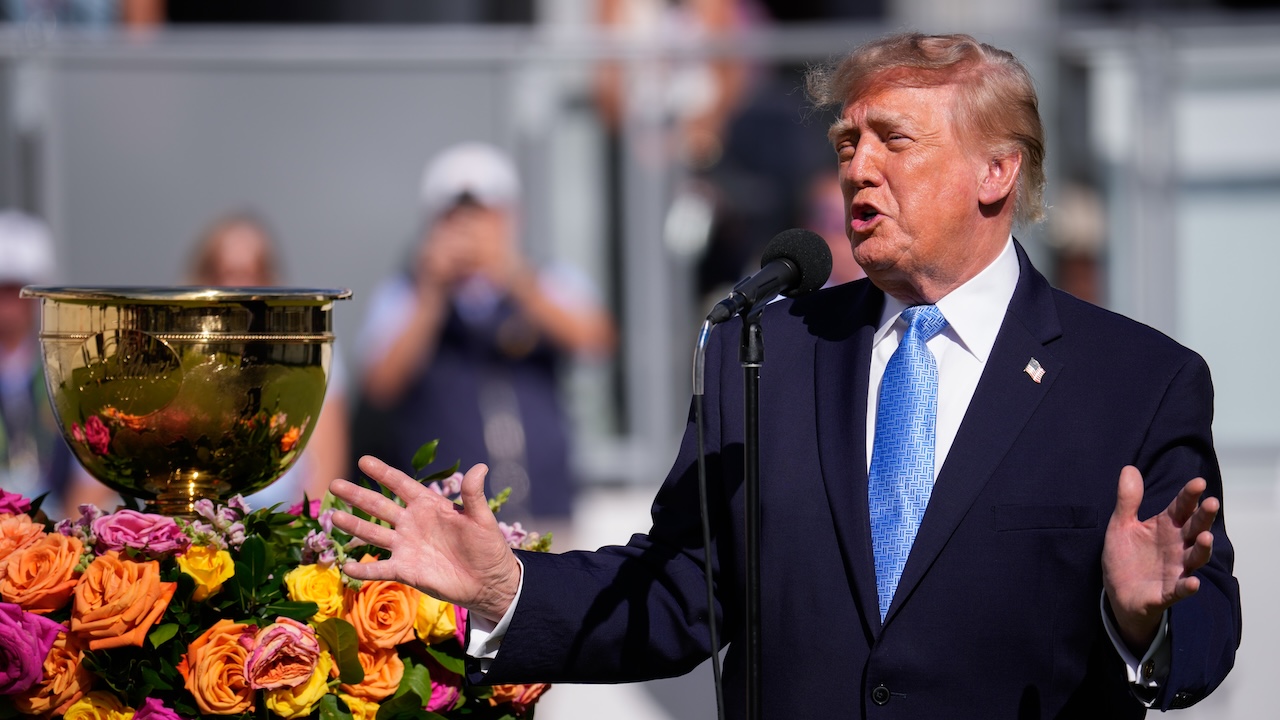

President Donald Trump speaks from the first tee before the final-round singles matches between the U.S. and International teams at the Presidents Cup golf tournament at Medinah Country Club on Sunday, Sept. 27, 2026, in Medinah, Ill. (AP Photo/Matt Slocum).
After declining to pause her sanctions order against President Donald Trump and his lawyers over what she called a “collusive” IRS lawsuit with “no viable basis in law or fact,” a federal judge rebuked the effort to “mischaracterize” her ruling. With the denial now before an appeals court, Trump’s private lawyers and the Justice Department are joining forces.
In a brief filing Monday with the 11th U.S. Circuit Court of Appeals, Trump’s attorneys at DLA Piper LLP said they agreed with the DOJ’s filing from four days earlier. Both sought an “immediate stay” of U.S. District Judge Kathleen Williams’ “unprecedented, unconstitutional sanctions.”
Williams rejected “each argument” for pausing the “imposition of three sanctions” roughly two weeks ago, calling them “unpersuasive.” Her order upheld a referral to the bar and allowed 35 former federal judges, along with former IRS and Treasury officials, to pursue attorneys’ fees from Trump after opposing the lawsuit as amici curiae, or friends of the court.
Williams, an appointee of President Barack Obama, previously ordered Florida to close “Alligator Alcatraz” before being overruled by the 11th Circuit. In the sanctions dispute, however, she stood by her “detailed findings” that Trump’s lawyers filed a “collusive” case designed to “manipulate the judicial process.” She said the lawsuit supplied a veneer of legitimacy to a $1.776 billion “anti-weaponization” fund and a “settlement” that would shield Trump and his family from past tax investigations.
Trump’s lawyers argued Monday that Williams had created a “categorical rule” barring a sitting president from suing the government he leads. They based that claim on her statement that Trump “could have” brought the same lawsuit while he was a private citizen.
That statement “made clear that the purported defect turned not on the claims asserted, but on President Trump’s status while asserting them,” the attorneys wrote.
Williams directly rejected that interpretation in the order at issue.
IN CASE YOU MISSED IT: Brooklyn Kitten Rescue Itty Bitty City Kitties Bans MAGA Supporters From Adopting
“The Movants mischaracterize the Sanctions Order as establishing a brightline rule ‘that a President who sues the Executive agency is necessarily suing himself,’” the judge wrote. “This is incorrect; the Sanctions Order established no such categorical rule. On the contrary, the Sanctions Order acknowledged that Lead Plaintiff did have a right to sue and could have done so, without issue, during the lawfully specified time and while a private citizen.”
Williams was referring to the applicable statute of limitations.
In her July sanctions order, Williams likewise acknowledged that Trump “had a legal right to bring a suit for the unlawful disclosure” of his tax returns. Her conclusion was that he failed to bring the case within the required time.
“Notably, had President Trump (and his then-lawyers Alina Habba and Todd Blanche) brought this lawsuit in a timely fashion while he was a private citizen, this litigation understandably might have been resolved in a 109-day time span,” Williams wrote. “But that is not what happened. Instead, President Trump did not pursue his claims until he once again occupied the White House and had appointed his former lawyer, and the former lawyer of persons who are putative beneficiaries of the ‘Anti-Weaponization Fund’ to prominent positions in the DOJ.”
Williams said those officials later negotiated on behalf of the United States with Trump’s current lawyers, including his former White House counsel, to reach a “settlement.” Given those circumstances, she wrote, it was “risible to suggest that there was ever adverseness between” Trump as an individual and the IRS under his administration.
The DOJ has described Williams’ ruling as “wrong” and “illogical,” warning that it could trigger an “onslaught of sanctions motions and orders against every claim, lawyer, party, or settlement that any interloper or district judge personally dislikes—precedent, logic, jurisdiction, the Constitution, and the facts all be damned.”
The post A judge refused to let Trump lawyers “mischaracterize” her punishment — then they went right back to the well first appeared on Law & Crime.