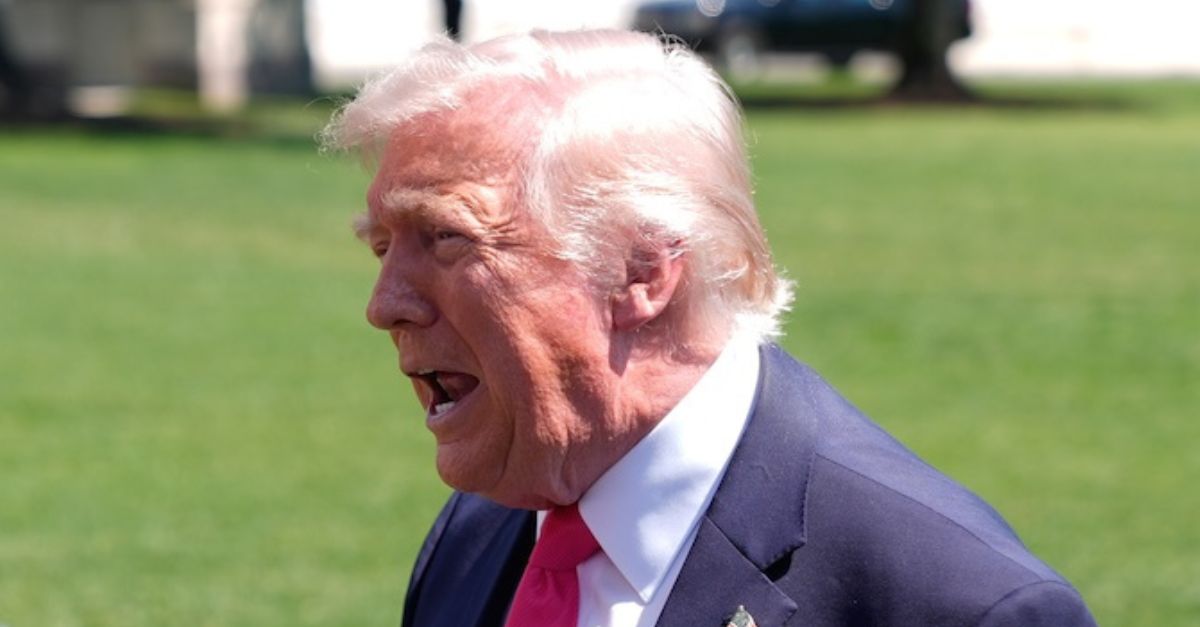

President Donald Trump speaks to reporters on the South Lawn of the White House before boarding Marine One on Thursday, April 16, 2026, in Washington (AP Photo/Manuel Balce Ceneta).
A federal judge on Wednesday refused to remove President Donald Trump as a defendant in a lawsuit targeting his executive order that critics say attempted to turn the “Executive Branch, via the USPS,” into a regulator of state mail-ballot systems.
U.S. District Judge Indira Talwani gave an early victory to plaintiffs led by the League of Women Voters, who argue that a central provision of Trump’s executive order 14399 “violates the separation of powers doctrine, is ultra vires, violates principles of Federalism, and violates their members’ right to vote.”
“The right to vote is a fundamental right, which the Constitution guarantees to all citizens,” wrote Talwani, an appointee of former President Barack Obama who serves on the U.S. District Court for the District of Massachusetts. “As this court has explained, Section 3 of the EO is unconstitutional.”
The order, issued in late March and titled “Ensuring Citizenship Verification and Integrity in Federal Elections,” instructed Postmaster General David Steiner to begin USPS rulemaking requiring outbound ballot mail to use envelopes marked as Official Election Mail, including approved USPS identifiers such as the Official Election Mail logo when appropriate. It also called for ballot envelopes to be automation-compatible, carry a unique Intelligent Mail barcode or future USPS tracking technology, and undergo a USPS design review to confirm compliance with mailing standards, including barcode placement.
The challenged section went further, stating that USPS “shall not transmit mail-in or absentee ballots” from voters unless those individuals were listed on a state-specific “mail-in and absentee participation list.”
Talwani found that Section 3 is “unconstitutional,” emphasizing that the president “plays no role in the regulation of elections” and that Congress “has not delegated authority to USPS to sort the mail, let alone to refuse to transmit mail ballots for certain voters.”
In a footnote, the judge said Trump’s directive would require USPS to violate multiple obligations imposed by Congress, including the statute’s complete definition of “nonmailable matter,” which does not cover ballot mail sent by unenrolled individuals, as well as the Postal Service’s duty to avoid “any undue or unreasonable discrimination among users of the mails.”
Although the DOJ had argued that Trump should be dismissed as a defendant from the lawsuit, Talwani advised the government to take it up with Justice Antonin Scalia’s jurisprudence.
“Presidential action is not inherently unreviewable,” the judge said, citing Scalia’s concurrence in the 1992 case Franklin v. Massachusetts. “Ultimately, Justice Scalia’s Franklin concurrence does not ineludibly proscribe declaratory judgments against the President.”
“Therefore, the court denies Defendants’ Motion to dismiss the President,” the opinion said.
In a statement, the plaintiffs’ attorneys said they are pleased Talwani “recognized the disruption and chaos caused by the executive order and ruled that our clients’ claims can move forward.”
The post Judge refuses to let president off the hook while finding Trump’s executive order illegally directed USPS to ‘refuse to transmit mail ballots’ first appeared on Law & Crime.


