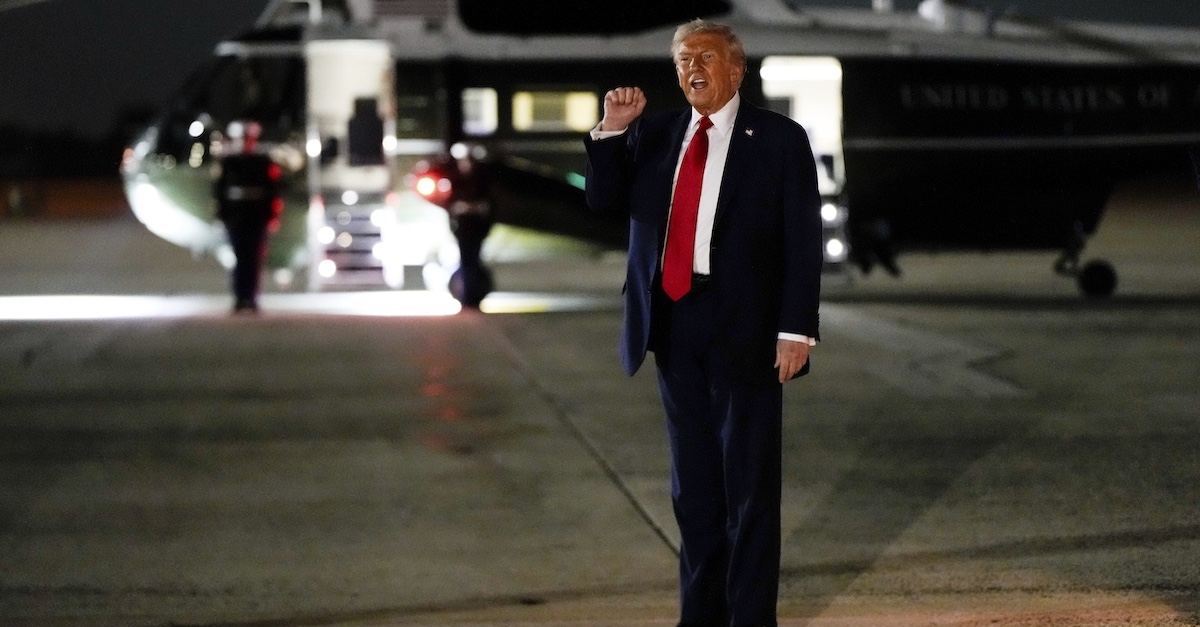

President Donald Trump gestures to members of the media before walking to Marine One, Sunday, Sept. 21, 2025, at Joint Base Andrews, Md. (AP Photo/Julia Demaree Nikhinson).
The Department of Justice is requesting that the full 5th Circuit U.S. Court of Appeals, which has a conservative majority, rule that two judges incorrectly “failed” to defer to President Donald Trump’s decisions regarding the allegations that Venezuelan gang members had entered the U.S. illegally and should be swiftly expelled under his Alien Enemies Act (AEA) proclamation.
In a 21-page filing on Monday requesting a rehearing en banc, the DOJ argued that a three-judge panel, aside from the dissenting opinion, mistakenly “invalidated” Trump’s proclamation made in March, which labeled Tren de Aragua (TdA) as a “Foreign Terrorist Organization” consisting of “thousands of members” allegedly “conducting irregular warfare and undertaking hostile actions against the United States” with the endorsement of Venezuelan President Nicolas Maduro.
The government, frequently referencing the dissenting opinion, claimed that the 2-1 majority “failed to defer” to Trump, “misinterpreted the AEA’s text and history to unduly restrict its scope,” and intruded on the president’s authority under Article II of the Constitution.
“The full Court should rehear this case to make clear that the AEA supports the President’s Proclamation, and reaffirm that the government’s policy for notifying enemy aliens of their removal under the AEA is in accordance with due process,” the DOJ asserted.
Earlier in September, the panel, led by U.S. Circuit Judge Leslie Southwick’s majority opinion, concluded that Trump’s application of the 1798 wartime law was invalid because there was “no invasion or predatory incursion” occurring under the statute’s definition, the U.S. is not at war with TdA or Venezuela, and that the president’s admittedly “broad discretion” was subject to judicial review.
Southwick, a George W. Bush appointee, was joined by U.S. Circuit Judge Irma Carrillo Ramirez, a Joe Biden appointee, in holding that the Trump administration’s reliance on the AEA statute was blocked and that the government would have to rely instead on other statutory authority to remove alleged “foreign terrorists” from the country.
“Therefore, we define an invasion for purposes of the AEA as an act of war involving the entry into this country by a military force of or at least directed by another country or nation, with a hostile intent. Some of the definitions we have quoted also suggest the intent needs to be to conquer, occupy, or otherwise exercise some long-term control. We see no reason for being that specific in this case,” the majority said. “Petitioners are likely to succeed in demonstrating that the Proclamation cannot be supported either by the existence of a declared war or an invasion.”
That conclusion didn’t come as a surprise, considering Southwick’s audible skepticism during June oral arguments.
But U.S. Circuit Judge Andrew Oldham, a Trump appointee, clearly warmed to the administration’s arguments in favor of Trump’s authority and ended up penning the lone dissent — one which the government is embracing in its request that the whole 5th Circuit second-guess the panel’s ruling. Oldham accused the majority of essentially making themselves president, treating Trump like some “run-of-the-mill plaintiff,” and holding him to a different standard than any president ever.
“For 227 years, every President of every political party has enjoyed the same broad powers to repel threats to our Nation under the Alien Enemies Act (‘AEA’). And from the dawn of our Nation until President Trump took office a second time, courts have never second-guessed the President’s invocation of that Act. Not once,” he began, stating that the U.S. Supreme Court has “time and time again” said the president’s “declaration of an invasion, insurrection, or incursion is conclusive.”
“For President Trump, however, the rules are different. Today the majority holds that President Trump is just an ordinary civil litigant. His declaration of a predatory incursion is not conclusive. Far from it. Rather, President Trump must plead sufficient facts—as if he were some run-of-the-mill plaintiff in a breach-of-contract case—to convince a federal judge that he is entitled to relief,” Oldham went on. “That contravenes over 200 years of legal precedent. And it transmogrifies the least-dangerous branch into robed crusaders who get to playact as multitudinous Commanders in Chief. I respectfully but emphatically dissent.”
The DOJ’s request for an en banc rehearing cited Oldham at least a dozen times in urging the full 5th Circuit to decide that there’s little the courts can or should do when it comes to evaluating Trump’s declaration and whether an “invasion or a predatory incursion” actually “exists.”
“The panel erred at the threshold of its AEA analysis by failing to give proper deference to any of the President’s determinations—then faulting the President’s determination that TdA is committing a ‘predatory incursion’ and ‘invasion’ against the United States,” the DOJ said. “The Supreme Court has long recognized that judicial review under the AEA must be extremely limited.”
Instead of “deferring” to Trump, the administration continued, the panel engaged in an “erroneous” exercise to question whether his words were tethered to fact.
“[A] court’s ‘interpretation’ of the AEA cannot involve second-guessing the President’s conclusions whether hostilities rise to the level of a threatened incursion or invasion,” the filing added. “Nor can courts then second-guess the President’s factfinding. That review contravenes Supreme Court precedent and supplants the President’s national-security determinations in an area of core Article II powers.”