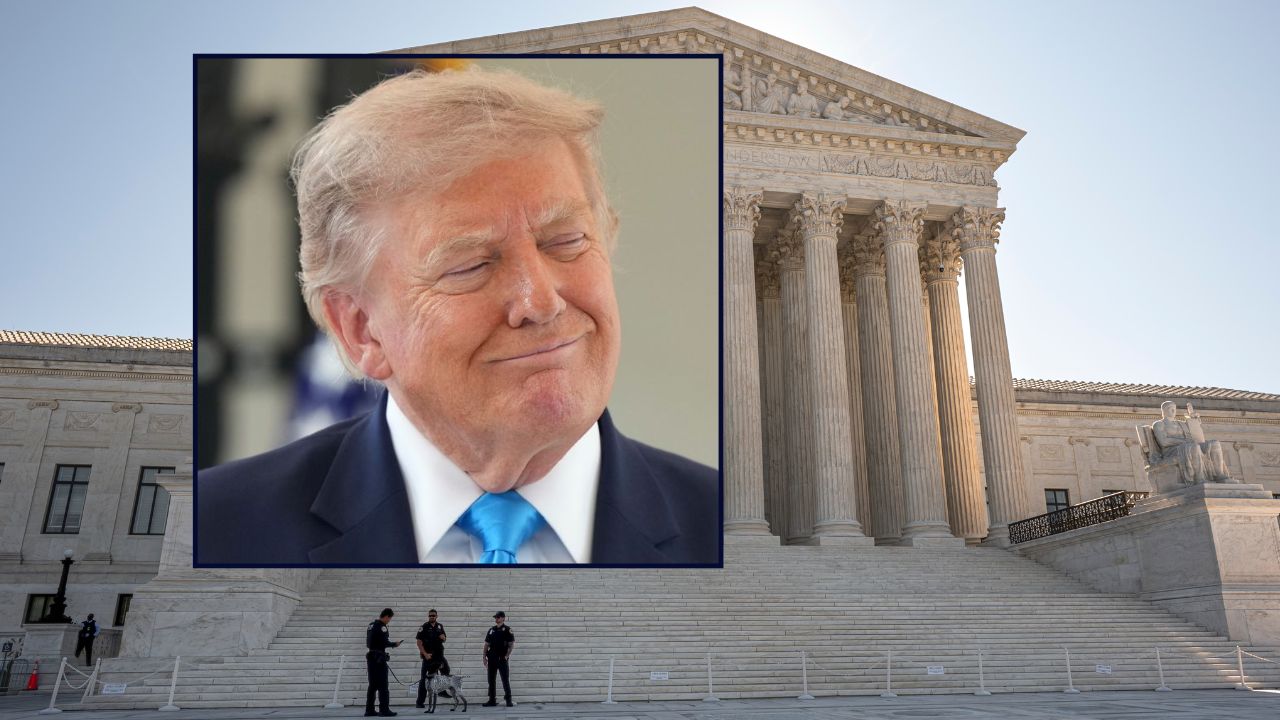

Inset: President Donald Trump listens during a White House event announcing the Freedom Haulers initiative on Thursday, July 30, 2026, in Washington (AP Photo/Alex Brandon). Background: The Supreme Court building is shown the morning after its conservative majority sided with the Trump administration in a dispute over President Donald Trump’s executive order limiting mail-in voting, on Capitol Hill in Washington, Tuesday, Aug. 25, 2026 (AP Photo/J. Scott Applewhite).
Just four days before the Jan. 6, 2021, attack on the Capitol, President Donald Trump pressed Georgia’s Republican secretary of state in a now-infamous phone call, urging him again and again to “find 11,780 votes.” Now, that same official, Brad Raffensperger, is part of a bipartisan coalition of current and former election administrators asking the Supreme Court to take a narrower path in the latest fight over mail-in voting.
The dispute arrives as Democratic-led states and the League of Women Voters are urging the justices to block the U.S. Postal Service from enforcing what they describe as an “unprecedented” and “unconstitutional” final rule. The Justice Department, meanwhile, is again asking the high court to pause a Massachusetts judge’s injunction, defending what it calls limited envelope-design and recipient-information rules for federal election ballots sent through the mail under Trump’s March executive order.
Justice Ketanji Brown Jackson, who handles emergency matters arising from the 1st U.S. Circuit Court of Appeals, had set Wednesday as the deadline for responses to the administration’s request. The League of Women Voters responded by arguing that the federal government’s “eleventh-hour” bid to control how states run mail voting is flawed both legally and because of how close it comes to the election calendar.
“If states do not or cannot comply, USPS will refuse to deliver their ballots—even though states are required by their own laws to mail those ballots to millions of voters now and in the coming days,” the group wrote in its opposition filing. In a separate warning, former national security officials said the rule could leave service members and their families living overseas without a meaningful chance to vote.
“No federal statute gives USPS that power, and the Constitution assigns the Executive Branch no role in prescribing the manner of federal elections,” the filing continued. “Yet, at the President’s direction, USPS rushed to adopt these requirements just days before the start of mail voting for the November 3, 2026 elections.”
The same day, the Supreme Court docket filled with friend-of-the-court briefs, including one submitted by current and former state and local election officials, with Raffensperger listed among them.
When the Supreme Court’s conservative majority put one of U.S. District Judge Indira Talwani’s injunctions on hold in August, its unsigned order included an important caveat: the stay did “not mean that any measure taken by the Government to implement the [Trump executive] Order will necessarily be lawful.”
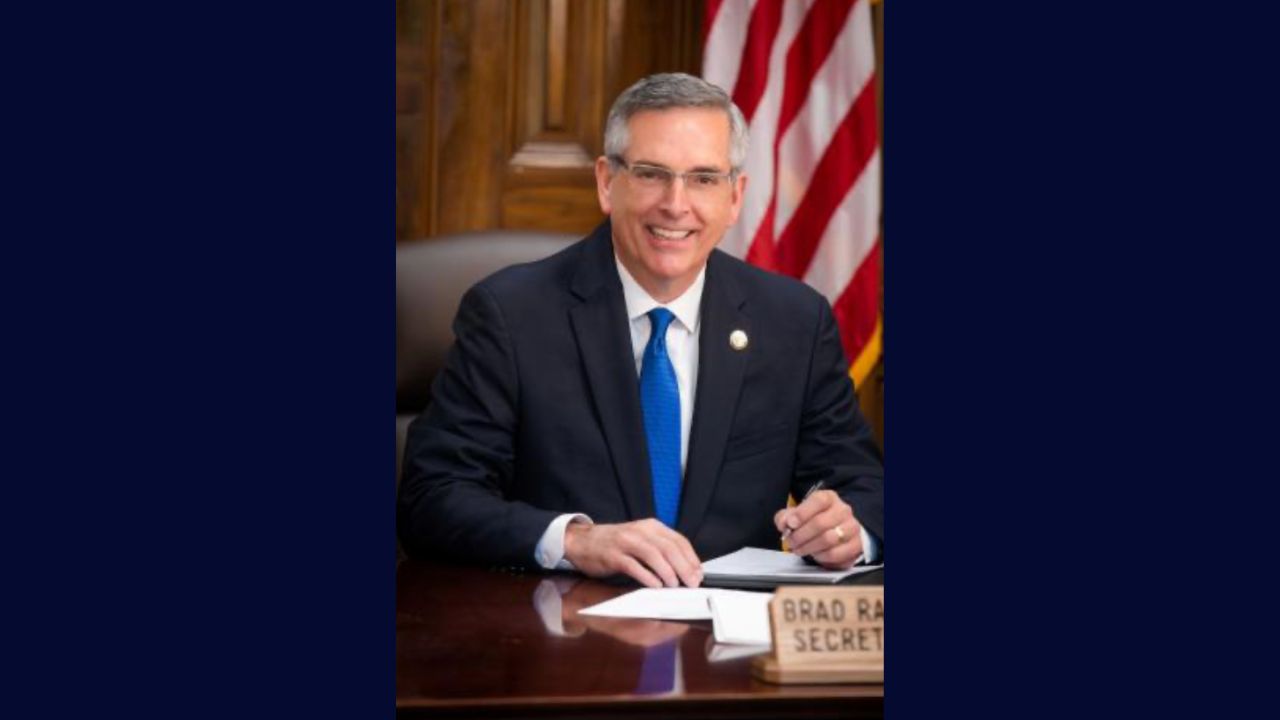
Georgia Secretary of State Brad Raffensperger (Georgia Secretary of State’s Office).
Raffensperger’s coalition took “no position on whether the Postal Service had statutory authority to promulgate” the final rule, instead suggesting the justices punt on the rule’s “validity” until after the 2026 midterms but before the 2028 presidential election.
Implementing the rule at the state level can’t be done in such a short time frame and, in any event, “ballots are already going into the mail” in some states, with “other states” soon to follow, the amici said.
“No election office, at any level of government, has budgeted for the work the Rule requires. And none have the time or the means to fully train or test on this Rule. That simply cannot be done midstream of this election,” the brief said, stating as a matter of fact that mail-in ballots that are “never delivered” will deny the “franchise to an eligible voter who has followed state law in every respect,” whether they are Republicans or Democrats.
“And an election conducted under requirements that many offices could not satisfy invites a challenge to the margin in every close race in the country, brought by whichever side comes up short,” the amici continued. “Amici, who will be asked to canvass and certify those results, have a strong interest in avoiding that prospect and no stake in which party it would favor.”
In May, Jackson penned a solo dissent accusing the conservative justices of abandoning principle to aid Republicans’ electoral prospects in Louisiana.
“There is also the so-called Purcell principle,” Jackson said, “which we invoked only five months ago to chide a federal district court for ‘improperly insert[ing] itself into an active primary campaign.'”
Raffensperger’s brief similarly cautioned that “late changes of [the] kind” proposed by USPS are what the Purcell principle “forbids” and “counsels against.”
“The Rule itself supplies clear evidence that it is too late. Section 705.24.2 contemplates a runway of at least 90 days for election officials to notify the Postal Service of their intent to send ballots by mail,” the brief observed. “For the November 3 election, that date was August 3, 2026. But the Rule took effect on August 21.”
“The Postal Service adopted an immediate effective date so that the Rule would govern this election, but it did not exempt this election from a timeline its own text treats as the minimum. Nor does the calendar of federal elections require that choice,” the amici added, considering that there’s plenty of time before 2028 to reach the “merits of the Rule.”
The post Election official Trump once asked to ‘find 11,780 votes’ gives SCOTUS an off-ramp on USPS rule, notes ‘ballots are already going into the mail’ first appeared on Law & Crime.