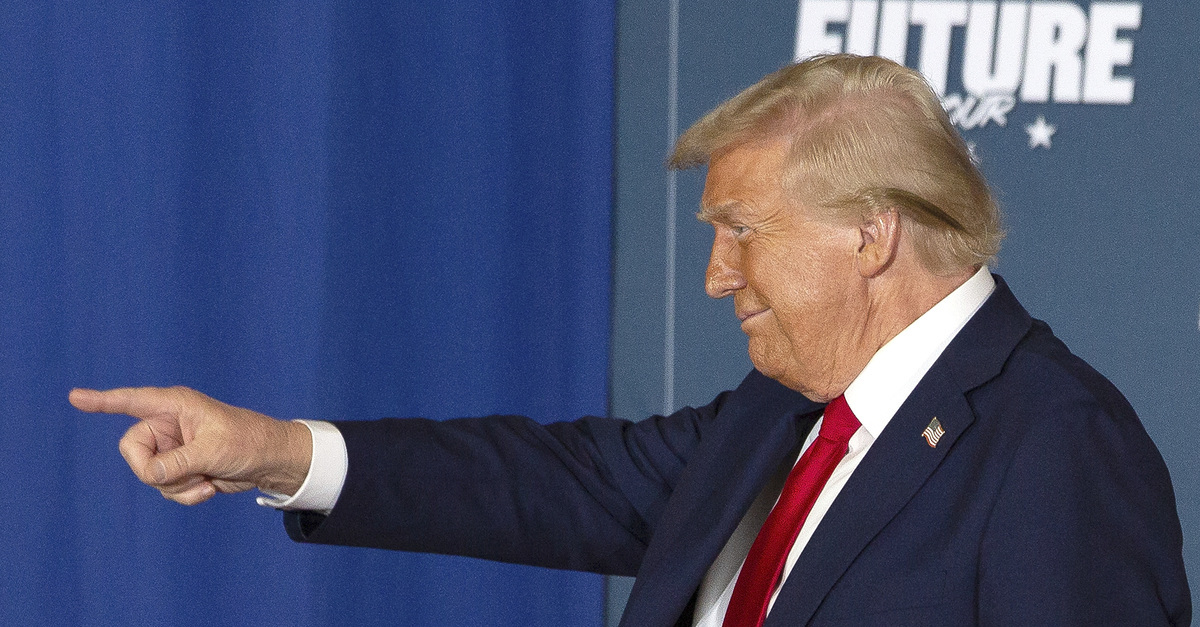

Then-Republican Candidate for President Donald Trump attends the Building America”s Future, Southeastern Pennsylvania Roundtable at the Drexelbrook Event Center on Oct. 29, 2024, in Drexel Hill, Pennsylvania (Matt Bishop/imageSPACE/Sipa USA via AP Images).
Lawyers for President Donald Trump are urging a federal judge not to pursue a deeper review of the settlement process behind a controversial $1.776 billion “anti-weaponization fund” that critics say is designed to benefit the president’s allies and supporters.
Trump first sued the IRS in January in the U.S. District Court for the Southern District of Florida. But by mid-May, the case had been closed at his own request, with Trump opting instead to resolve the matter through a publicly funded program intended to compensate pro-Trump figures and others who say they were unfairly targeted.
According to the settlement, people eligible to seek compensation include those allegedly subjected to the “sustained use of the levers of government power” by Democratic elected officials, federal employees, contractors, and agents for what the agreement describes as improper or unlawful political, personal, or ideological reasons.
When she formally closed the case, U.S. District Judge Kathleen Williams, an appointee of former President Barack Obama, signaled concerns about whether the matter had truly been resolved. Still, she appeared willing to leave the issue alone for the time being. At the same time, at least four separate lawsuits or legal claims were filed seeking to halt what opponents have labeled a “slush fund.”
Among those challenges was a filing from nearly three dozen former federal judges. They asked Williams to set aside what they called Trump’s “fraudulent” voluntary dismissal, reopen the case, and investigate “exactly what happened here,” according to an earlier report by Law&Crime.
Any uncertainty over whether Williams would revisit a case she had already dismissed with prejudice — or whether the retired judges had standing to press their objections through the original lawsuit — was soon resolved.
“Here, the non-party movants advance grievous allegations that Plaintiffs voluntarily dismissed this litigation solely to avoid judicial scrutiny of a lawsuit that ‘was collusive from the start’ and was only filed to provide the imprimatur of legality for an unlawful settlement,” Williams wrote in a late May order.
The court’s four-page order directed Trump’s lawyers to respond to the former judges’ objections by June 12 – and allowed the judges to reply by June 19. Now, motions practice looks to be right on schedule.
In their June 12 response, Trump’s legal team chides the former judges for penning “a baseless motion to reopen a case that was lawfully and properly dismissed” and says their professional pedigree “only makes their frivolous motion all the more damaging to our rule of law.”
The response goes on like this, at length:
Movants should be above making what is a transparently political filing intended to gin up press attention to a fully proper government settlement that they knowingly have no standing to challenge. Movants were not parties to any litigation with Plaintiffs; they had never expressed any interest in the case until they filed their motion; and they have no legally cognizable interest in it.
To hear Trump’s side tell it, the settlement simply cannot be contested by the judges or overseen by the court.
The procedural vehicle used – under the Federal Rules of Civil Procedure – to dismiss the case is “self-executing [in] nature,” according to the filing.
“The Court had no discretion to grant or deny the dismissal, no motion to weigh, and no adjudicative function that could have been corrupted,” the response reads. “There was therefore no ‘fraud on the court’ within the meaning of the doctrine, and no basis for the Court to exercise any form of ancillary jurisdiction over an unfiled settlement agreement between private parties and the Executive Branch.”
Second, Trump says the ex-judges “lack standing” to invoke their own chosen procedural attack on the settlement.
“Movants’ alleged stake—their generalized interest in ‘the administration of justice’ and public ‘confidence’ in the courts—is the paradigmatic abstract grievance that does not support standing,” the response continues. “Movants’ generic concerns are plainly insufficient to confer standing to challenge such a settlement.”
Finally, Trump’s legal team says the court itself incorrectly invoked a rule in “an effort to manufacture nonparty standing where none exists.”
Here, the response is referring to an issue raised by the court itself under another rule of civil procedure – which, on its own terms, “requires that an attorney or unrepresented party filing a pleading certify that the filing is not presented for any improper purpose.”
In other words, Williams suggested the attorneys involved in the settlement might have engaged in “serious misconduct” rising to the level of having “abused the judicial process” if they did, in fact, “file a frivolous lawsuit for the sole purpose of forcing a settlement.”
The attorneys say such an accusation must be raised by a party – not the judge – and that limited exceptions where a judge can raise such an issue do not apply.
“The Movants are not parties and could not satisfy the safe harbor,” the response goes on. “The Court’s own initiative fares no better: even a sua sponte sanction is barred here.”
Trump’s response goes on to scold Williams for her efforts to inject the rule into the proceedings – and argues that she suffers from two incorrect assumptions.
Again, the motion, at length:
Stripped to its essence, any sua sponte theory that the Court might entertain reduces to two propositions, and neither supports the requested relief. The first is that the parties settled without submitting the agreement for the Court’s review. But the Court had no authority to review or approve that settlement in the first place; a power that does not exist cannot have been evaded, and its non-exercise is neither a Rule 11 violation nor a fraud on the court. The second is that the litigation was collusive. It was not.
“There is, in short, no credible Rule 11 approach, and no credible fraud-on-the-court approach—only disagreement with an Executive settlement, which is not a basis for relief,” the response continues.
The Trump response goes on to accuse the judges of lacking much of any legal argument and instead relying on “rhetoric” to make their case about collusion. The filing rubbishes those arguments as “bare-bones assertions.”
“In sum, the Movants’ position amounts to the assertion that because they disagree with the government’s decision to settle, the settlement must have been collusive,” the response concludes. “That is not a legal standard. It is a policy objection dressed as a fraud claim, and it does not warrant the extraordinary remedy of reopening a closed case, which, in any event, this Court does not have the power to do.”