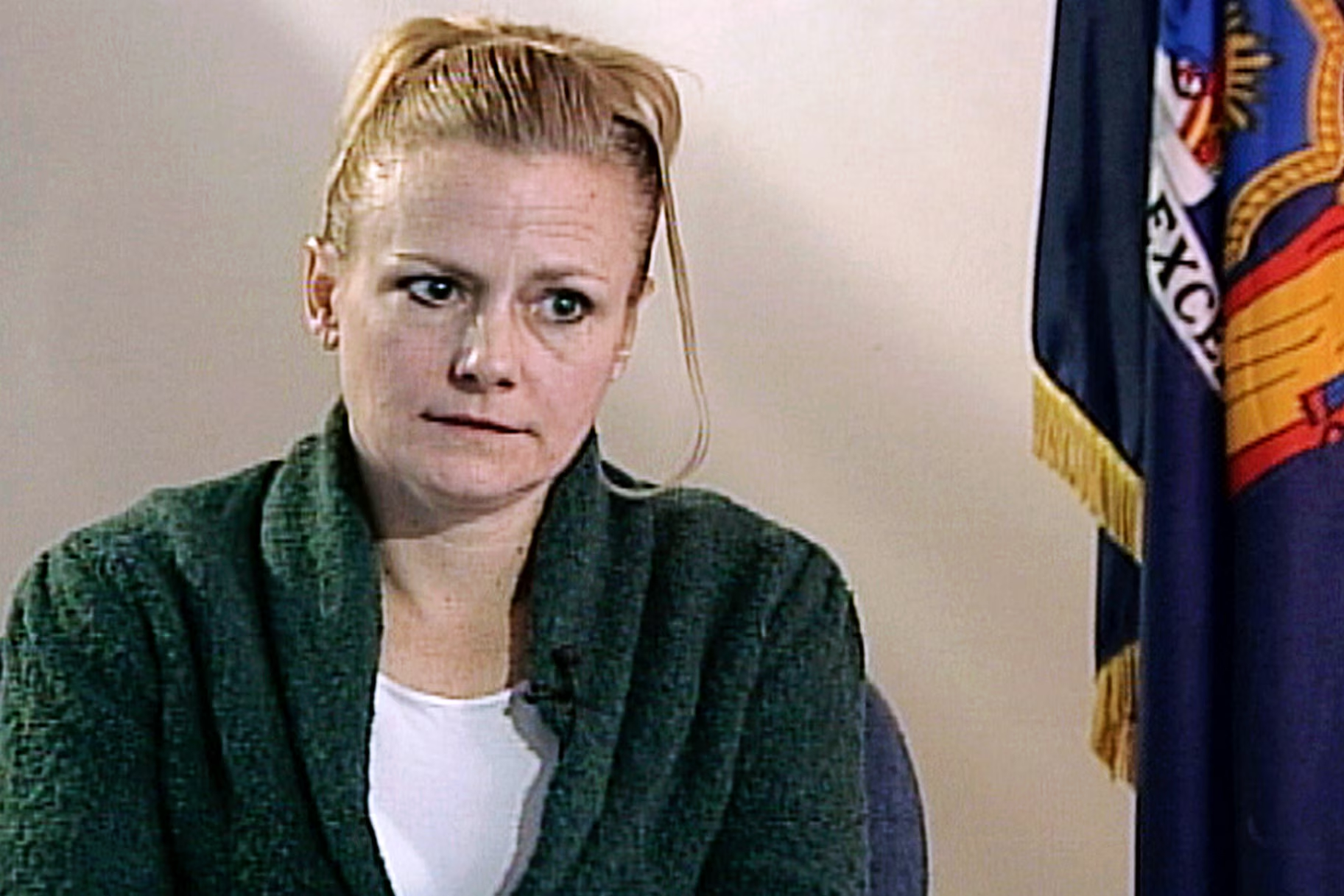

Pamela Smart, the New Hampshire woman found guilty in 1991 of conspiring with her teenage student in the murder of her husband, is once again pushing for a chance to have her case heard by a new jury.
Her legal team was back in a New Hampshire courtroom on July 20, urging a judge to let her newest habeas corpus petition, filed in January, proceed. The attorneys argued that serious questions remain about the fairness of Smart’s original trial, according to The Associated Press.
At the center of the latest Pamela Smart legal challenge are transcripts given to jurors during her trial. Her attorneys claim prosecutors presented written versions of secretly recorded conversations made after the 1990 killing of her husband, Gregg Smart, in a way that may have led jurors to believe certain words were captured on the tapes even when the audio itself was unclear.
One disputed phrase highlighted by the defense was “you had your husband killed.” Smart’s lawyers argued that the word “killed” could not actually be heard on the recording, the outlet reported.
“Modern science confirms what common sense has always told us: when people are handed a script, they inevitably hear the words they are shown,” Smart’s attorney Matthew Zernhelt said in a statement earlier this year, according to the AP. “Jurors were not evaluating the recordings independently — they were being directed toward a conclusion, and that direction decided the verdict.”
During the hearing, Zernhelt also argued that supplying jurors with the transcripts may have shaped how they interpreted the evidence. “No one should be sitting in a life-without-parole sentence where the conviction resulted from untrue or inaccurate evidence,” he said, according to the The Concord Monitor.
Zernhelt cited forensic research suggesting that when listeners are given a transcript, they can be primed to hear the words printed in front of them, even if those words are not actually present or are impossible to clearly distinguish on the recording.
“There’s no absolute truth about what’s on the tapes,” he told the court, according to the AP. “Nothing decipherable is on the tapes. But when you tell someone what they’re hearing, you set this expectation … and they will hear it.”
Pamela’s attorneys also argued that the intense media attention surrounding the case could have prejudiced the jury.
It was the first murder trial to be televised nationally, per The Concord Monitor, and went on to inspire the popular 1995 movie To Die For starring Nicole Kidman.
Though Pamela did not appear in court herself, she watched the proceedings from the Bedford Hills Correctional Facility for Women where she is serving out a life sentence without the possibility of parole.
Prosecutors Argue Defense Position is Not Based on Facts
In response to the arguments laid out by the defense, prosecutors noted that many of the issues had been raised in Pamela’s prior appeals and had already been resolved by the New Hampshire Supreme Court, according to The Associated Press.
They also pointed out that during the initial trial the judge had instructed jurors to rely on the recording rather than the transcript if there was any doubt about what they were hearing.
Assistant Attorney General John A. Drennan also argued that Pamela’s attorneys had failed to explain how the transcripts influenced the verdict, according to WMUR.
As he explained, ”The petitioner does not tell us in what way this affects the verdict, how it was problematic.”
He also questioned the study presented by the defense and argued that the contentions made by the defense were not supported by facts.
Pamela’s defense attorneys are hoping the judge will grant them an evidentiary hearing to explore the issue further. The judge is expected to make a ruling within 30 to 60 days, per the AP.
Her aunt Dorothy Keville was in court to support her niece. She is still hopeful that Pamela will someday be granted parole.
“I would like to see her with a bracelet and for her to come home and take care of her mother, my sister,” Keville told WMUR. “I’m the matriarch of the family, and I still feel a lot of pain.”
For years, Pamela has unsuccessfully tried to have her sentence reduced to life with the possibility of parole.
What Was Pamela Smart Convicted Of?
Pamela was working at a media job at a local high school and preparing to celebrate her first anniversary with husband Gregg, when prosecutors said she convinced the high school student she was having an affair with to kill her husband, according to Oxygen’s Dateline: Secrets Uncovered.
The 16-year-old student Billy Flynn recruited Patrick Randall and two other friends to help him carry out the plot. Then, on May 1, 1990, Billy shot Gregg in the head in what they hoped would look like a robbery gone wrong.
“I said ‘God, forgive me,’” Billy recalled through tears on the stand. “I pulled the trigger.”
At the time, Pamela contended that Billy had acted on his own after she cut off the relationship.
All four teens were convicted and later released from prison after serving their time.
Pamela remains the only person connected to the plot to still be behind bars.
In 2024, Pamela accepted full responsibility for her husband’s death for the first time.
“For me that was really hard, because going into those places, in those spaces is where I found myself responsible for something I desperately didn’t want to be responsible for, my husband’s murder,” she said in a video statement, according to The Associated Press. “I had to acknowledge for the first time in my own mind and my own heart how responsible I was, because I had deflected blame all the time, I think, almost as if it was a coping mechanism, because the truth of being so responsible was very difficult for me.”


