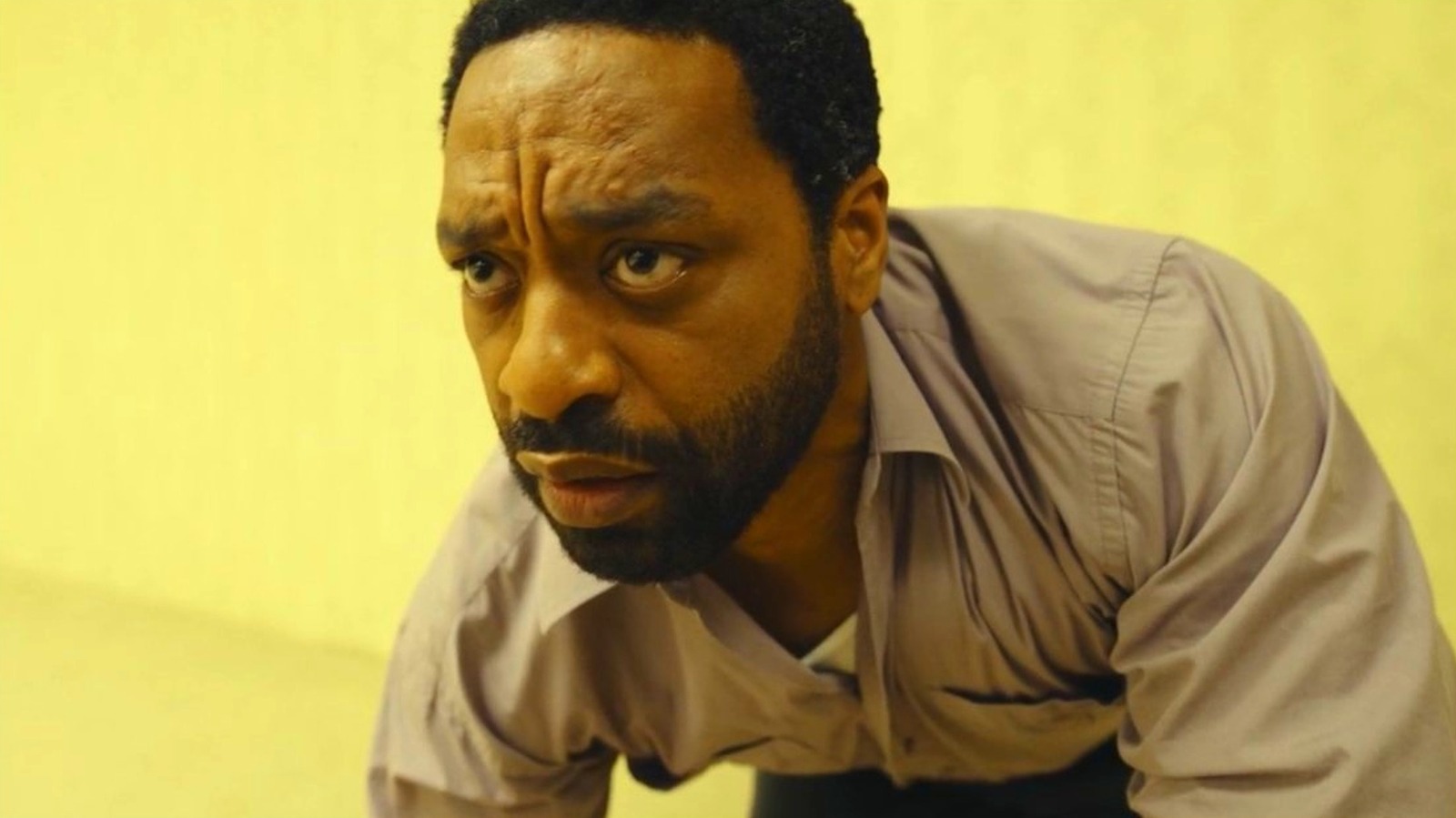

If you’re unfamiliar with Kane Parsons’ “Backrooms” web series, the movie adaptation might leave you scratching your head with more questions than solutions. Although the film is crafted to stand independently, it contains ample references to the broader, pre-existing lore of the eerie, unsettling universe first introduced in the YouTube shorts (for a quick refresher on “Backrooms,” check out this link). While the movie doesn’t provide a clear-cut explanation for the phenomena occurring within these walls, Chiwetel Ejiofor’s character, Clark, proposes a fresh theory for viewers inclined to follow an emotional thread—a topic we’ll delve into shortly. The narrative hints that a group of scientists has been investigating this enigma for an extended period.
The story unfolds in the summer of 1990, beginning with a found-footage video dated June 19 and capturing Clark’s initial venture on CCTV footage from the 29th. In the YouTube series timeline, these events occur a month after the Async Research Institute faked the death of their employee, Peter Tench, to conceal their hazardous experiments, only for him to reemerge and escape back to the surface. Though not directly referenced, the harrowing failed mission depicted in the opening footage and the evasive interrogation of Mary (played by Renate Reinsve) by Phil (Mark Duplass) at the film’s conclusion suggest the organization is burying more secrets than ever under intensified internal scrutiny.
This article will dissect the film’s ending, examine its connection to existing lore, and explore how it expands our understanding of the Backrooms.
After fleeing from the monstrous Clark and being sprayed with a mysterious gas by a team in hazmat suits, Mary is led to an interrogation chamber. Along the way, viewers catch further cryptic hints about Async’s research. Notably, a storage room brimming with identical cardboard cutouts of a man, each equipped with a bilingual tape recorder, reveals the company’s significant attempt to communicate with the creature.
During Mary’s interview with Phil, she receives no concrete answers. He shares that the institute once produced MRI machines, but since discovering this place, its mission has shifted entirely to mapping it. While he doesn’t go into specifics, he claims, “nothing in recorded history means more.” The implications for Mary remain ambiguous; given the recent events in the timeline, it seems unlikely she’ll be permitted to leave.
What happened at the end of Backrooms
The film concludes with a montage of pivotal moments from Mary’s life, from her challenging childhood to the distribution of her self-help book. It culminates in an image of her bound to a chair, her face distorted like the humanoid creatures encountered with Clark earlier. It’s open to interpretation whether this is a replica created by the rooms, feeding on her energy, or if the lore has evolved to the extent that she has transformed due to prolonged entrapment. The former scenario seems more plausible.
Once interviewed by Phil, Mary doesn’t get anything in the way of concrete answers; he tells her that his institute used to make MRI machines, but, since finding this place, it has become fully committed to mapping it out. He doesn’t elaborate on the plans specifically, but tells her “nothing in recorded history means more.” What this all means for Mary is left vague; what happens to her next isn’t up to Phil, but, based on the recent history of the in-universe timeline, it’s unlikely she’ll be allowed to leave.
This is accelerated by a closing montage with various landmark moments from Mary’s life, from her troubled childhood to store shelves where her self-help book was sold. It ends on an image of her, tied to a chair, with the same warped facial rendering as the humanoid creatures we saw with Clark earlier on. It’s left open to interpretation whether or not this is a replica the rooms have made, feeding off her energy while she was inside them, or if the lore has advanced to the point that she’s actually transformed due to being stuck down there for so long. It’s most likely the former.
What do we learn from Mary’s childhood memories?
After Clark led his two young employees into the Backrooms, both met grisly ends, but rather than doing the obvious thing and getting out of there, he chose to stay and make it his new home. Calling his therapist Mary, he cryptically tells her that he’s “opened the window” and “won’t be coming back,” heightening her concern after he used their last session to rant about his discovery behind the store walls (men would literally rather move to the Backrooms than address their issues in therapy, it seems).
We learn after he kidnaps her that he’s still obsessing over their recent therapy session in which she made him do a roleplay where she played his ex-wife in a bid to address his alcoholism and relationship issues. Despite professionally unpacking the trauma of others, Mary’s own emotional torment is kept locked up; the recent demolition of her childhood home has brought back memories of growing up with a mother with an unspecified mental illness. The first flashback we see is a happy memory of the pair putting their handprints in fresh cement, but she’s later shown in an uncleaned house, told to stay inside by a conspiratorial mother.
Mary seems to see Clark’s psychotic break as being similar to her own childhood domestic situation. When the Creature appears, resembling a giant Clark and killing him, she’s only able to make her escape because she weakens it by attacking it with a rock she had earlier pocketed from her office, a totem harking back to an earlier childhood memory. She outruns it but ultimately can’t escape the Backrooms, which now feature recreations of landmarks from her life. The film is telling us that if you fight to keep it at bay and don’t talk about it, unprocessed trauma won’t just vanish.
Who is Phil the scientist?
In the brief web series episode “Prototype,” we’re told that, back in 1982, a man named Philip R. Heymann conducted an experiment into what would become to be known as the Low-Proximity Magnetic Distortion System. This is the device Async uses to travel between the real world and the Backrooms, and this prototype experiment was shown to be successful — the episode ends with an object being successfully transported into the other dimensional space. This character is never again referenced in the web series, but in the film, we meet an Async employee who goes by the name Phil.
Could the Phil played by Mark Duplass (known for “Creep” and its sequel “Creep 2,” a horror movie with a perfect Rotten Tomatoes score) be Philip R. Heymann from the web series? He’s presented as a high-ranking researcher, so this would make a lot of sense. He’s also clearly not the big boss, as he doesn’t get to decide the fates of those he interrogates, purely acting out of an attempt to understand how other people perceive this space. This also tallies with Philip R. Heymann, who isn’t at the top of the Async ladder (the highest ranking person mentioned in the web series is vice director Ivan Beck, who is unseen here but is a major force in that source material).
There are some additional clues about the extent to which Phil’s research is top secret, too. The CCTV images of Clark he shows Mary have the cardboard cutout man he interacts with redacted behind a black square, possibly because the existence of that tool indirectly implies the existence of a creature they’re trying to tame. While it’s a research institute, Async has corporate intentions with the Backrooms, which the web series explores in detail. If you’re familiar with it, then you’ll know that Clark’s decision to move in acts as an unintentional test case for Async’s ultimate plan.
What else does the YouTube series tell us about Async?
By telling us that Async previously made MRI machines and received government grants for its research, “Backrooms” goes one step further than the web series in establishing what the organization got up to before it fully dedicated itself to exploring this new dimension. But Async’s specific motives are left unclear in the film, with its secret objectives hidden from Mary when she asks about them — luckily, Kane Parsons’ web series fills in those blanks.
In 1988, Async vice director Ivan Beck announced at a press conference that the company was working on “a solution to all current and future storage and residential needs,” something which could “save billions of dollars on property construction and management.” In other words, after early experiments with the Low-Proximity Magnetic Distortion System proved successful, Async established a new project (named Project KV31) with the intention of solving various housing and homelessness crises, attempting to make the Backrooms livable despite the deadly creatures that roam there.
Subsequent tests tore a hole in the fabric of reality and led to a major increase in missing persons’ cases linked to the complex, with many unfortunate souls falling into the Backrooms through solid ground, never to return again. In the series timeline, Async never found a way of taming the creatures, meaning the idea of human co-existence within this space remains ridiculous. In the film, Clark decides to stay there, but that’s because he’s trying to recreate domestic bliss with subservient humanoids, an idea that backfires when they turn against him.
What has Kane Parsons said about links to the Backrooms web series?
Kane Parsons didn’t invent the concept of the Backrooms — it began with a 4chan thread in 2019. Parsons was inspired to make his own web series after seeing the original meme start a liminal space photography trend. By that time, there was already pre-existing lore about what the Backrooms were, which he pushed in a more overtly sci-fi direction with his web series. One thing he kept at the forefront of his mind while making the movie was not alienating those who loved the series. “I despise a retcon, and I wouldn’t know what to do with myself if suddenly we were telling two versions of the same story,” he told Sci-Fi Now. “It’d be like two different alternate realities that are just barely touching, and I would never be able to reconcile that in my head. So it inherently needed to be connected.”
In the same interview, Parsons discussed wanting to return to the “simplicity” of his earliest shorts and avoid “lore bloat” at all costs, knowing that, for most viewers, this would likely be their Backrooms entry point. This means that, while there are plenty of allusions to Async’s operations, none of its schemes from the series are directly referenced, even if the franchise timeline has been maintained. This is also why the only named character from the organization (Mark Duplass’ Phil, assuming he’s actually Philip R. Heymann from the episode “Prototype”) is a minor one who barely factors into the lore of the series. Yes, the film and the series are connected, but winks to the devoted fanbase of the latter are kept to the barest minimum.
How does the movie expand the lore?
The movie’s biggest innovation and addition to the pre-existing lore is the revelation that the environment of the Backrooms is directly affected by those who enter there, with the space digging deeper into someone’s subconscious to try and replicate objects, locations, and even people from their lives. The web series established that people can be mutated in the backrooms (dead bodies discovered by researchers were found to have grown mold while decaying), but Kane Parsons wanted to go in a less organic direction with the feature film. “I wanted to make sure that we’re coming from a more psychological perspective, looking at these characters’ inner worlds and how that colors the Backrooms,” he told Sci-Fi Now.
In some production notes released to press by A24, Parsons said: “What if it’s not only buildings and objects that can be replicated, but also human beings? What if we’re not special in any particular way? What if we’re just clumps of cells that can be copied by this place, like mutations?” Clark’s words after kidnapping Mary hint at this idea, telling her “this place remembers things, slightly wrong.” Objects like the store furniture are replicated in ways which sink into the floor. Signage from the real-world appears as its mirror image and human faces are distorted, with a marshmallow-like substance where flesh and bone is supposed to be. Whether you can take this broken man’s reading at face value is a different question; is it only people with the most damaged psychology who shape the environment to this extent?
Is the movie about nostalgia, AI, or both?
When people share images of liminal spaces such as abandoned malls and playgrounds, or seemingly never-ending hallways with drab carpeting and wallpaper, one of the common reactions isn’t one of fear, but of nostalgia. The slightly blurred nature of liminal space photography can appear like a hazy childhood memory turned into reality; for some, these images are as likely to comfort as they are to get under your skin. It’s a theme brought to the forefront of the psychological horror here, and explains why someone like Clark would be so eager to keep exploring. Even the big red flag of the creatures he spots doesn’t turn him off. He goes on to see them as “improvements” due to their inability to feel pain or fear.
Kane Parsons has said that a twisted idea of nostalgia is inherent to the world he’s created. In an interview with Fangoria, he explained that the Backrooms sucking people in via those loose memories is “how it gets you.” It feels uncanny, but nobody could confuse the poorly made resemblance for the real thing. Which begs the question: is “Backrooms” subtly offering an anti-AI commentary? Speaking to The Australian on this press tour, Parsons went as far as saying: “If I could snap my fingers and make generative AI disappear forever, I probably would.” You can view the bizarro world he’s created, which is built on warped recreations, as a commentary on how AI-generated content will never authentically resemble work created by real people. It’s a space that translates everything but human emotion, just like AI.
Is Clark the real villain?
Clark indirectly caused the deaths of two employees by asking them to go deeper into the Backrooms with him and record the evidence, showing signs of obsession due to the allure of its nostalgic pull even before he fully snapped and kidnapped Mary. It’s a surprising character arc considering that the trailers painted him as a traditional horror protagonist who only wanted to find out why this mysterious space was behind the walls of his furniture store. He becomes sociopathic in his desire to put right his past mistakes and recreate events in a world he can control, and he gets his comeuppance when realizing that the Backrooms can’t be governed. In this sense, it’s far closer to a traditional supernatural horror like “The Shining,” specifically the original Stephen King novel, which offered a more grounded portrayal of Jack Torrance than Jack Nicholson’s manic performance in Stanley Kubrick’s film adaptation.
Jack Torrance from “The Shining” has a dark history: He is also a troubled family man battling alcoholism whose inability to juggle his personal and professional commitments sees him become an easy mark for the spirits of the Overlook Hotel, who transform him into a psychopath. Extensive time in the Backrooms causes Clark to undergo a similar transformation, strangling Mary and kidnapping her just after they’re reunited, determined to regain the control he’s felt slipping away in the real world. It’s not directly stated that these impulses have only manifested because of his time in there, but it seems clear that the Backrooms have pushed him in a direction that he may not have taken in the real world. The most charitable reading is that he’s a tragic hero whose emotions have become as warped by the Backrooms as the physical manifestations of his memories.
What could a Backrooms sequel explore?

A24
Based purely on how unlikely it is that Mary was allowed to leave the Backrooms (she was likely either killed or left to become a mutation by Async), there’s little chance of a direct sequel, especially considering there are no other survivors to anchor a narrative around. However, with the web series often following an anthology format, documenting the unlucky people who unwillingly entered the Backrooms as much as the ongoing research, this will likely be the approach taken. And we say “will” because, even though it hasn’t been announced, critics were left stunned by “Backrooms” and it’s on course to break some box office records, so a second instalment seems inevitable. However, the follow-up might end up being on the small screen rather than the big one.
Kane Parsons has made no secret of the fact that he wants to expand on the story. Speaking to Polygon, the 20-year-old director revealed that making more “Backrooms” projects after his feature film had “been the intention since 2022.” He went on to reveal that he would prefer to make a “Backrooms” series rather than another movie. “I think that’s the most practical way to narratively get what you want,” he explained. “But obviously, a series is a whole thing. So it won’t be immediate, it won’t be ‘snap your fingers and it’s here.’ And in general, the series, in my mind, is not determined by its genre label. The way I think of it is definitely a lot more of an interpersonal sort of drama built on top of a supernatural techno-thriller.” There have already been a few TV shows based on Creepypasta, and this would be the biggest one yet if it were to happen.


