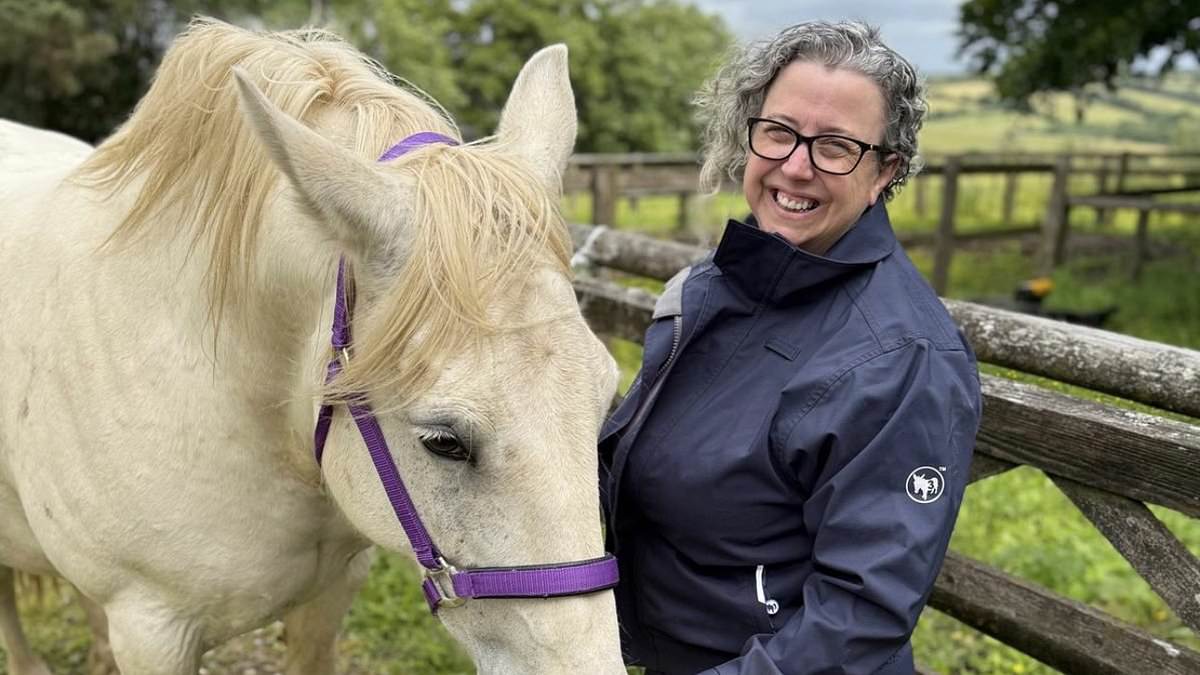

Amanda Marshall, a mother of five from Devon, initially dismissed her thinning hair as a typical post-pregnancy issue, given that she had recently welcomed twin toddlers. However, her concerns grew when she began experiencing hot flashes and a rapid heartbeat. Assuming these were signs of menopause, as she was in her early 40s, Amanda was taken aback when these symptoms escalated to what she believed were panic attacks. By October 2016, she decided to consult her GP, unaware of the surprising diagnosis that awaited her.
“I’ve always been active, so I ignored these signs for a while,” Amanda explains. “They just gradually made themselves known.” Already a mother to three children from a previous marriage—Ciaran, now 24, Philippa, 22, and Roberta, 19—Amanda had Ben and Toby, who are now 12, with her partner Mark in 2013. Three years later, she noticed her hair starting to break off.
Today, at 50, Amanda recounts, “I experienced these fleeting hot flashes throughout the day. Climbing the hill after tending to my farm animals would leave me breathless, with my heart racing.”
Given her age, Amanda assumed menopause was the culprit. “I’d suddenly feel overwhelmingly hot and breathless. One particular day, standing by the stables, my heart raced so intensely that I had to lean over for support. That’s when I suspected something more than a panic attack and decided to visit the doctor.”
Fortunately, Amanda’s doctor responded swiftly, prescribing beta-blockers for her heart, conducting a blood test, and noticing a neck lump. “Within ten days, I saw an NHS specialist,” she shares. An ENT specialist determined that the lump was related to her thyroid, leading to a referral to an endocrinologist, who diagnosed her with Graves’ disease. “I had never heard of it before,” Amanda admits.
Amanda combines dairy farming with looking after a horse, three donkeys, two dogs and chickens, plus running her 3 Donkeys women’s overalls clothing brand
The British Thyroid Foundation notes that approximately one in 20 individuals in the UK has a thyroid condition, with women making up 90% of these cases. Most thyroid disorders are autoimmune, with the body’s antibodies either attacking thyroid cells (leading to hypothyroidism) or causing the thyroid to overproduce hormones (resulting in hyperthyroidism).
Thyroid hormones regulate the metabolism, explains Professor Kristien Boelaert, a consultant endocrinologist and president of the Society for Endocrinology and the British Thyroid Association. ‘Hyperthyroidism is too much thyroid hormone and hypothyroidism is not enough. Too much and your metabolism speeds up – you get a fast heart-rate, lose weight and get hot and sweaty,’ she says. ‘The opposite happens with hypothyroidism, so everything slows down – you gain weight, get fatigued, constipated and your skin becomes coarse and dry.’
Graves’ disease causes hyperthyroidism – although Amanda says it hadn’t caused her to lose weight. ‘Sixty to 80 per cent of hyperthyroidism in the UK is caused by Graves’ disease, which is an autoimmune condition,’ says Professor Boelaert. ‘It means you produce antibodies against your thyroid. In Graves’ disease, these antibodies stimulate the thyroid gland to make more thyroid hormones.’
The standard treatment is to start anti-thyroid medication, to block the enzyme that is responsible for thyroid hormone synthesis. Carbimazole is the most commonly used and this is what was prescribed to Amanda, in the hope it would get her thyroid back under control. It’s usually continued for around 18 months, but because Amanda’s levels would not regulate, nine months later specialists decided to operate and remove her thyroid completely. If left untreated, Graves’ disease can cause heart failure and even prove fatal.
If medication can’t make the disease go into remission, there are two other treatment options, says Professor Boelaert. ‘One is to give radioactive iodine and the other is surgery to remove the thyroid gland.’ She explains that surgery used to be very common 60 years ago, but is used less now, unless in very resistant cases like Amanda’s. Lower-risk treatments are favoured.
Following the surgery, Amanda now has to take thyroxine medication daily, to replace the lost thyroid hormones. Ironically, she now finds herself facing the menopause for real, as she’s in her 50s. ‘I thought: “Give me a break!” But I just have to pull up my Bridget Jones big pants and get on with it,’ she says. ‘I get the occasional hot flush and struggle to sleep, but I went on HRT and that’s helping.’
Amanda Marshall initially dismissed her hair-thinning in her 40s as a lingering post-partum problem after having twins

Around one in 20 people in the UK live with a thyroid condition – 90 per cent of those are women
Amanda says she tries to manage day-to-day stress and does suffer from brain fog. ‘I now drop more balls than I juggle,’ she says, combining dairy farming with looking after a horse, three donkeys, two dogs and chickens, plus running her 3 Donkeys women’s overalls clothing brand.
Overactive thyroids and Graves’ Disease are often mistaken for menopause, says Professor Boelaert. ‘The symptoms are often vague and commonly mistaken for the menopause. The peak time Graves’ Disease occurs is in women aged around 40 and because women get sweaty, restless and don’t sleep well, they often think it’s the menopause,’ she says. ‘It is 10 times more common in women than men and the GP might initially think it’s because you are going through the change.’
It’s important to get treatment, she says, as if left untreated, it could result in heart-rate irregularities and heart failure. However, the good news is, it’s a simple blood test to diagnose. ‘If you are worried, ask your GP for a blood test,’ says Professor Boelaert. But she cautions against using an at-home kit. ‘The over-the-counter tests are not validated, they are unreliable. Always see your GP.’
- 3donkeys.co.uk
- british-thyroid-association.org


