

SHOHAM – Archaeologists believe they have discovered one of the world’s oldest burial sites in a cave in Israel, where well-preserved remains of early humans dating back about 100,000 years were meticulously arranged in pits.
The findings at Tinshemet Cave in central Israel, published in an academic journal earlier this year, enhance previous discoveries in northern Israel and contribute to a deeper understanding of the origins of human burial practices.
Particularly intriguing to archaeologists are the objects found alongside the remains, which may have been used in ceremonies honoring the dead. These artifacts could provide insights into how our ancient ancestors comprehended spirituality and the afterlife.
“This is an amazing revolutionary innovation for our species,” said Yossi Zaidner, one of the directors of the Tinshemet excavation and a professor of archaeology at Hebrew University in Jerusalem. “It’s actually the first time we are starting to use this behavior.”
Archaeologists working at Tinshemet since 2016 have discovered the remains of five early humans that date back to around 110,000 to 100,000 years ago, according to various technologies.
The skeletons were discovered in pits and carefully arranged in a fetal position, which is known as a burial position, said Zaidner. Many were found with objects, such as basalt pebbles, animal remains or fragments of ochre, a reddish pigment made from iron-rich rocks.
These objects, some sourced from hundreds of kilometers (miles) away, had no known practical use for daily life, so experts believe they were part of rituals meant to honor the dead.
A bridge between peoples
Tinshemet Cave is a dark slash in central Israel’s rolling hills filled with squeaking fruit bats. Inside and around the cave is an unassuming stone mound which Zaidner calls “one of the three or four most important sites for study of human evolution and behavior during the Paleolithic time.”
The Paleolithic era, also known as the Stone Age because of the onset of stone tools, lasted from as early as 3.3 million years ago until around 10,000 years ago. Tinshemet Cave is from the Middle Paleolithic era, roughly between 250,000 to 30,000 years ago.
Some of the Tinshemet researchers’ core findings were published in March in Nature Human Behavior. A key discovery were the remains of five early humans, including two full skeletons and three isolated skulls with other bones and teeth. Also of note were more than 500 differently sized fragments of red and orange ochre, a pigment created by heating iron-rich stones to a certain temperature — evidence that early humans had the means to create decorative objects.
“Here we see a really complex set of behaviors, not related to just food and surviving,” Zaidner said.
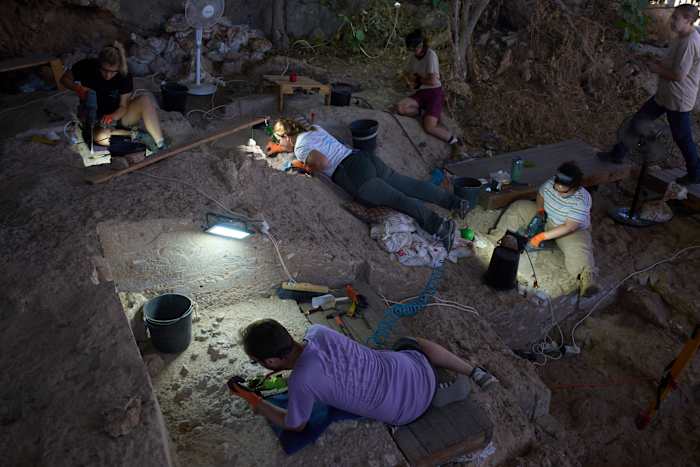
Using hand chisels and delicate, pen-sized pneumatic drills that resemble dental tools, archaeologists will need many more years to excavate the site. The field work, which started in 2016, is usually done over the summer months. This year, a dozen archaeology undergraduate and graduate students fanned out across the site, painstakingly documenting and removing each fragment of tool, object or bone.
At the entrance to the cave, the skull of one of the early humans is slowly emerging from the rock sediment; it will be years before it is fully excavated.
Tinshemet is exceptionally important to archaeologists because the local climate preserved the bones, tools, and ornaments in good condition, unlike many other parts of the world where these items were lost to time, said Christian Tryon, a professor at the University of Connecticut and a research associate at the Human Origins Program at the Smithsonian Institution, who was not involved in the study.
The skeletons and objects were so well preserved because of ash from frequent fires, likely for rituals. This large amount of ash mixed with rainfall and Israel’s acidic limestone, creating optimal conditions for perseveration. One skeleton was in such good condition archaeologists could see how the fingers were interwoven, hands clasped beneath the head.
A window into a little-known period
Tryon said the Tinshemet findings are bolstering earlier discoveries from two similar burial sites dating back to the same period in northern Israel — Skhul Cave and Qafzeh Cave. Skhul Cave was excavated almost 100 years ago, and Qafzeh Cave mostly around 50 years ago, when archaeological practices were more haphazard.
“There were so many uncertainties with those sites, but this is confirming it’s a pattern we know, and they’re really nailing down the dates,” Tryon said.
Tinshemet has helped archaeologists conclude that burial practices started to become more widespread during this time, representing a shift in how early humans treated their dead.
Some archaeologists believe intentional burials started earlier. In South Africa, the Homo naledi species – an ancient cousin of Homo sapiens – may have been intentionally placing their dead in caves as early as 200,000 years ago. But many archaeologists said the findings are controversial and there is not enough evidence to support the claim of intentional burials.
A bridge between peoples
In ancient times, Israel was a bridge between Neanderthals from Europe and Homo sapiens from Africa. Archaeologists have identified other subgroups of early humans in the area, and believe the groups interacted and may have interbred.
Experts have been studying the two full skeletons brought from Tinshemet for years, but it’s still unclear if they were Neanderthals, Homo sapiens, a hybrid population or another group altogether.
The mix of subgroups created opportunities for different groups of early humans to exchange knowledge or express identity, said Zaidner. It’s around this time that archaeologists first see examples of early jewelry or body painting, which could be ways early humans started outwardly belonging to a certain group, drawing boundaries between “us” and “them,” he said.
Israel Hershkovitz, a physical anthropologist at Tel Aviv University and the co-director of the Tinshemet site, said the concept of cemeteries in prehistoric life is important because it symbolizes “a kind of a territory.”
He said that same kind of claim over land where ancestors are buried still echoes in the region. “It’s a kind of claim you make to the neighbors, saying ’this is my territory, this part of the land belongs to my father and my forefather’ and so on and so on.”
Copyright 2025 The Associated Press. All rights reserved. This material may not be published, broadcast, rewritten or redistributed without permission.


