

WASHINGTON – House Democrats have achieved their strongest general election performance in decades, capturing at least 259 seats in a sweep not seen since 1990. The victory offers the party broad opportunities to govern while creating significant pressure to fulfill its campaign promises and priorities.
Democrats have gained 45 House seats from their Election Day starting point, surpassing the 40 seats they won in President Donald Trump’s first midterm election in 2018.
The party reached 259 seats Tuesday when Democrat Victoria Broderick defeated Republican Rep. Scott DesJarlais in Tennessee. Three House contests remain unresolved: one in Minnesota and two in Louisiana, where December runoff elections are scheduled.
Republicans are assured of at least 173 seats in the minority.
The result in the 435-member House will produce divided government, with Democrats also controlling the Senate while a Republican occupies the White House. Energized Democrats are preparing a 100-day agenda focused on the high cost of living, even as they plan an expansive oversight effort aimed at Trump during the remainder of his second term.
The Democratic majority will be larger than any the party has won since Bill Clinton’s first presidential election in 1992, when Democrats secured 258 seats, or Barack Obama’s 2008 victory, when they won 257. It will nevertheless fall short of the Franklin D. Roosevelt era, when Democratic House majorities exceeded 300 seats.
The result brings both major opportunities and formidable challenges.
“Like, hell yeah, we should feel pressure,” said Democratic Rep. Jason Crow of Colorado, a former Army Ranger.
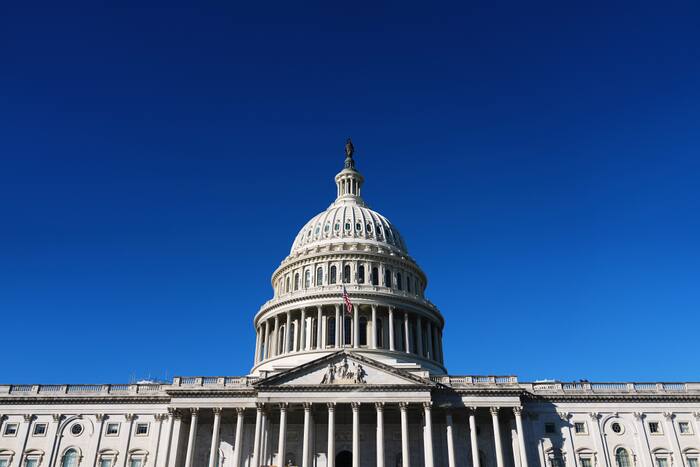
“There are people dying in this country and people losing their healthcare, losing their livelihoods, losing their farms, being terrorized from ICE,” he said earlier this month at the Capitol, referring to U.S. Immigration and Customs Enforcement. “If you don’t feel a sense of urgency and pressure in this job, and a desperation to deliver for folks, then you don’t belong under this Capitol dome.”
Election rout creates a mandate to govern
The results highlight the extraordinary reach of the Democratic gains, which extended from heavily Republican states to the Midwest and East Coast. Voters angered by high prices and the Iran war, and concerned about corruption, delivered a clear rebuke to Trump.
When Democrats take control of both chambers in January, they will do so with a voter-backed mandate and high expectations to produce results. Senate Democrats won a 56-seat majority in the 100-member chamber, their strongest advantage in more than a decade.
As part of their 100-day plan, Democrats intend to hold quick votes to reverse Republican cuts to Medicaid and restore Affordable Care Act tax credits that Republicans allowed to expire.
Democrats also have pledged to use their subpoena authority and launch numerous investigations to reinforce Congress’ role as a check on presidential power. Their plans include examining how Trump and his family have increased their wealth since he returned to office. Democratic leader Hakeem Jeffries of New York, who is expected to become House speaker, has not ruled out pursuing a third impeachment of Trump.
“This is a historic moment for our country. This is one of the largest classes we have seen,” progressive leader Rep. Alexandria Ocasio-Cortez, D-N.Y., said at the Capitol.
She described the party’s numbers as “a mandate for change.”
Rep. Tom Suozzi, a centrist Democrat from New York and a professional accountant, said House Democrats should devote 75% of their attention to affordability and 25% to accountability.
“Everything should be tied back to the people — and how it’s affecting the people,” he said.
For instance, he said, investigations into Trump’s financial dealings should explain the direct consequences for Americans. “How does that affect people’s pocketbooks?”
The White House has warned Democrats against their planned investigations of the administration, even suggesting that such probes — a routine part of Congress’ oversight responsibilities — could constitute “blatant criminality.”
A new generation of leaders
House Speaker Mike Johnson, R-La., struggled to keep the chamber operating over the past two years because his narrow, single-digit majority allowed only a handful of Republican lawmakers to derail the party’s agenda. Democrats will enter with a much wider margin, giving their leadership considerably more room to act.
Jeffries, who could make history as the first Black speaker of the House if elected by his colleagues on Jan. 3, 2027, will be able to lose dozens of Democratic votes on individual measures and still reach the 218 votes required for passage against Republican opposition.
“We’re not a monolith — people come to the caucus with different ideas — it’s OK,” said Rep. Troy Carter, D-La., who is expected to lead the Congressional Black Caucus.
Republicans saw their House representation fall to one of the lowest levels in decades. Their numbers are well below the end of the Obama administration, when Republicans won 247 seats in the 2014 election, and the rise of Newt Gingrich, when the party captured 230 seats in 1994.
Rep. Jim Jordan of Ohio, whom his colleagues elected as the Republican minority leader, vowed that the party would fight to regain power.
“Over the next two years, House Republicans will fight for American families,” Jordan said.
The GOP’s record House majority came in the 1920 election, when Republicans won 301 seats.
___
Follow the AP’s coverage of the 2026 elections at


