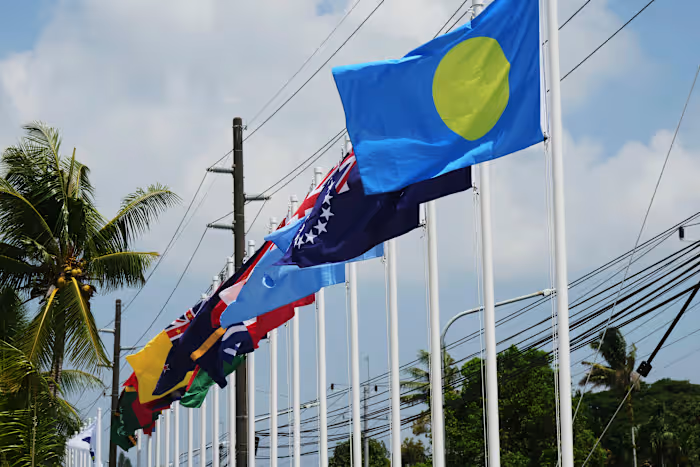


KOROR – A world away from the power corridors of New York or Davos, leaders from some of the planet’s smallest nations are gathering in Palau, a quiet tropical archipelago without a single traffic light. As delegates from dozens of countries arrived for the Pacific Islands Forum Leaders Meeting, the host nation’s population was expected to rise from about 18,000 to 20,000.
Before the summit’s official opening on Monday, Palau’s president and other senior officials took to the island’s main road to collect trash. Across the country, barbers and tattoo artists got ready to drive visiting delegates, while student volunteers prepared to guide arriving dignitaries.
Yet behind the meeting’s unmistakably Pacific rhythm — where discussions move at their own pace and decisions are reached by consensus rather than formal votes — a tense geopolitical argument is gathering force over who will help define the future of the vast ocean region.
In recent years, major powers with interests in the Pacific have moved quickly to strengthen ties with island leaders, deepening a struggle for influence involving China, the United States, Taiwan, and forum members Australia and New Zealand. Those competing overtures have at times exposed divisions within the forum itself, raising the risk of annual gatherings being disrupted by outside rivalries.
“The Pacific is our home, not a theater for geopolitical competition,” Palau’s President Surangel Whipps Jr. told reporters Sunday. He called on the larger countries closely watching the week’s meetings not to intrude on discussions he wants focused on the urgent challenges facing small Pacific island nations, including climate change and fragile economies.
“Let’s not use this as a place that we should be threatening or making people feel uncomfortable,” Whipps added. But keeping geopolitics at bay may prove difficult.
Small island nations have become crucial partners
The Pacific Islands Forum is made up of 18 member countries and territories, some with populations of only a few thousand or tens of thousands. Long viewed by many outsiders mainly as idyllic vacation destinations, several also control vast and valuable exclusive economic zones rich in fisheries and seabed minerals. Their positions across the Pacific have become increasingly strategic as global tensions sharpen.
While Forum countries often reference a “Pacific family,” members come from diverse cultures and political systems and their remote locations mean few opportunities for leaders to speak in person. The annual leaders’ summit was once a relaxed and casual affair, where officials from countries with little power in the global order sought to amplify their voices by reaching unified positions, particularly in urging bigger countries to curb greenhouse gas emissions as rising seas began to threaten low-lying atoll nations.
As major powers over the past decade have escalated their efforts to secure access to Pacific waters and ports by inking security deals and offering funding, immigration access to their countries and other sweeteners, the leaders’ ability to speak with one voice at their annual summit has come under pressure.
“We see examples of this where that consensus-based model, which is referred to as the Pacific Way, can sometimes lead to a bit of paralysis in taking action,” said Oliver Nobetau, Pacific Islands program director at the Lowy Institute, an Australian think tank.
Pacific nations face worsening climate and fuel shocks
In a recent episode, the Forum’s foreign ministers failed to reach consensus on a statement criticizing Beijing’s launch of a ballistic missile into the South Pacific Ocean in July. While most member states strongly opposed China’s actions, the refusal of two to endorse a statement saying so meant none was issued.
“At this point in time when Pacific Islands are facing a lot of acute security issues, decision-making is paramount for this one,” Nobetau said. “We’ll be looking to see if President Whipps can sort of steer the forum to take tangible action.”
Among the issues vexing Pacific island nations are the effects of the latest El Nino weather chaos, which has brought droughts and floods across the region. The volatile weather threatens food security and access to clean water, already vulnerable in island nations dependent on imported goods and funded largely by foreign aid.
Fuel volatility from the Iran war has also prompted some Pacific countries experiencing severe economic shocks to declare national emergencies in a region overwhelmingly reliant on imported diesel and gasoline, arriving via a fragile supply chain.
Whipps this week suggested that the wealthy countries seeking involvement in the region could open their wallets to finance the widespread establishment of solar power capabilities across the region.
“What are they doing together with us to partner to get a 100% renewable Pacific?” Whipps said.
Conflict over members’ alliances is expected
However, some of the powers at loggerheads over the region were always going to see this year’s summit as a showdown. Palau is one of just 12 countries worldwide to recognize Taiwan, incurring the ire of Beijing, which sees Taiwan as part of its territory.
It also sits at the nexus of other great power struggles. Located in the western Pacific Ocean, next to the Philippines, Palau draws from the Asian tourism market and has closer ties to the United States than much of the Forum’s members. A Compact of Free Association allows defense and security access for the U.S. in Palau’s territory in exchange for tens of millions of dollars in U.S. funding each year.
Palau’s turn as host also comes as the summit’s leaders try once more to draw up a structure governing how other countries are permitted involvement in its meetings. Countries approved to engage in the Pacific Islands Forum, including the United States and China, are known as dialogue partners, while Taiwan holds separate status as a development partner.
Beijing has ramped up pressure on forum hosts to exclude Taipei’s envoys from the annual summit, a dispute that grew so fractious ahead of the 2025 event in Solomon Islands that all countries except member nations were entirely barred from attending. Palau’s warm diplomatic relations with Taipei have this year drawn the attendance of Taiwan’s Foreign Minister Lin Chia-lung and provoked a warning from Beijing that China would oppose Taiwanese officials’ participation.
That in turn has prompted exasperation from some officials and Pacific-watchers at the prospect of another summit overshadowed by rivalry between non-member countries. Early arrivals over the weekend were roiled by the news that one leader, Solomon Islands Prime Minister Matthew Wale — a newly elected leader more friendly to Australia than the more Beijing-aligned leader before him — had returned home just hours after arriving because an opponent had mounted a leadership challenge.
It wasn’t immediately clear how much his forced departure, and the absence of others such as Kiribati’s President Taneti Maamau, whose country’s China ties have warmed during his tenure, could be attributed to unease about the summit’s geopolitics.
“You’d be defying gravity and logic if you said it wasn’t a big problem,” New Zealand Foreign Minister Winston Peters told reporters in Koror on Sunday, referring to bids for foreign interference in the event.
The leaders’ non-attendances were “seriously disappointing” and did not help, Peters added.
“But in the main the delegations are of the highest standard,” he said. “So let’s see how we go.”