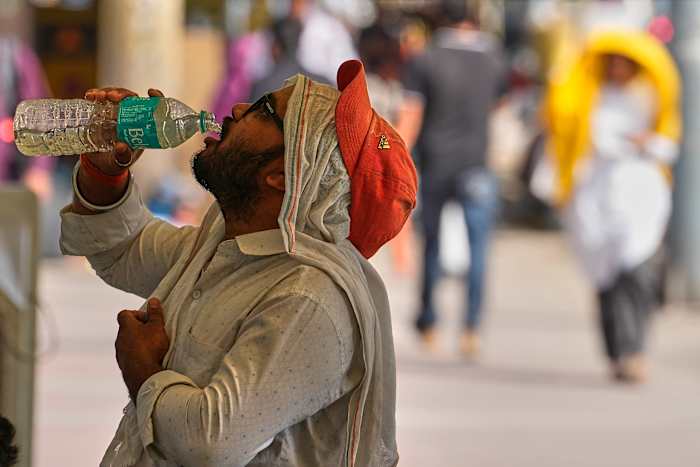


NEW DELHI – As a powerful heat wave engulfs vast areas of India, roads and markets have noticeably cleared during the afternoons, with some farmers opting to work under the cooler night skies to escape the intense heat.
On Thursday, the India Meteorological Department predicted that temperatures in New Delhi would soar to around 45 degrees Celsius (113 degrees Fahrenheit). In response, local authorities have established temporary “cooling zones” across the city to aid residents in managing the stifling conditions.
The weather agency has issued warnings that several northern regions will continue to endure this heat wave, with temperatures remaining significantly higher than normal for this time of year. Officials have advised the public to remain indoors during peak heat hours and to take necessary precautions to avoid heat-related health issues.
India classifies a heat wave as conditions where temperatures exceed 40 degrees Celsius (104 degrees Fahrenheit) in the plains or 30 degrees Celsius (86 degrees Fahrenheit) in the mountainous areas.
The severe heat is causing widespread disruption to everyday life in numerous northern states.
The extreme heat has disrupted daily life across several northern states.
In some parts of Uttar Pradesh state, India’s most populous, roads and markets have closed in the afternoons as people stayed indoors while some traders shifted work to early mornings. Farmers began working at night because daytime conditions became unbearable.
The heat also disrupted schools, with authorities in several areas announcing early summer vacations and suspending classes as the maximum temperature shot up to 48.2 C (118.8 F) on Tuesday in the city of Banda.
Health authorities urged people to avoid going outdoors during peak afternoon hours, stay hydrated and seek medical help if they experience symptoms such as dizziness or high fever.
Cooling shelters offer relief
In New Delhi, residents and tourists sought relief from the heat inside cooling shelters set up across the capital. The shaded space provides air coolers, fans, drinking water and oral rehydration solutions to help people deal with the extreme heat.
Inside one tent on Wednesday, people rested beside air coolers as officials distributed cups of water mixed with rehydration salts.
“We had come here for outing. But it is too hot here. The cooling system here is good for us,” said Basharat Ahmad Malla, a 25-year-old tourist.
Extreme heat tied to global warming
Climate experts say India’s rising temperatures are part of a broader global pattern linked to climate change.
India has faced more frequent and intense heat waves in recent years, with all of its warmest years on record occurring in the last decade.
“India has warmed considerably as a result of anthropogenic (human-made) climate change in the last decade compared to previous years. Northwestern India has warmed much faster than many other parts of the country,” said Anjal Prakash, author of several United Nations climate reports and professor of public policy at Pune-based Flame University.
Prakash said India is accustomed to summer heat but “climate change is loading the dice towards extreme and pervasive episodes like those we see now.”
Studies by public health experts found that up to 1,116 people have died every year between 2008 and 2019 due to heat. Public health experts say the true number of heat-related deaths is likely in the thousands, but because heat is often not listed on death certificates, many deaths are not counted in official figures.
___
Associated Press journalists Biswajeet Banerjee in Lucknow, Piyush Nagpal in New Delhi, and Sibi Arasu in Bengaluru, India, contributed to this report.