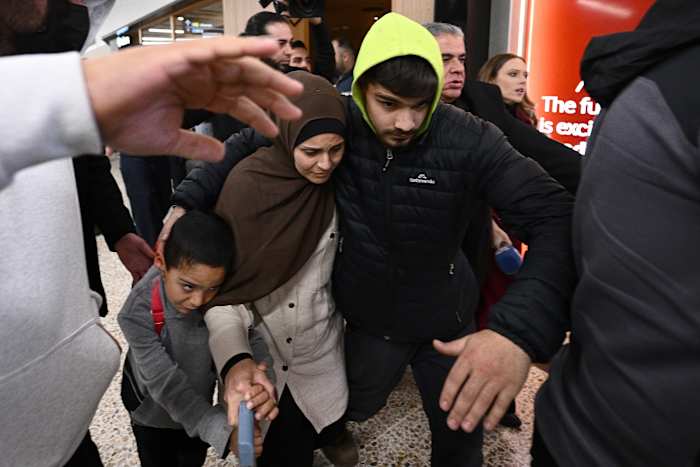


MELBOURNE – In a significant legal development, three Australian women have been formally charged with offenses related to slavery and terrorism. This follows their return from Syria, accompanied by ten others who police claim have connections to the Islamic State group.
These women, along with nine children, had been residing in the Roj Camp located in the Syrian desert for several years. Despite prior warnings from the Australian government about facing charges upon their return, they touched down on Australian soil via two separate Qatar Airways flights from Doha on Thursday.
Among those facing charges are Kawsar Abbas, 53, and her daughter Zeinab Ahmed, 31, who appeared in a Melbourne court on Friday. Police have accused them of purchasing a female Yazidi slave for $10,000, as detailed in a statement released on Friday.
Legal representatives for Abbas and Ahmed have indicated plans to seek bail for the pair in a hearing scheduled for Monday.
The allegations date back to 2014 when Abbas, along with her husband and children, traveled to Syria, which at the time was the epicenter of the Islamic State’s proclaimed caliphate. Authorities allege that Abbas was actively involved in acquiring the slave, who was subsequently kept within the family’s residence.
Abbas was complicit in buying the slave, who was kept in the family home, police allege.
The mother was charged with four crimes against humanity under Australian law, and the daughter was charged with two slavery crimes. Each charge carries a potential penalty of 25 years in prison.
Both women were detained by Kurdish forces in March 2019 and have been held with other family members at Roj Camp since.
Another 32-year-old woman was arrested at Sydney Airport and charged with being a member of a terrorist organization and with entering or remaining in a region controlled by a terrorist organization. Each charge carries a potential maximum sentence of 10 years in prison.
Police say she followed her IS-fighter partner to Syria. Australia made it illegal to travel to the former Syrian Islamic State group stronghold of Raqqa without a legitimate reason from 2014 to 2017.
She is expected to apply to be released on bail in a Sydney court later on Friday.
The Australian government has condemned the women for supporting Islamic State militants by traveling to Syria and refused to help repatriate them.
Police have been investigating Australians’ potential involvement in atrocities in Syria for more than a decade.
Another 21 Australian women and children remain in Roj Camp in northeast Syria near the Iraq border. Their supporters have told reporters they intend to repatriate them within weeks.
One of those women is banned from returning to Australia by a temporary exclusion order.
Australia can use such orders to prevent high-risk citizens from returning for up to two years.
The orders were created by laws introduced to in 2019 to prevent defeated IS fighters from returning to Australia. There are no public reports of an order being issued before.
Such orders can’t be made against children younger than 14. But Australia has ruled out separating children from their mothers.
Australian governments have repatriated Australian women and children from Syrian detention camps on two occasions. Other Australians have returned without government assistance.


