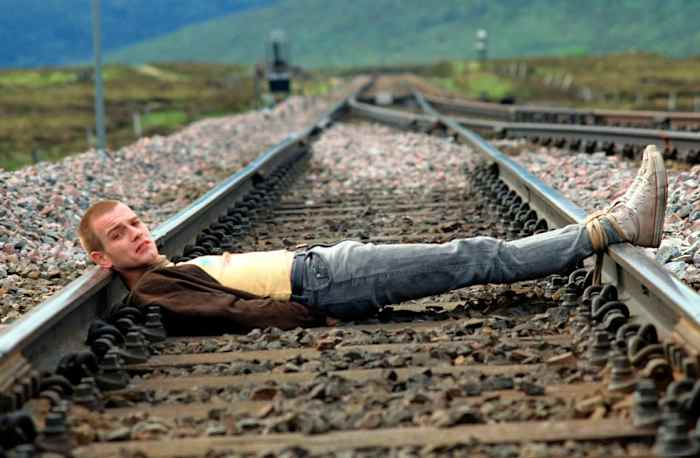


Ewan McGregor experienced a brief taste of rock star fame following the release of “Trainspotting.” This surge of popularity wasn’t due to his debut in filmmaking, nor was it his first collaboration with director Danny Boyle. Yet, at the time, McGregor admits he carried a certain level of arrogance and self-assuredness. The film, a dynamic portrayal of four heroin addicts in late-1980s Scotland, became a landmark not only in his career but also in cultural circles, offering him a glimpse into genuine artistic fulfillment.
Reflecting on this pivotal project, McGregor shared with The Associated Press, “It’s a cornerstone of my early career, and even now, arguably the most significant work I’ve been part of. It profoundly impacted my life—not just due to its success but because of the experience of creating it. It unknowingly set a high benchmark that’s been challenging to reach again.”
As the 30th anniversary of “Trainspotting” approaches, both McGregor and Boyle find themselves reminiscing about that transformative period and their cinematic achievement. Beginning Friday, audiences nationwide will have the chance to revisit the film in theaters, thanks to a 4K digital restoration. Although deeply rooted in its era with a Britpop soundtrack and Thatcher-era backdrop, its dark humor and poignant highs and lows have ensured its legacy endures.
“Young people, even those as young as 17, still approach me saying they’ve just discovered it,” Boyle remarked. “I could easily be their grandfather, yet the film continues to resonate with them.”
As they celebrate this milestone, McGregor and Boyle are also reflecting on a time when Hollywood was momentarily set aside, allowing them to create something uniquely timeless.
Putting Hollywood on hold
Boyle was a hot commodity after “Shallow Grave,” a 1994 black comedy about flatmates in Edinburgh starring McGregor, and Hollywood was calling. Literally. A peak-famous Sharon Stone cold-called him and asked if he’d want to come make a film with her. But he had his sights set on Irvine Welsh’s buzzy debut novel, teaming once again with screenwriter John Hodge and producer Andrew Macdonald.
The budget would be small, 1.5 million pounds or about $1.9 million, and the shoot would be quick and local. They didn’t know what they didn’t know: Boyle remembers asking his cinematographer, the late Brian Tufano, if they could use an anal probe camera for the “worst toilet in Scotland” scene.
“I remember him saying, ‘Well, Danny, yes, you can get that. But I’m not sure how Ewan and his family and agent will feel about that,’” Boyle said with a laugh. “He tempered my kind of extreme way of approaching this material.”
And somehow it all worked, driven by youthful energy, a bit of arrogance and a passionate commitment to the material.
‘It would have been a disaster if it had been done differently’
“‘Trainspotting’ had to be made that way,” said McGregor, who was 23 at the time. “It would have been a disaster if it had been done differently.”
For McGregor, at least part of the vitality came from the fact that they were shooting on film; money was going through the camera on every take.
“We shoot on these cards now, and it just doesn’t matter anymore,” McGregor said. “There’s no natural sort of like rhythm to filmmaking like there used to be then. … I think back to ‘Shallow Grave’ and ‘Trainspotting’ and it feels almost like a different job.”
Boyle too has been chasing that kind of innocence ever since. He said he might have come close on his upcoming film “Ink,” with Jack O’Connell.
“It was liberating not having enough money because you don’t have that limitation of thinking, oh, that’s going to be too extreme for the studio or for the audience reach we’re meant to have,” Boyle said. “You could make it so that if it didn’t work, you just, you know, sulk away with your tail between your legs and call back Sharon Stone and say ‘I was wrong.’”
The rock star moment
Like any film about drugs, there was a fair amount of discourse around its release. U.S. presidential candidate Bob Dole even denounced it, unseen, for romanticizing heroin during his campaign. But the film was in the conversation — and it had an enviable group of supporters, including Pulp frontman Jarvis Cocker and Blur’s Damon Albarn, both of whom provided songs for the film.
After “Trainspotting” became a hit, life changed profoundly for McGregor. In London, he said, “it was madness.” At the time he was sharing a flat with his co-star Jonny Lee Miller, Jude Law and Sean Pertwee. When they’d go out to clubs, they felt like rock stars.
“There was a real energy around it,” McGregor said. “We were part of that, you see, the Blur and Oasis and Pulp and The Verve and all of that amazing music that was happening then. We were the sort of movie version of it, I guess, because Danny knew what he was doing with the soundtrack and because the novel was so huge and current and … and maybe because it was ours. It was British and it wasn’t pandering to America. We didn’t make it for America.”
An absolute love of cinema
Boyle hopes that audiences take a chance on “Trainspotting” in the theater, whether they’re revisiting it or seeing it for the first time. It was, he said, made with an absolute love of cinema.
“It’s very indebted to ‘Goodfellas,’ which also has that feeling of: You are here to be absolutely assaulted by an experience,” Boyle said. “You know, you have given us your money and you’ve given us your time to be here for 90 minutes, two hours, whatever it is, and we promise, we promise to deliver everything to you that we can.”