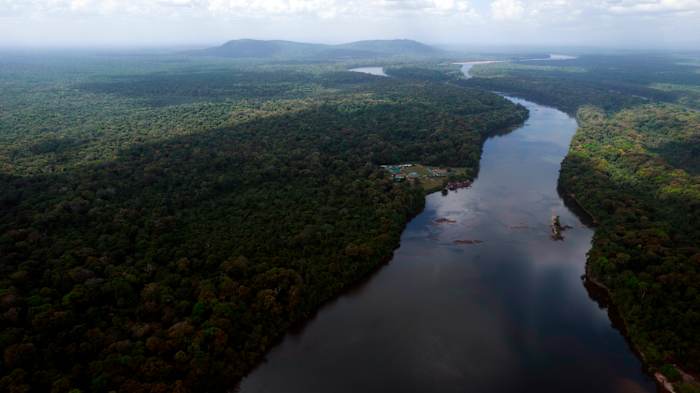


THE HAGUE – On Wednesday, Venezuela made a strong case before the International Court of Justice, asserting that a mineral-rich region claimed by Guyana was unjustly taken from them in the 1800s, describing it as an act of colonial exploitation. Venezuela argued that a 1966 agreement, not the UN’s highest judicial authority, should ultimately determine the rightful ownership of this contentious territory.
The Court is currently conducting hearings to address the claims of both South American countries over the Essequibo region. This area, abundant in gold, diamonds, timber, and other natural resources, is also strategically located near significant offshore oil reserves.
In 1899, a boundary was drawn by arbitrators from Britain, Russia, and the United States, favoring Guyana by aligning the border along the Essequibo River. At the time, the U.S. represented Venezuelan interests due to Venezuela’s severed diplomatic ties with Britain. Venezuela maintains that this arbitration was a conspiracy involving the Americans and Europeans to deprive them of their rightful territory.
Venezuela has long claimed Essequibo as part of its territory, tracing its rights back to the Spanish colonial era when the region was within its borders. The country argues that the 1966 Geneva Agreement was intended to address and rectify the injustices of the 19th-century arbitration.
“Guyana positions itself as the legitimate successor to British and Dutch territories, yet it profited from colonial dispossession through fraudulent arbitration. The Geneva Agreement aims to amend this historical wrong,” stated Venezuela’s representative, Samuel Reinaldo Moncada Acosta, before the international court.
Moncada Acosta emphasized Venezuela’s rejection of the court’s jurisdiction, which he described as “wrongly imposed” in a 2020 ruling. He asserted that the 1966 agreement provides a foundation for reaching a negotiated settlement.
As hearings opened Monday, Guyana’s Foreign Minister High Hilton Todd told the panel of international judges that the dispute “has been a blight on our existence as a sovereign state from the very beginning.” He said that 70% of Guyana’s territory is at stake.
The court, based in The Hague, is likely to take months to issue a final and legally binding ruling in the case.


