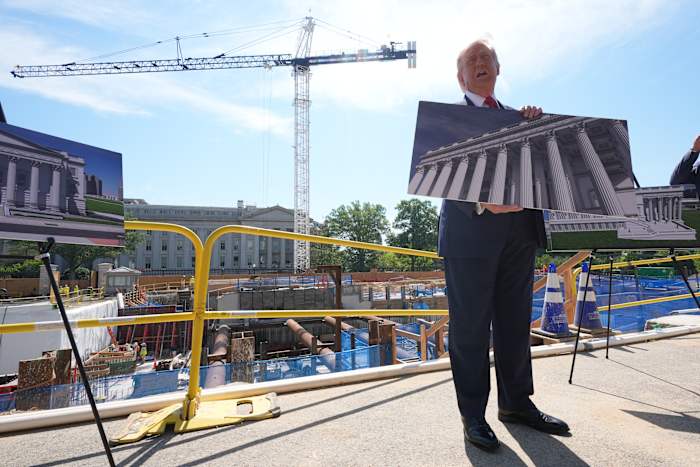

WASHINGTON – A contentious proposal to allocate $1 billion for security enhancements at the White House, including a new presidential ballroom, is encountering increasing resistance from Republican lawmakers. Despite advocacy from President Donald Trump and the U.S. Secret Service, the funding measure faces a crucial vote this week.
Republicans are working to amend the proposal following the Senate parliamentarian’s ruling on Saturday that it failed to meet the criteria necessary for inclusion in a bill aimed at funding immigration enforcement agencies. Even if adjustments satisfy parliamentary guidelines, backing for the initiative remains uncertain. Several Republican senators have voiced concerns about the security expenditure, while tensions between the White House and the Senate have intensified.
“Ultimately, it will depend on whether we have the votes to get it passed,” commented Senate Majority Leader John Thune, R-S.D., on Tuesday, indicating that the proposal’s fate hangs in the balance.
Thune noted that discussions are ongoing among Senate and House members, as well as with the White House, to shape legislation that aligns with the parliamentarian’s requirements.
Internal party opposition is a significant hurdle. Numerous GOP senators have expressed reluctance to endorse the proposal if it maintains the hefty $1 billion allocation for White House security.
Several GOP senators have said they are unlikely to support it if the bill contains the $1 billion price tag for White House security.
People “can’t afford groceries and gasoline and healthcare, and we’re going to do a billion dollars for a ballroom?” asked Louisiana Sen. Bill Cassidy, who lost reelection in the GOP primary on Saturday after Trump endorsed one of his opponents.
Cassidy said the proposal, which would pay for Secret Service training and a new visitor center at the White House along with security for Trump’s ballroom, is premature when there are still many questions about the project. The Trump administration hasn’t been able to provide Congress with engineering assessments, environmental evaluations or architectural work, he said.
“And by the way, the president has pledged to us that he would use private donations to pay for it,” Cassidy said.
Republican Sens. Rand Paul of Kentucky and Lisa Murkowski of Alaska have also suggested they might not support the security funding, among others who have said they have questions. Sen. Thom Tillis, R-N.C., has said he’s opposed if the proposal remains unchanged.
Security debate comes as Senate, White House at odds on other issues
The questions on the security funding and Trump’s ballroom come as Senate Republicans are trying to defend their majority in this year’s midterm elections and as Democrats are making affordability a central election issue.
“Americans can barely afford to keep a roof over their own heads,” Senate Democratic Leader Chuck Schumer, D-N.Y. “They should not be forced to pay for a golden roof over Trump’s head.”
And while most Republicans rarely break with Trump, there was more tension than usual between the Senate and the White House this week, including over the announcement of $1.8 billion court settlement to compensate Trump’s allies who believe they were targeted politically.
“I don’t see a purpose for that,” Thune told reporters Tuesday morning.
Hours later, Trump made a surprise endorsement in the Texas Republican primary, backing the opponent of incumbent Sen. John Cornyn — angering many GOP senators who had pushed him for months to endorse Cornyn.
“Not very enthusiastic” is how Murkowski described her own mood after Trump’s endorsement and the Republicans’ weekly conference lunch.
Sen. Jim Justice, R-W.Va., said he’s supportive of the security money and thinks it is necessary to protect the president. But he conceded that the optics aren’t very good for Republicans, and that they haven’t communicated about it very well.
“We’ve got people out there who are worried about how in the world they’re going to have enough gas to get home,” Justice said.
Security funding could be reduced, or revised
Republicans are considering reducing the amount of money for the White House security or narrowing the proposal significantly as they try to figure out how to win votes and win approval from the parliamentarian. They are using a complicated budget maneuver called reconciliation to bypass Democrats, who have blocked funding for U.S. Immigration and Customs Enforcement and Border Patrol for months.
Thune said that the immigration enforcement money is the “principal objective” of the legislation.
Once the measure is on the floor, the Senate will launch a long series of votes where Democrats can propose to strip out various parts of the bill.
The Homeland Security and Governmental Affairs Committee advanced the immigration portions of the $72 billion measure Tuesday morning in a committee meeting where Democrats who have demanded reforms at ICE and Border Patrol offered some five dozen amendments.
The GOP-led committee blocked all of the Democratic amendments, including requiring federal agents to display their last names and identification numbers on their uniforms and to secure a judicial warrant before breaking into a home.
___
Associated Press writer Joey Cappelletti contributed.