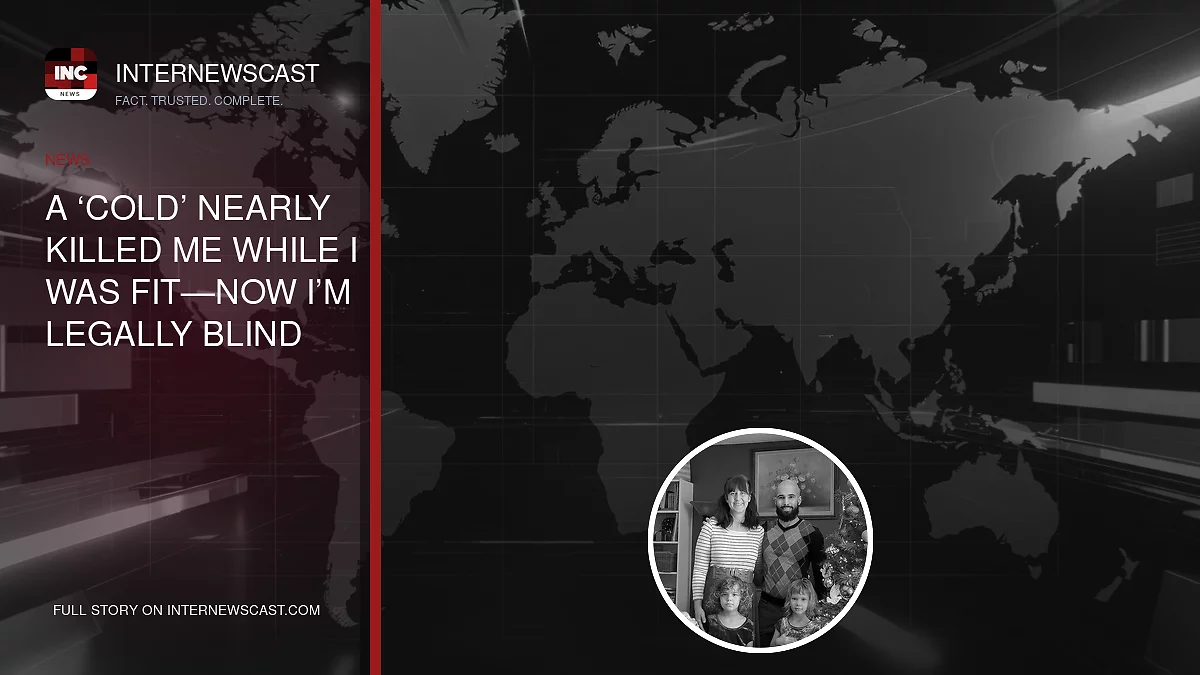

For years, Jared Maynard lived the kind of lifestyle most people associate with peak human fitness.
The Ontario, Canada, father of three was deeply committed to bodybuilding and powerlifting, often hitting the gym six days a week while also building a career as a physical therapist.
So when he developed what seemed like a minor cold in January 2023, Maynard assumed it was nothing his strong, healthy body could not handle.
Within days, however, the situation took a frightening turn: his skin began to yellow, and he started slipping into confusion and delirium.
A trip to the hospital led to extensive testing, and doctors soon discovered he was not battling an ordinary virus. Maynard had hemophagocytic lymphohistiocytosis, or HLH, a rare, aggressive and potentially fatal immune disorder in which the body’s defenses begin attacking its own organs.
The condition targeted his liver and kidneys, sending him into multi-organ failure. Physicians later concluded that his HLH had been triggered by the Epstein-Barr virus, a common infection best known for causing mononucleosis, or “kissing disease,” that can remain hidden in the body for many years. The rare disorder is deadly in about 40 percent of cases.
Maynard spent nearly two months on life support and in hospice care before making an unexpected recovery. But the ordeal left his body severely weakened, and muscle wasting forced him to spend another two months learning basic functions again, including how to walk, sit, stand, talk and breathe without assistance.
He believed the worst was finally behind him — until five months later, when he began losing his peripheral vision.

Jared Maynard is pictured with his wife and children before his battle with hemophagocytic lymphohistiocytosis

Maynard, pictured in the hospital in 2023, spent several weeks on life support and hospice before having to relearn how to do everything
‘I thought being on end-of-life care would be the last battle I had to face,’ the now 34-year-old said.
‘But the next one I literally couldn’t see coming.’
As a teen, Maynard had suffered night blindness, meaning his eyes had trouble adjusting to dark conditions, especially when driving. At 17, doctors told him he could not legally drive.
He was diagnosed at the time with choroideremia, a genetic eye disease affecting one in 50,000 Americans, or 6,000 people, most of whom are men.
The condition, caused by a mutation of the CHM gene on the X chromosome, causes progressive degeneration of the retina, the light-sensitive layer of tissue at the back inner surface of the eye, and the choroid, tissue at the middle of the eye’s wall.
For most patients, like Maynard, it starts with minor vision changes before eventually progressing to legal blindness, or severe vision loss that isn’t complete darkness.
‘It started off with night blindness. Then my peripheral vision was eaten away until only a narrow tunnel was left,’ he said.
Doctors had told him the condition likely wouldn’t progress until he hit his 50s or 60s. But they now believe his near-death battle with HLH accelerated the decline, potentially due to inflammation and cellular stress.
Now, Maynard believes it’s only a matter of time before his central vision vanishes as well.
‘I thought I had time,’ he said. ‘But everything declined faster than anybody expected. At 33, I suddenly couldn’t see my own computer screen. Not long after, my eye doctor said the words I was dreading out loud: “You’re legally blind.”
‘I’m only 34. I survived the disease that was supposed to kill me, only to find out that while I cheated death, I was blindsided in the process.’

Maynard, pictured above, is adjusting to his vision loss and is hoping to return to the competitive bodybuilding scene by the end of the year

‘Everything I do now runs on four words: you’re not done yet. That isn’t a promise that everything goes back to how it was. Some things don’t. Some scars stay,’ Maynard said
There is no cure for choroideremia, and treatments like gene therapy to manage progression are still experimental.
Maynard has recently purchased a white cane to help him get around and warn people of his vision impairment, though he is still getting used to it.
‘I was so scared of the noise it made that I barely touched it to the ground,’ he said. ‘Then I tripped over a bench I couldn’t see and went down in the middle of a packed airport.
‘I wasn’t just the blind guy anymore. I was the blind guy that face-planted in front of everyone. It was humiliating.’
But as he adapts to his normal, he’s not letting it break him. He is still working and uses assistive technology like screen readers to help him with day-to-day tasks. He is also in the process of getting a guide dog.
By the end of the year, he hopes to return to competitive bodybuilding.
‘Everything I do now runs on four words: you’re not done yet. That isn’t a promise that everything goes back to how it was. Some things don’t. Some scars stay,’ Maynard said.
‘But ‘done’ is only when you stop trying to become the person you want to be – and I’m nowhere near that.’


