For decades, restaurants have leaned on mouthwatering menu photos — cheese spilling from burgers, fries fried to a perfect crunch and oversized sandwiches stacked high — to tempt customers into ordering.
But a growing number of businesses are finding that a poorly chosen image can do more harm than good.
Restaurants, food trucks and cafes are increasingly using artificial intelligence to generate photos for menus, flyers and social media promotions, only to see diners react with discomfort to the oddly glossy, surreal and sometimes unsettling creations.
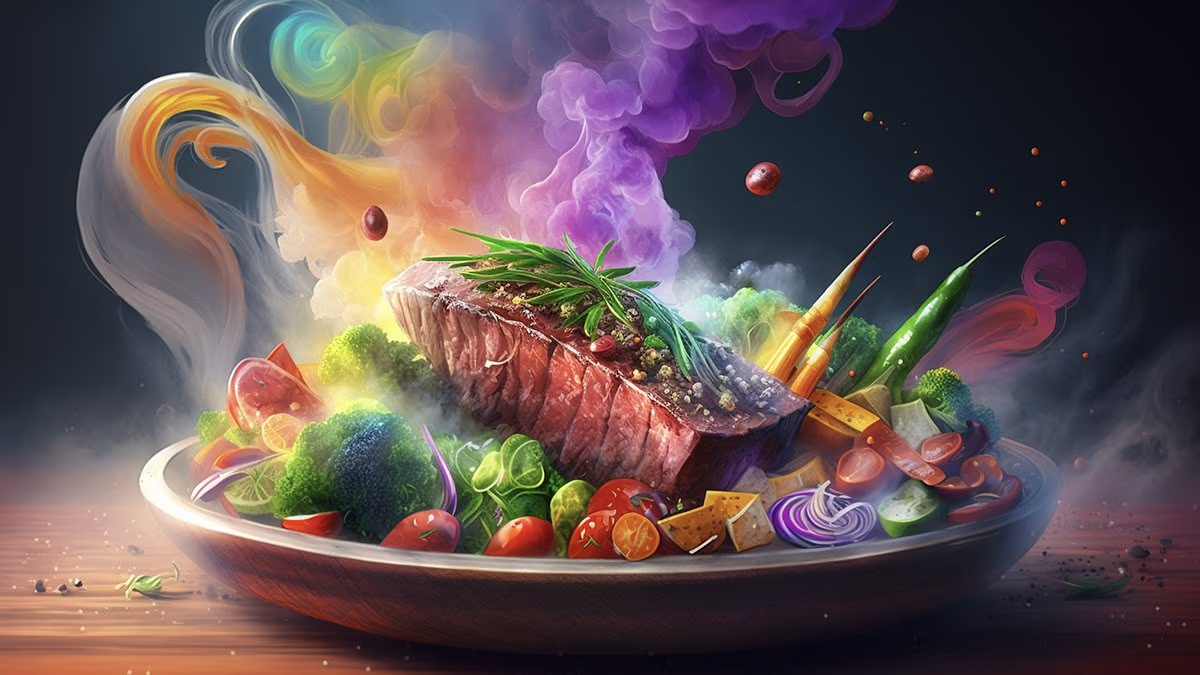
At a quick glance, the images can seem close to real. A second look tells a different story: meat with an unnatural surface, pasta that appears rubbery, shrimp shaped like unfamiliar creatures and sauces that look as though they were squeezed on with industrial adhesive.
The trend has become so common across the internet that social media users have coined a blunt label for it: “AI food slop.”
Adaeze Onejeme, a 28-year-old advertising sales worker based in Los Angeles, said she recently noticed what she called an “AI flyer epidemic” during a visit to a Hollywood night market with her sister.
As they passed stalls selling loaded fries, taquitos and smoothies, she saw promotional images that seemed to show real dishes at first — until the details began to look wrong.
“I was like, ‘Those don’t look like chicken nuggets. Those don’t look like typical food that we eat,’” she told CNN.

Restaurants, food trucks and cafes are increasingly turning to artificial intelligence to create images for their menus and marketing – only for diners to recoil from the strange, shiny and sometimes downright disturbing results

Shrimp is not supposed to look like this! One Reddit contributor asked ‘Why can’t they just use the REAL FOOD?’
She filmed several of the stalls and shared the footage on TikTok, but ultimately bought fries and lemonade from vendors using traditional photographs.
‘Not too long ago, people would just take a picture of the food and that would be on the menu,’ she said.
‘Now, these AI-generated pictures – the saturation, the coloring, the texture. It’s like you don’t even know what you’re going to get when it comes out.’
That distrust can be particularly damaging for small restaurants trying to persuade customers to give them a chance.
One San Francisco family-run cafe found that out the hard way after using AI-generated food images in its storefront.
Grind & Unwind, which opened on the city’s iconic Haight Street in May, became the target of a social media backlash after displaying computer-generated pictures of its food and drinks.
Owners AJ and Lyndsey Lozano said the images were intended as a temporary marketing solution as they juggled opening a new business while raising three children under five.
Instead, critics branded the posters ‘AI slop’ and accused the cafe of misleading customers.

Grind & Unwind, which opened on San Francisco’s iconic Haight Street in May, found itself at the centre of a social media storm after displaying AI-generated images of its food and drinks

Owner Lyndsey Lozano said she had never imagined the AI-generated posters would provoke such a fierce reaction
The backlash eventually spilled from the internet onto the street. In July, the cafe’s awning was spray-painted with red graffiti, leaving the family facing a repair bill expected to exceed $700.
‘It was kind of a stir on Haight Street, which is good and bad, I guess,’ Lyndsey told SFGate. ‘But the response was not what we were expecting.’
Reddit users had already been merciless. One mocked the cafe’s focaccia by comparing it to a ‘loofah’ or a ‘lung’, while an iced coffee was joked to look as though it was wearing ‘fishnet stockings’.
Another commenter summed up the suspicion behind much of the backlash: ‘Any fake images on a menu make me think their actual food is not good enough to be shown.’
The cafe eventually removed the AI posters on July 6 and replaced them with displays featuring its real pastries. Its homemade banana bread and chocolate chip cookies have reportedly been selling out regularly.
The problem with AI food imagery goes deeper than simply making an ugly picture.
Alexander Diel, a psychologist at Germany’s University of Duisburg-Essen who has studied people’s responses to AI-generated food images, says humans are particularly sensitive to food looking wrong.
‘Food is important to us,’ he explained to CNN. ‘At the same time, it’s something that can easily make us sick, so we are very sensitive to when something is even slightly off.’
That may explain why an AI-generated person with an extra finger can seem amusingly bizarre, while a strangely rendered sandwich can provoke something much closer to disgust.
Researchers believe this reaction may be linked to the evolutionary purpose of disgust, which helps humans avoid potential contamination, disease and decay.
Diel and his colleagues have found that slightly imperfect AI food images can be perceived as more ‘uncanny’ and less pleasant than both obviously unrealistic pictures and genuine food photography.
There is also the famous ‘uncanny valley’ effect – the discomfort people can experience when something looks almost, but not quite, real.

Imperfect AI food images can be perceived as more ‘uncanny’ and less pleasant than both obviously unrealistic pictures and genuine food photography.
Food appears to fall directly into that uncomfortable territory. New York food photographer Emily Hawkes says customers have an instinctive ability to recognise when something appetising is genuine.
‘There’s something wrong, and you might not be able to put your finger on it, but you know it when you see it,’ she said.
For restaurants, however, the financial temptation is obvious.
The industry is under intense pressure, with the National Restaurant Association reporting that 42 percent of operators said their businesses failed to turn a profit in 2025. It also found that 26 percent of restaurant operators were using AI, with marketing among its most common applications.
For a cash-strapped small business, generating an entire menu of images in seconds can look far more attractive than hiring a professional photographer.
But diners may not see it as clever marketing.
One Reddit user said they would rather see ‘a blurry cell phone picture’ because at least it proved the restaurant actually had the food.
Another asked the question that perhaps sums up the entire backlash: ‘Why can’t they just use the REAL FOOD?’
And that may be the biggest danger of all.
Instead of making customers hungry, a bizarre AI image can leave them wondering what the restaurant is trying to hide – and whether the real food will be any better than the nightmare staring back at them from the menu.
As Hawkes put it: ‘A thoughtful photo of your food with your iPhone is going to be better than whatever AI is going to generate because it’s your food.’
For hungry customers, it seems that imperfect and authentic may still beat artificial perfection every time.