
US defence officials have warned that the military is facing ammunition shortages following its conflict with Iran, contradicting President Donald Trump’s repeated claims that American weapons stockpiles remain fully replenished.
A report submitted to Congress on Monday estimated that Operation Epic Fury (OEF) cost $33.4 billion (£24.8 billion) between February 28 and June 30. Of that total, approximately $22.3 billion (£16.5 billion) was spent on munitions used during the campaign.
“The munitions expenditure on OEF has resulted in strategic inventory shortfalls and revealed industrial base bottlenecks for munitions resupply,” the inspector’s report stated.
Operation Epic Fury is the name used by the US for its joint military campaign with Israel, which US Central Command (CENTCOM) said was intended to “destroy Iran’s ability to project military power.”
The Pentagon said it is attempting to address the shortages by speeding up procurement and manufacturing timelines while building reserves of essential materials, components and selected weapons, according to the report.
However, officials cautioned that increasing production capacity is a complex process that requires “significant lead time.”
The reported shortages could alarm countries such as Ukraine and Taiwan, both of which depend heavily on US arms sales as they confront, or seek to deter, significantly larger adversaries.
Ukraine is seeking additional interceptor missiles for the US-made Patriot air defence systems deployed in its war with Russia. Taiwan, meanwhile, relies on weapons agreements with Washington as it attempts to deter China, which claims the self-governing island as part of its territory.

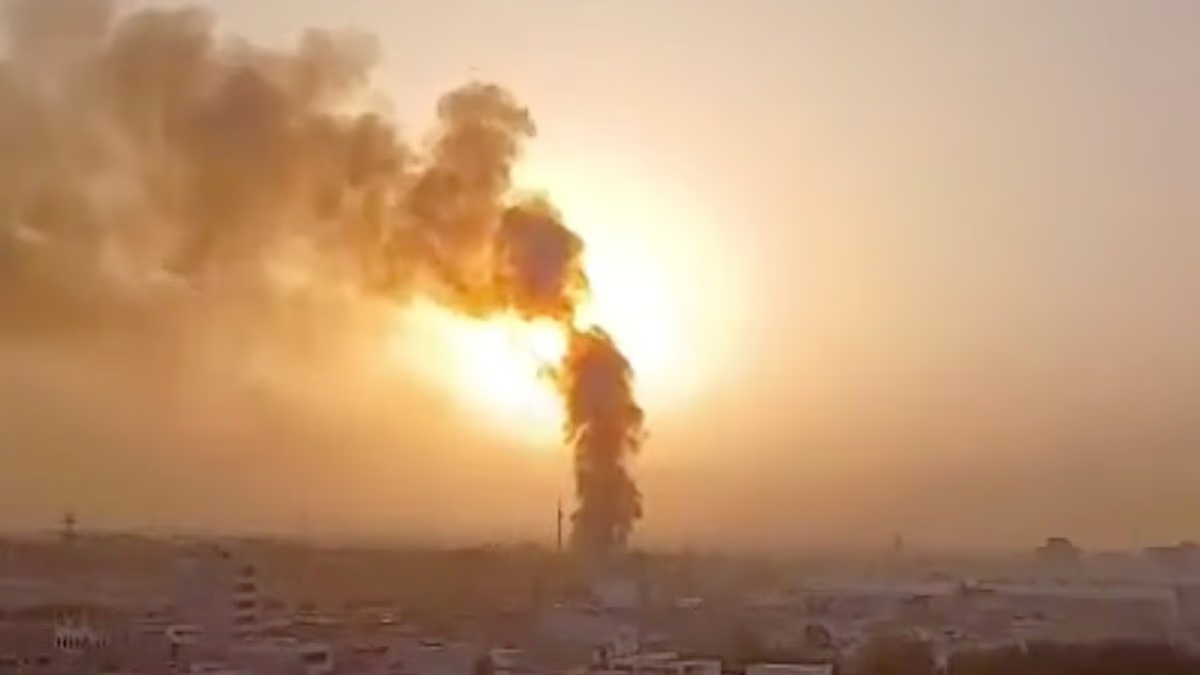
Smoke billows over Iran following reports of multiple US strikes on Ahvaz, in Khuzestan Province, in July.

Heavy structural damage can be seen at a destroyed residential building on Iran’s Qeshm Island in Hormozgan Province on Friday.
American Aircraft and Drones Lost During Iran War
Trump has repeatedly dismissed warnings that the six-month conflict in the Middle East has drained US weapons reserves. He recently claimed that America possesses “virtually unlimited” ammunition.
In a post on Truth Social on Monday, the president also said the US was producing “more Exquisite and Elite Weapons than at any time in our History.”
CNN previously reported that shortages of long-range precision missiles and air-defence interceptors had influenced Trump’s military strategy toward Iran. The US military was said to have used almost 80 per cent of its THAAD interceptor stockpile.
CENTCOM has said American forces struck more than 1,000 targets during the opening 24 hours of the war with Iran. The military has not carried out attacks on that scale again in the months since.
The report also detailed losses and damage to US aircraft, including four destroyed F-15 fighter jets, one damaged F-35, seven damaged KC-135 tanker aircraft and as many as 30 MQ-9 Reaper drones destroyed.
It also confirmed that the US Navy’s main logistics hub in the region, located in Bahrain, had been targeted by Iran with drone and ballistic missile strikes.
Hundreds of buildings and structures at US bases in Kuwait, Bahrain, Qatar, the United Arab Emirates, Saudi Arabia, Iraq, Oman, and Jordan have been damaged or destroyed by Iranian strikes during the conflict.
The report does not include those costs in its estimates, saying it is not yet clear if all the bases will be rebuilt, or who will foot the bill.

A sailor handles munitions on a flight desk of the USS George Washing in the Arabian Sea on Sunday.
US Military Toll Mounts During Iran Combat Operations
As of June 30, seven US service members had been killed in action and seven killed in non-hostile events during OEF combat operations, the report said.
An additional 417 service members were wounded in action, it added.
The US and Israel launched the war against Iran on February 28. For decades, Western powers have accused the Islamic republic of seeking nuclear weapons, a claim that Tehran categorically denies.
It comes as pump prices in the UK have hit new Iran highs as a result of the conflict. The cost of diesel reached 191.68p on Monday, while petrol was up to 169.68p, according to the RAC.
Those are the highest levels since August 2022, soon after Russia’s full-scale invasion of Ukraine. The motoring group warned that diesel is closing in on the all-time record of 199.05p set in June that year.
Oil prices have been surging again amid fears that Saudi Arabia could run out of export stocks in a matter of days if it does not repair a bombed pipeline.


Drone Attack Badly Damages Saudi Arabia’s Key Oil Pipeline
Satellite images have revealed the extent of the damage to the 745-mile east-west oil pipeline after drones were launched from Iraq on Thursday, with a pumping station appearing badly charred.
The pipeline has helped Saudi Arabia – the world’s largest crude oil exporter – bypass the Strait of Hormuz by re-routing around four million barrels a day to the port of Yanbu on the Red Sea.
Riyadh decided to shut the key pipeline following the attack, threatening the loss of 4 per cent of global supplies and driving the price of crude higher.
If the pipeline remains shut, existing stocks at Yanbu could only support exports for around five to seven days, industry sources told Reuters.
The global energy market is already under severe strain after the Iran war triggered the closure of the Strait of Hormuz, through which a fifth of the world’s oil and gas normally flows.