
Wendell Huang, chief financial officer of Taiwan Semiconductor Manufacturing Co. (TSMC), speaks during a news conference in Taipei, Taiwan, on Thursday, July 16, 2026.
Bloomberg | Bloomberg | Getty Images
TSMC is moving quickly to ramp up production capacity at its Arizona facility as customer demand continues to reflect what Chief Financial Officer Wendell Huang described to CNBC as a “multi-year demand mega trend.”
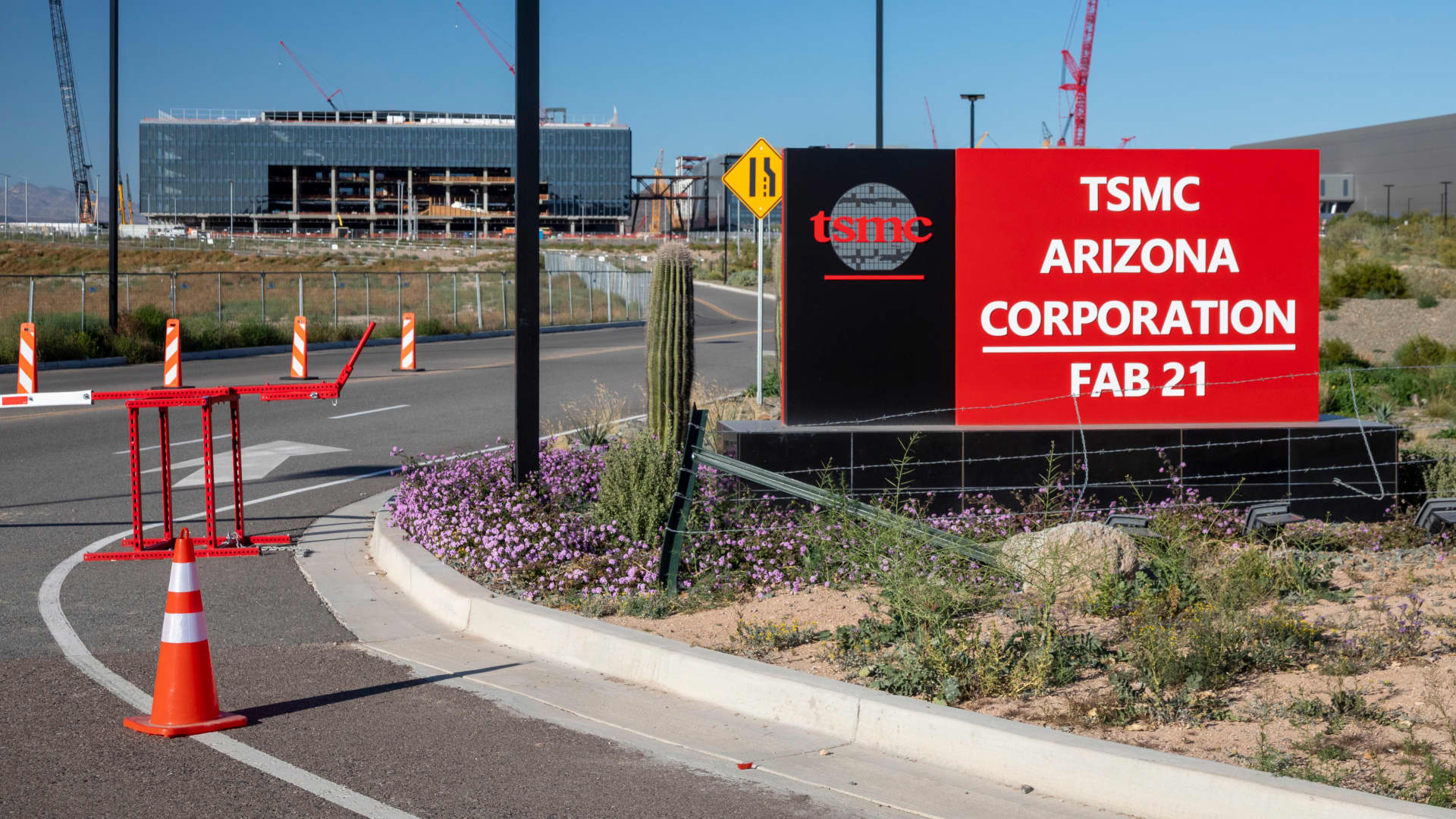
TSMC, or Taiwan Semiconductor Manufacturing Co., is expanding its already massive Arizona investment with an additional $100 billion commitment, a move aimed at sharply increasing its U.S. chip manufacturing presence as long-term structural demand for artificial intelligence accelerates.
The new pledge brings TSMC’s total Arizona investment pipeline to $265 billion, highlighting the scale of its AI-driven capacity expansion. The momentum has also prompted the company to raise its full-year capital expenditure forecast to a range of $60 billion to $64 billion.
In an exclusive interview with CNBC’s Emily Tan, Huang said the latest investment is being driven by strong demand from U.S. customers, along with significant support from the government.
“We’re seeing this strong-structure, multi-year demand, and we do not plan to leave any food on the table for anybody else,” Huang told CNBC. “As long as the megatrend is right, then we’re able to continue to deliver the profitable growth to our shareholders,” he said.
Surging demand
To keep pace with surging customer needs, TSMC is pushing to optimize its most advanced manufacturing capacity, Huang said, including a rapid shift from 5-nanometer production to the more advanced 3-nanometer node to better support clients.
The nanometer figure refers to the size of each individual transistor on a chip. The smaller the transistor, the more of them can be packed onto a single semiconductor. Typically, a reduction in nanometer size can yield more powerful and efficient chips.
When it comes to TSMC’s U.S. expansion, phase one, using 4-nanometer technology, is already up and running, the CFO told CNBC.
“It’s going to be bigger and bigger in the next few quarters,” Huang said, framing the 2-nanometer technology as the company’s newest revenue driver heading into the third quarter, following its initial revenue generation in the second quarter.
U.S. fab construction costs are four to five times higher than in Taiwan, however, Huang said that while the initial dilution will widen as the scale of overseas operations grows, the expansion will ultimately further foster the development of the U.S. semiconductor ecosystem.
“It will be both the front-end wafer fabs and back end advanced packaging fabs,” Huang said regarding the deployment of the fresh $100 billion investment.
TSMC shares ended the day up over 1% after it posted earnings, however shares slumped 7% on Friday. The stock is up around 48% year-to-date.

TSMC shares year-to-date.
Responding to the company’s share price performance, Huang said TSMC does not have any control over the financial markets. “What we can do is really to focus on fundamentals of our business,” he said, adding that while the sector faces hefty price increases in components, the company sees minimal impact due to its strategic focus on the high-end market.
Aside from market factors, TSMC is also managing its regulatory footprint. On China, Huang said that TSMC continues to comply with all export controls while serving its Chinese customers, who contribute about 8% of total revenue.
The chipmaker is expanding its focus toward future expansion drivers. Regarding the prospects of physical AI, he added that the company’s recent joint venture with Sony for image sensors is part of its strategic commitment to supporting long-term customer growth in specialty technologies.
— CNBC’s Arjun Kharpal helped contribute to this story.


