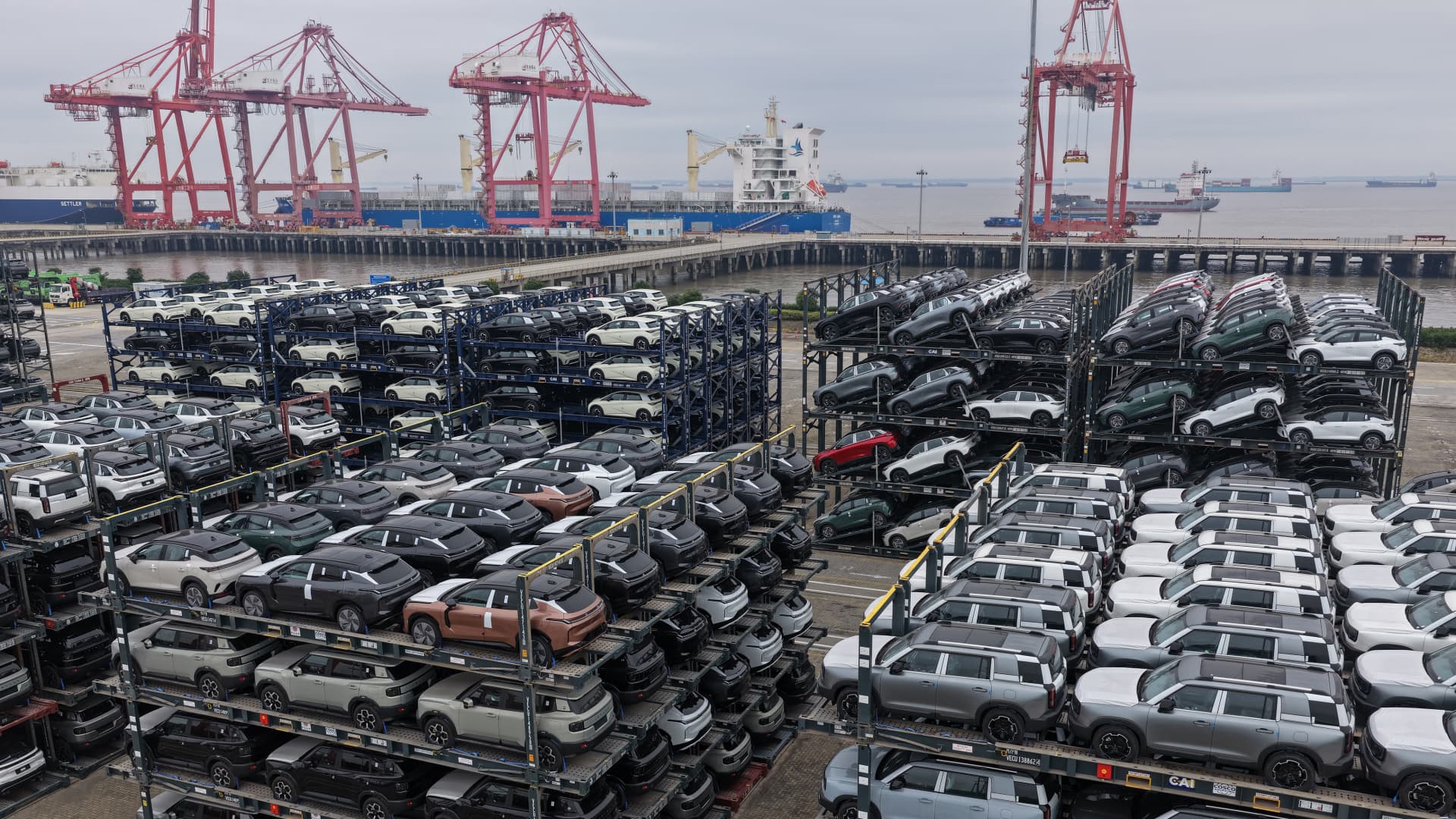
Chinese-built vehicles sit in specialised racks awaiting shipment at Taicang Port, part of Suzhou Port, in Jiangsu province on October 12, 2026.
– | Afp | Getty Images
The Trump administration has announced a new round of proposed tariffs covering more than a dozen trading partners, placing China, Vietnam and India among those facing the greatest pressure to reach trade agreements with Washington.
Presented as an effort to address excess industrial capacity, the proposed duties would begin at 15% for the European Union, South Korea, Switzerland and Taiwan, and climb as high as 35% for Vietnam.
The Office of the U.S. Trade Representative said the rates could be limited for countries that finalize agreements with Washington or continue making progress in negotiations.
Mark Williams, chief Asia economist at Capital Economics, said the immediate regional effect is likely to be modest. The proposal largely “puts most of the targeted countries back where they were earlier in the year,” he said, following the Supreme Court’s decision in February to invalidate Trump’s emergency tariffs.
Analysts nevertheless said the threat of higher rates could encourage governments to accelerate negotiations and secure more favorable terms.
U.S. Trade Representative Jamieson Greer said Wednesday that the policy was unlikely to take effect for several months. A senior U.S. official said some of the duties could begin as soon as January.
China
China would face a maximum new rate of 20%, in addition to an existing 25% tariff introduced during Trump’s first term. The total could rise to 40% if the trade truce agreed in South Korea last October is not extended beyond January, according to the USTR.
Beijing has dismissed Washington’s allegations of excess capacity and said it will take whatever steps are necessary to defend its rights.
Chinese Commerce Ministry spokesperson He Yadong urged Washington on Thursday to “rectify its wrongdoing and return to the right track of resolving issues through dialogue.”
He was responding to the U.S. plan to increase tariffs following Section 301 investigations. The ministry also called on Washington to carry out $30 billion in reciprocal tariff reductions agreed by the two countries in late September.
While not happy, Beijing seems prepared to live with the new rates provided that they don’t exceed 20%.
Wendy Cutler
Senior Vice President, Asia Society Policy Institute
The latest escalation follows several attempts at rapprochement between President Donald Trump and Chinese President Xi Jinping this year. It also comes despite what Williams called Trump’s “apparent lack of concern” over claims that Chinese technology companies have found ways around U.S. restrictions on chip exports.
Trump and Xi are expected to hold their fourth meeting of the year at the Group of 20 leaders summit in Miami in December.
“While not happy, Beijing seems prepared to live with the new rates provided that they don’t exceed 20%,” said Wendy Cutler, senior vice president at the Asia Society Policy Institute.
By keeping open the possibility of higher duties if negotiations falter, Washington is using tariffs as leverage to “secure expected shipments of critical minerals and rare earths, and further purchases of U.S. agricultural goods,” Cutler said.
The U.S. has warned that tariffs on Chinese products could double to 40% if the USTR determines that Beijing is not negotiating in good faith. “If the trade war did start up again, today’s measures provide the U.S. with some ammunition,” Williams said.
Williams said the measures aimed at the other 13 trading partners also appear to be closely connected to China. He noted that the word “China” appears 253 times in the USTR’s report on Vietnam and 315 times in its report on the European Union.
“Foremost among the ‘unreasonable acts, policies, and practices’ that these countries are criticised for is being slow to restrict imports and FDI from China,” Williams said.
Vietnam, India, Singapore
Although the proposed tariffs would generally make only limited changes to average rates, India and Vietnam face unusually large differences between the duties proposed without an agreement and the lower rates available through a deal.
The proposed tariffs stand at 25% for India and 35% for Vietnam. Those figures could fall to 17% and 20%, respectively, if ongoing negotiations produce reciprocal trade agreements with the U.S.
Both countries have “a strong incentive” to complete agreements with Washington and lock in the reduced rates, Cutler said.
Vietnam’s trade ministry said Thursday that it was working with the U.S. to finalize an agreement as soon as possible, Reuters reported. India could also gain an advantage over some Asian competitors if New Delhi completes its long-delayed trade deal with Washington.

Singapore faces a comparable dilemma. The proposal would impose a maximum 20% rate on its exports, excluding existing Section 301 tariffs. That figure could fall to 10% if Singapore reaches a reciprocal trade agreement with the U.S. or completes other talks addressing the USTR’s concerns, according to the country’s Ministry of Energy, Trade and Industry.
The ministry said it disagreed with the U.S. findings and was “very disappointed” by the proposed action, arguing that the assessment did not reflect the structure of Singapore’s economy.
Deputy Prime Minister Gan Kim Yong told reporters that roughly 33% of direct exports, worth 9.4 billion Singapore dollars ($7.2 billion), would be affected. If Washington applies the full 20% levy, the effective tariff on those exports would rise to 10.3% from 7.8% currently.
“I’m also very surprised that this has happened because this is not something that you would expect from an important major trading partner,” Gan said. He noted that Singapore and the U.S. had worked together for years and had maintained a free trade agreement since 2004.
Under that agreement, Singapore charges no tariffs on U.S. goods, while the U.S. has recorded a trade surplus with the city-state for more than two decades, the ministry said. The surplus increased to $33 billion in 2025 from $27 billion in 2024.
Singapore said it would provide additional comments during the public consultation and press the USTR to reconsider its proposal.
South Korea and Taiwan
Analysts said exemptions covering semiconductors and other electronics should soften the effect on South Korea and Taiwan, whose economies rely heavily on those industries.
The USTR criticized South Korea’s concentration in memory-chip manufacturing and what it characterized as excessive government support. However, South Korean chips were excluded from the proposed excess-capacity tariffs.
Taiwan would face a 15% cap on the excess-capacity tariff and would also benefit from exemptions covering products such as mobile phones and networking equipment. Williams estimated that Taiwan’s effective tariff rate would increase to about 9% from 6%.
Europe
Switzerland was subjected to a surprise 39% tariff in 2025, affecting major export categories including chemicals, pharmaceuticals, gold, watches and chocolate. In November 2025, the country reached an agreement that reduced the U.S. duties to 15% in exchange for a pledge to invest billions of dollars and expand manufacturing in the United States.
In March 2026, the U.S. opened additional Section 301 investigations into Switzerland, citing “unfair or discriminatory trade practices,” and recommended another 15% tariff.
Switzerland’s Economy Ministry told CNBC that it rejected the allegations and had already set out its position during bilateral consultations with the U.S. Treasury.
The ministry said it presumed the latest recommendation was compatible with the November 2025 agreement and was consulting closely with U.S. officials while determining its next steps.
During trade negotiations last year, officials from Switzerland and the European Union argued that goods trade surpluses with the U.S. did not tell the full story. Once services were included, they said, the broader relationship was balanced, with the U.S. especially dominant in technology and finance.
Brussels said it was reviewing the U.S. report but rejected the assertion that Europe contributes to industrial overcapacity.
“To the contrary, Europe is among those most exposed to overcapacity,” European Commission spokesperson Olof Gill said in a statement.
“The EU and the U.S. share a real concern about global overcapacity, much of it state-driven and concentrated in third countries. We regret the lack of joint action,” Gill added.
Gill said any measure resulting from the investigation should comply with the existing agreement establishing a 15% all-inclusive ceiling on EU goods.
EU trade ministers are scheduled to speak with U.S. Trade Representative Jamieson Greer on Monday.
Citi analysts said European retailers could suffer if the proposals remain unchanged, with companies including Adidas, H&M, Puma and Primark potentially facing reductions in full-year 2027 earnings estimates.
Inga Fechner, ING’s senior economist for global trade, wrote in a Wednesday note that the U.S. “tariff wall keeps changing, but it isn’t coming down.” She said American protectionism was becoming “increasingly difficult to unwind.”
A newly Democrat-controlled Congress could seek to curb the president’s tariff powers, repeal specific duties or increase scrutiny through hearings and investigations. But Fechner said reversing the measures would remain challenging as long as Trump has veto power.
“We don’t think the blue wave will mark a return to free trade. The Biden years already showed that tariffs in strategically important sectors enjoy support across political camps.”
She said protectionist policy was becoming more targeted, creating an increasingly complicated web of country- and sector-specific duties imposed under different legal authorities.
— CNBC’s Evelyn Cheng contributed to this report.


