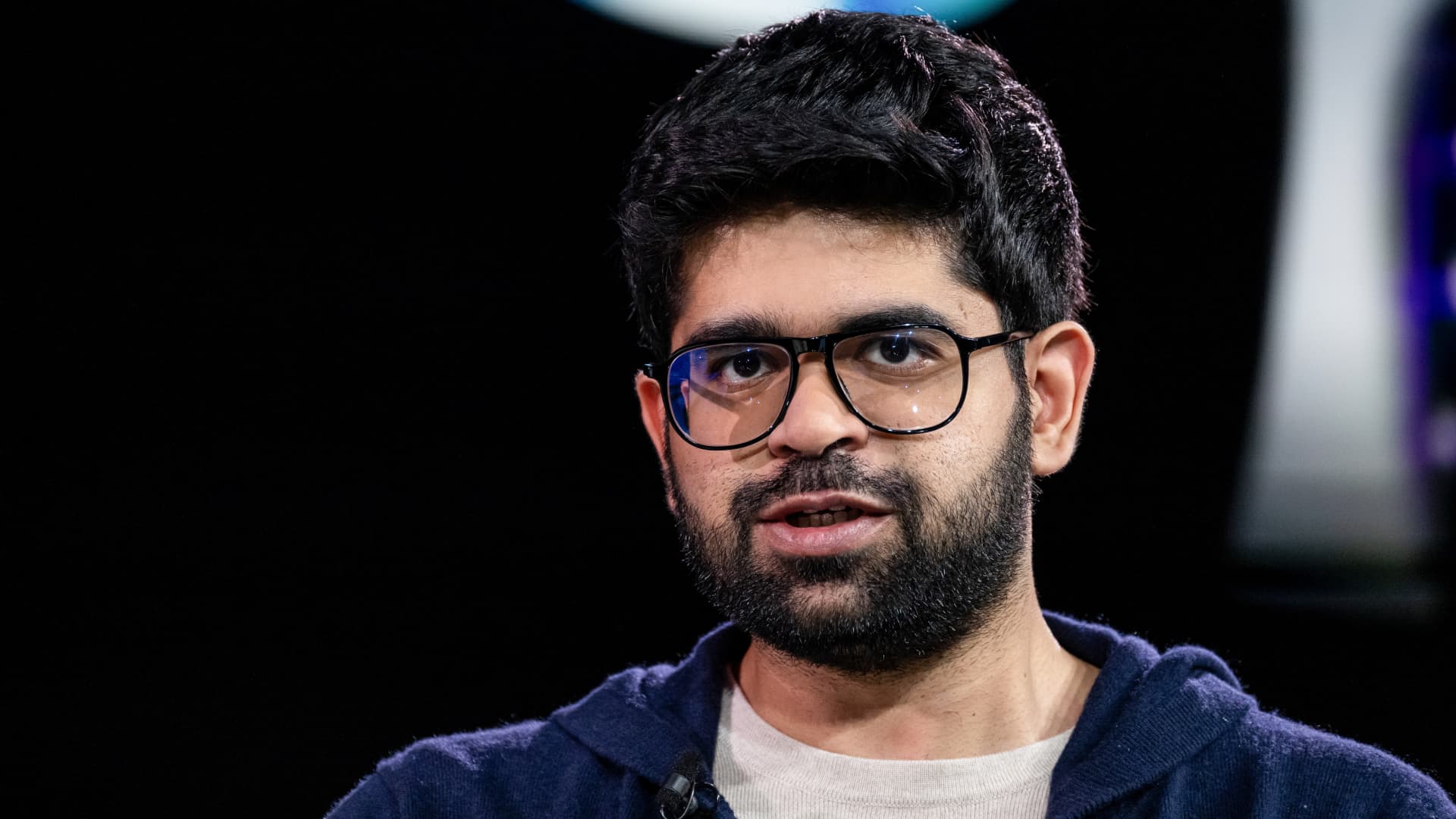

Aravind Srinivas, CEO of Perplexity, emphasized the pivotal role of economic value derived from AI power consumption in determining company valuations, as he discussed with CNBC on Wednesday.
According to Srinivas, the future belongs to the company that can deliver the “most token value per watt per user.”
“Success will come to those who can optimize this metric by harmonizing accuracy, latency, cost, privacy, and intelligence. That’s the formula for long-term victory,” Srinivas explained to CNBC’s Elaine Yu in an interview.
In the context of AI, a token is the fundamental unit of data processed by a model. When an AI chatbot is tasked with an operation, it decomposes the task into tokens, each requiring energy to process. Srinivas believes that companies capable of achieving the most favorable ratio of energy consumption to economic output will hold a competitive edge.
“Some model providers might appear profitable due to high pricing, but that’s merely short-term revenue growth,” Srinivas pointed out.
Perplexity is increasingly concentrating on agentic AI, which pertains to systems that can tackle more sophisticated tasks beyond basic inquiries. In February, the company introduced Perplexity Computer, an agent designed to perform complex tasks over extended durations.
While Perplexity develops some of its own models, its key products integrate models from other AI firms like Anthropic. A key focus for Perplexity is improving efficiency to achieve the best outcomes while minimizing energy use. To support that goal, Perplexity announced Personal Computer on Tuesday, a tool which it calls an “orchestrator.”

The process of orchestration involves a system that makes decisions on what the best model is to use for a particular task, how agents work together, and where the AI should process queries. Much of the actual AI processing today is done in data centers.
But there is an increasing focus from AI firms on enabling these models to be processed on a device like a phone or laptop. Experts say this could reduce the power required to process AI, make it faster and more secure, since the data is not being sent to a server. Perplexity Personal Computer automatically routes the processing to where it deems best.
“The data center is coming to your laptop,” Srinivas said, adding that it’s crucial to have an AI operating system that brings everything together in a single unified system.
On Wednesday, Perplexity said that its Personal Computer product will be available on Microsoft’s Windows operating system, enabling the AI to connect to apps like Word and Outlook, as well as files on a user’s device. Perplexity has already launched the Personal Computer on Apple‘s Mac product.
Srinivas said that Perplexity is focused on creating a “sustainable, durable advantage” versus competitors and that “this is an orchestration problem.”
“We believe that by solving that, we’ll be building a pretty valuable company that has endurable, long-term advantage,” Srinivas said.
Rising competition
Perplexity faces increasing competition as rivals like OpenAI, Anthropic and Google have ramped up their focus on AI agents.
Perplexity, which was last reportedly valued at $20 billion, trails behind Anthropic and OpenAI, whose valuations have climbed to nearly $1 trillion and just over $850 billion, respectively. Anthropic this week confidentially filed for an initial public offering in the U.S. as investor demand for AI stocks continues.
Even as Perplexity expands its products across products from Microsoft and Apple, those very same companies are developing AI agents of their own. On Tuesday, Microsoft announced new coding and reasoning models. Apple is currently working on an updated version of its digital assistant Siri based on Google’s AI models.
Srinivas said that while these companies will build their own AI, Perplexity’s platform-agnostic approach will help it compete.
“I think they absolutely will try to build their own AI systems, but we believe we’re building the most versatile operating system by making it work across different models, across different chips, across different traditional operating systems, different hardware providers, different laptops,” Srinivas said.
“That hybrid neutral orchestration layer is what we are doing, and that allows us to balance all the different objectives simultaneously.”
Whenever Anthropic’s models get better, Perplexity improves too because Anthropic’s models are integrated into Perplexity, the CEO said. This has led Perplexity to triple its annualized revenue since the beginning of the year, “thanks to model advances that have been made by Anthropic,” he told CNBC.


