
An asylum seeker, previously sent to France under Keir Starmer’s ‘one in, one out’ policy, has made his way back to the UK, expressing concerns that he might resort to crime to make ends meet.
The individual, currently in hiding, asserts that he is among at least 18 asylum seekers who have returned to the UK since the policy began last year.
After being deported to France by the Home Office, he found himself in dire circumstances and decided to return to the UK hidden in a lorry.
He recounts an encounter with human traffickers who attempted to coerce him into their operations, but he resisted their demands.
This defiance, he claims, led to a severe beating, leaving his face bruised and injured.
Faced with limited choices, he felt compelled to return to the UK, which he perceives as offering a safer environment for him.
The man – who spoke to the Guardian – said that when he was in the ‘Jungle,’ people were offered to journey back to Britain in lorries rather than in small boats because of the one-in-one-out policy.
The ‘Jungle’ refers to the refugee camp in northern France where people smugglers operate.
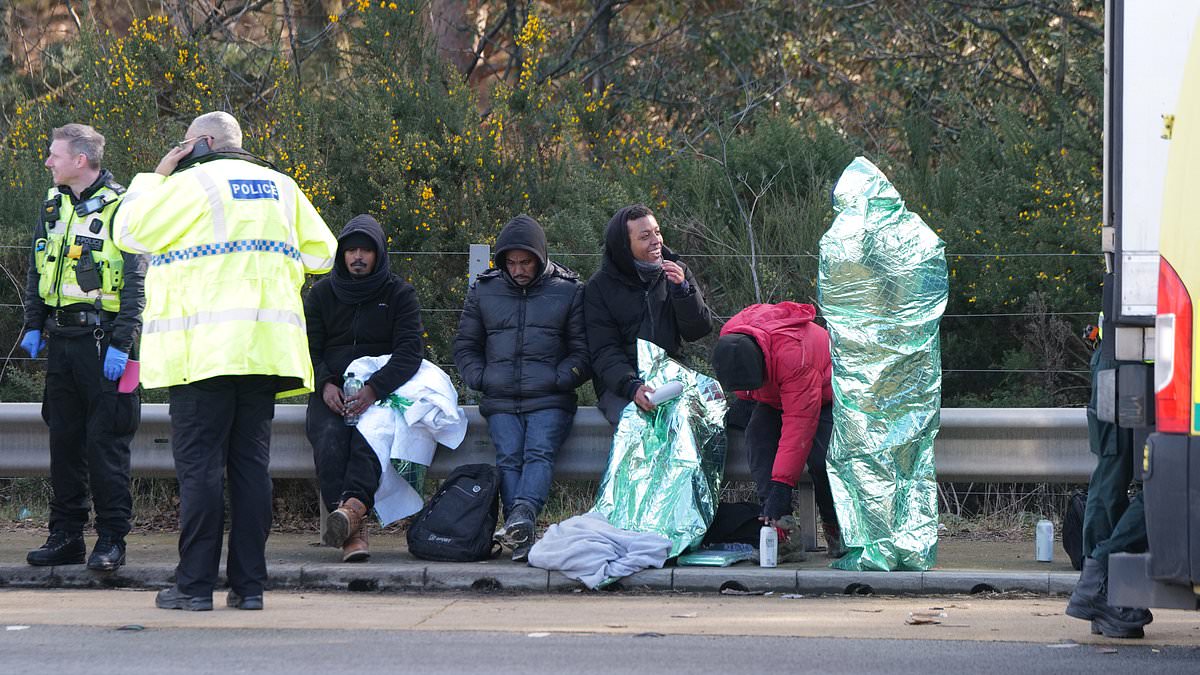
In February, suspected illegal migrants were discovered in the back of a lorry in Surrey – an alternative to crossing in small boats that is growing in popularity since ‘one in, one out’
‘The price for a small boat Channel crossing is €1,000-2,000, while the price for a lorry to the UK is €4,000 to 5,000,’ he said.
And although the man does not know ‘exactly how many’ people sent to France have made the journey back to Britain, he claims to know of 18 that are ‘now living underground’.
Despite his successful return to Britain, he went on to describe himself as ‘scared’ to leave the room he is staying in due to the threat of going back to France.
He said: ‘I’m running from the smugglers, the police and the Home Office. I don’t have a life any more and I don’t have a plan.
‘I keep thinking about handing myself into the police, but if I do that and the Home Office sends me back to France again I am sure the smugglers will kill me if they find me, because I ran away from them.’
He said he wishes to ‘live in peace’ in the UK, to ‘work legally and be safe’ – but went on to warn that those such as himself can be ‘forced’ into crime to survive.
Although he said he came to Britain to ‘respect the rules of the country,’ he said its current immigration policies may force refugees to ‘break the rules by doing things like working illegally.’
Under the terms of the ‘one in, one out’ deal – which was signed last July – Britain can send a small boat migrant back to France in return for accepting one who has not previously tried to arrive illegally.

Migrants pictured boarding an inflatable boat at the beach in Dunkirk attempting to cross the English Channel
The aim of the scheme is to deter small boat crossings and to stop people-smuggling operations which have been on the rise.
However, since the deal was enacted, thousands of asylum seekers have crossed the Channel – and people smugglers have adapted their business model accordingly.
Instead of northern France, people smugglers have begun to send small boats and vessels from Belgium, and offer more expensive crossings to Britain in lorries to avoid police on French beaches.
On Friday, nearly 400 migrants reached Britain’s shores in six small boats after people trafficking gangs took advantage of the hotter weather.
The crossing marked the first successful small-boat crossing to Britain in nearly two weeks, with the number of migrants totaling 394.
People in life jackets were seen being led from a Border Security Command vessel after arriving on the Kent coast.
The hot weather spell has allowed for several crossing attempts to be launched, as temperatures are expected to continue to soar over the bank holiday weekend.
The total number of arrivals, however, is down by 44 per cent since this time last year and 23 per cent on the same time in 2024.
And as of April 28, 605 people were returned to France under the ‘one in, one out’ scheme, and 581 people had come to Britain.
In April, Home Secretary Shabana Mahmood signed a three-year agreement to pay France £662million to aid beach patrols in a bid to decrease the number of arrivals.
The Home Office said the deal would see officers ‘targeting and detaining’ migrants on French beaches with the aim of removing hundreds from beaches every year.
This means Labour will spend £501million to cover five police units and enforcement activity on the French coast – with an extra £160million only paid if new tactics to curb Channel crossings are successful.
The Home Office has confirmed that if efforts fail, the additional funding will stop after a year.
It was also confirmed that the French authorities’ new initiative to stop boats at sea will only apply to dinghies with fewer than 20 people aboard.
Under Labour’s new agreement the £53million-a-year extra payments will conditionally depend on how many boats are intercepted at sea.
Britain will pay for a new specialist vessel for the French to use in interceptions, and 20 extra trained maritime officers to carry out the work.
It will also be used to pay for two new helicopters for the French to use in surveillance operations along their coastline.
Further British funds will also cover the cost of a new 50-strong police riot squad specially trained in dispersing large groups of people.
A Home Office spokesperson said: ‘Anyone looking to return to the UK after being removed under the UK-France agreement is wasting their time and money. They will be removed again.
‘Under this government, enforcement is up, asylum decision-making is up, removals are up and the backlogs and hotel use are coming down.
‘2025 was a record year for tackling organised immigration crime, with disruptions up by more than a third on 2024. Under our returns agreement with France, we have deported more than 600 illegal migrants from British soil.’