
Share this @internewscast.com
In brief
- The Orion capsule splashed down off the coast of California on Saturday morning AEST.
- The Artemis II mission saw astronauts travel further from Earth than any human before.
In a landmark achievement for space exploration, the astronauts aboard Artemis II safely returned to Earth, landing in the Pacific Ocean shortly after 10 a.m. AEST on Saturday. This mission marked humanity’s return to lunar exploration after more than 50 years.
NASA’s Orion capsule, aptly named Integrity, made a soft descent into the ocean near the southern California coast. This concluded a historic journey that saw the crew travel farther into space than ever before.
The recovery operation quickly commenced as teams worked to retrieve the four astronauts: Reid Wiseman, Victor Glover, Christina Koch from the United States, and Canadian astronaut Jeremy Hansen. By 11:40 a.m., all crew members had exited the capsule.
The scene was reminiscent of the iconic Apollo missions. In a meticulously coordinated operation, military helicopters airlifted each astronaut from an inflatable raft connected to the capsule, transporting them to the USS John P. Murtha, the navy’s recovery ship.
“These astronauts served as ambassadors for humanity in space, and I couldn’t have imagined a finer crew,” noted NASA Administrator Jared Isaacman from aboard the recovery vessel.
The Orion capsule, Integrity, completed its entire descent on autopilot. The spacecraft re-entered Earth’s atmosphere at an incredible speed of Mach 33, or 33 times the speed of sound, reaching velocities not witnessed since the Apollo era of the 1960s and 1970s.
The Artemis II flight, travelling a total of 1,117,515km across two Earth orbits and a climactic lunar flyby, was the debut crewed test flight in a series of Artemis missions that aim to start landing astronauts on the moon from 2028.
The splash down, about two hours before sunset local time, was carried by live video feed in a NASA webcast.
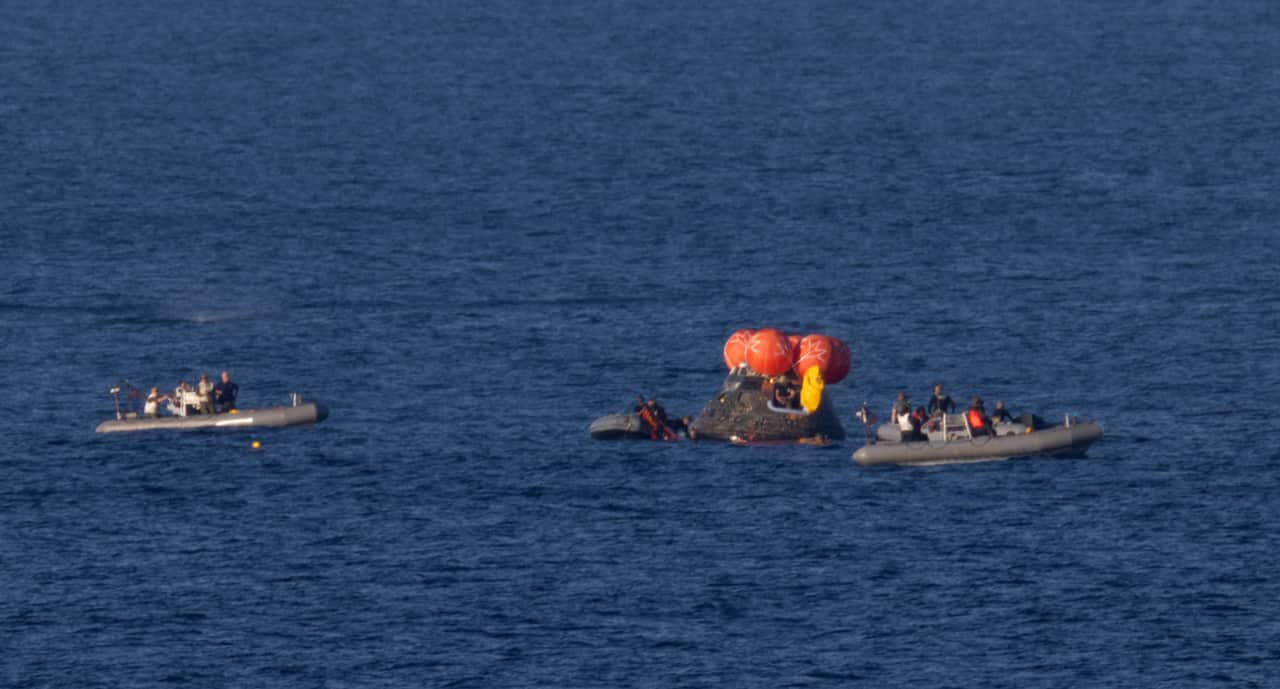
The crew’s homecoming cleared a critical final hurdle for the Lockheed Martin-built LMT.N Orion spacecraft, proving it would withstand the extreme forces of re-entry from a lunar-return trajectory.
It followed a white-knuckle, 13-minute fiery plunge through Earth’s atmosphere, generating frictional heat that sent temperatures on the capsule’s exterior soaring to some 2,760C.
At the peak of re-entry stress, as expected, intense heat and air compression formed a red-hot sheath of ionised gas, or plasma, that engulfed the capsule, cutting off radio communications with the crew for several minutes.
The tension broke as contact was re-established and two sets of parachutes were seen billowing from the nose of the free-falling capsule, slowing its descent to about 25km/h before Orion gently hit the water.
Artemis II’s record flyby and views of the moon
Launched from Florida on 1 April, the astronauts racked up one win after another as they deftly navigated NASA’s long-awaited lunar comeback, the first major step in establishing a sustainable moon base.
Artemis II didn’t land on the moon or even orbit it. But it broke Apollo 13’s distance record and marked the farthest that humans have ever journeyed from Earth when the crew reached 406,771km.
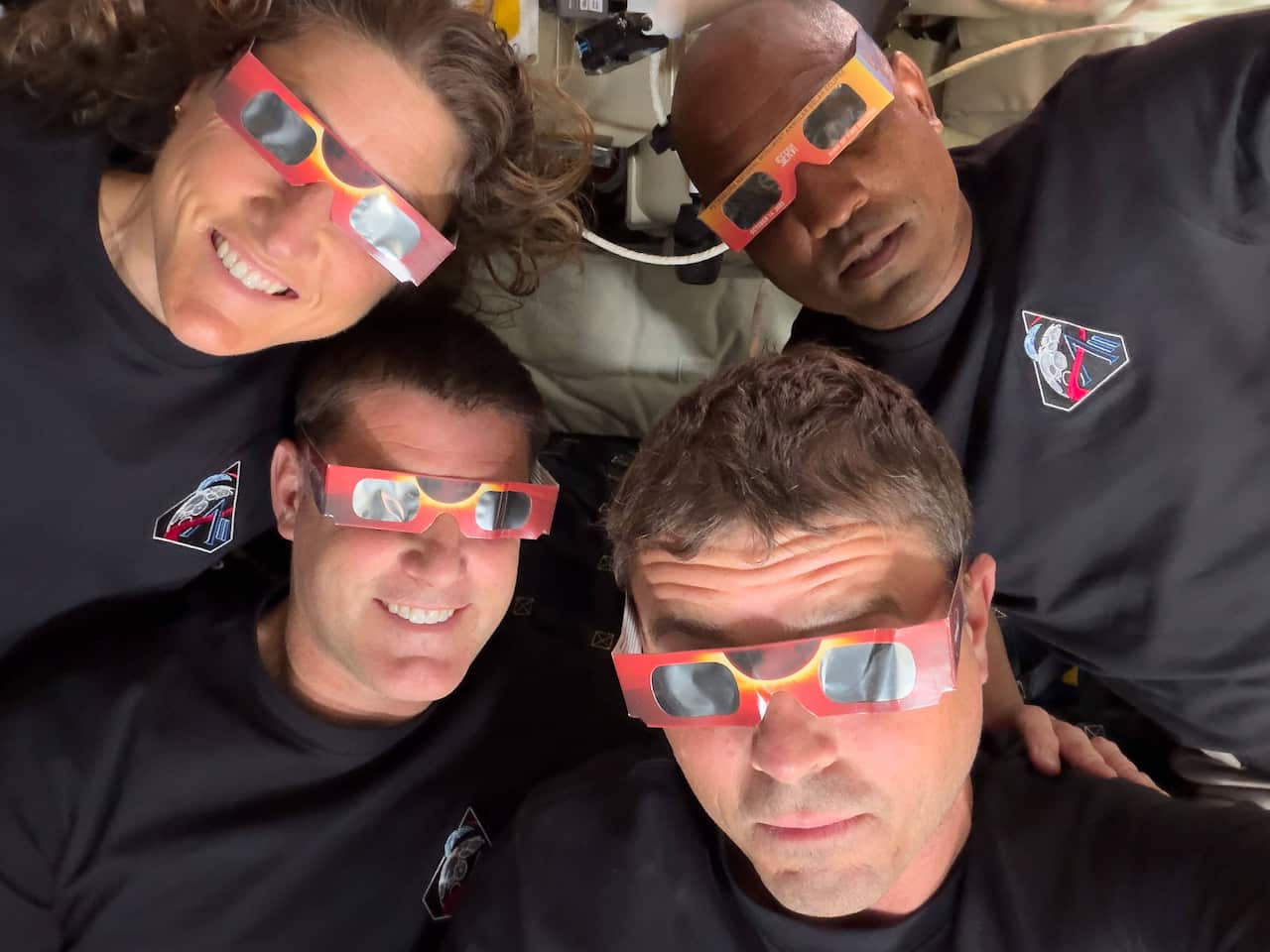
Then, in the mission’s most heart-tugging scene, the teary astronauts asked permission to name a pair of craters after their moonship and Wiseman’s late wife, Carroll.
During Monday’s record-breaking flyby, they documented scenes of the moon’s far side never seen before by the human eye, along with a total solar eclipse. The eclipse, in particular, “just blew all of us away,” Glover said.
Their sense of wonder and love awed everyone, as did their breathtaking pictures of the moon and Earth.
The Artemis II crew channelled Apollo 8’s first lunar explorers with Earthset, showing our Blue Marble setting behind the grey moon. It was reminiscent of Apollo 8’s famous Earthrise shot from 1968.
“It just makes you want to continue to go back,” Radigan said on the eve of splashdown.
“It’s the first of many trips and we just need to continue because there’s so much” more to learn about the moon.
Artemis II was a test flight for future moon missions
Despite its rich scientific yield, the nearly 10-day flight was not without technical issues. Both the capsule’s drinking water and propellant systems were hit with valve problems. In perhaps the most high-profile predicament, the toilet kept malfunctioning, but the astronauts shrugged it all off.
“We can’t explore deeper unless we are doing a few things that are inconvenient,” Koch said, “unless we’re making a few sacrifices, unless we’re taking a few risks, and those things are all worth it.”
Added Hansen: “You do a lot of testing on the ground, but your final test is when you get this hardware to space and it’s a doozy.”
Under the revamped Artemis program, next year’s Artemis III will see astronauts practice docking their capsule with a lunar lander or two in orbit around Earth. Artemis IV will attempt to land a crew of two near the moon’s south pole in 2028.
The Artemis II astronauts’ allegiance was to those future crews, Wiseman said.
“But we really hoped in our soul is that we could for just for a moment have the world pause and remember that this is a beautiful planet and a very special place in our universe, and we should all cherish what we have been gifted,” he said.
For the latest from SBS News, download our app and subscribe to our newsletter.