Share this @internewscast.com
Talks to strike a landmark global treaty on plastic pollution fell apart on Friday, leaving many frustrated and some calling it a “missed opportunity”.
Negotiators from 185 nations met in Geneva last week to try and draft the world’s first legally-binding treaty to deal with the growing global issue of plastic pollution.
Despite working beyond Thursday’s deadline and through the night, the talks were ultimately futile and nations could not reach a consensus.

A large bloc of nations including the European Union, Britain and many African and Latin American countries called for curbing plastic production and phasing out toxic chemicals used in plastics.

However, a smaller group of oil-producing states including Saudi Arabia, Kuwait and Russia argued instead for waste management.
These countries railed against the negotiations being based on the entire life-cycle of plastic: from the petroleum-derived substance through to waste.

While around 100 nations sought caps on plastic production, a number of countries including the United States stood against them and argued caps were unnecessary and a threat to their economies and industries.
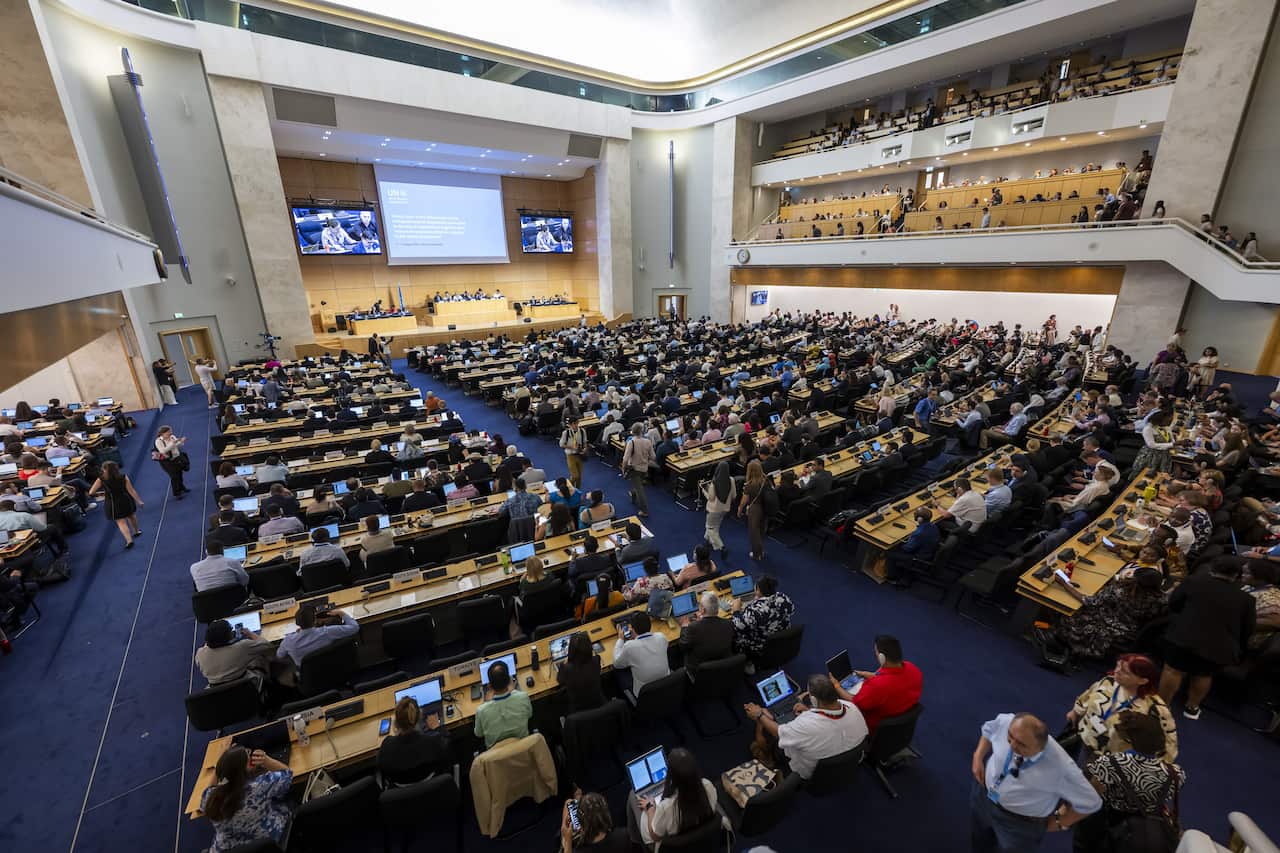
A large group of people in a room sitting and looking at a stage

While a large number of nations argued for caps on plastic production others, including the US, stood against them. Source: AAP / Martial Trezzini/EPA

‘Missed a historic opportunity’

Representatives of countries voiced anger and despair as the talks unravelled, but said they wanted future negotiations — despite six rounds of talks over three years now having failed to find agreement.
“We have missed a historic opportunity but we have to keep going and act urgently,” said Cuba.
Colombia added: “The negotiations were consistently blocked by a small number of states who simply don’t want an agreement.”
Tuvalu, speaking for 14 Pacific small island developing states, said: “For our islands this means that without global cooperation and state action, millions of tonnes of plastic waste will continue to be dumped in our oceans, affecting our ecosystem, food security, livelihood and culture.”

France’s ecological transition minister Agnes Pannier-Runacher said she was “disappointed” and “angry” and blamed a handful of countries “guided by short-term financial interests” for blocking an ambitious treaty.

“Oil-producing countries and their allies have chosen to look the other way,” she said.
Graham Forbes, the head of Greenpeace’s delegation to the talks called the collapse of negotiations a “wake up call for the world”.
“The vast majority of governments want a strong agreement, yet a handful of bad actors were allowed to use process to drive such ambition into the ground. We cannot continue to do the same thing and expect a different result. The time for hesitation is over,” he said.
Environmental NGOs also warned that without radically changing the process to better reflect the majority view, future talks will hit the same dead end.
David Azoulay from the Center for International Environmental Law’s David Azoulay said the talks had been an “abject failure” because some countries were out to “block any attempt at advancing a viable treaty”.

The World Wide Fund for Nature said the talks exposed how consensus decision-making “had now “outplayed its role in international environmental negotiations”.

What happens now?

Oil-producing nations argued that recycling, reuse and product design were sufficient to address the problem of global plastic pollution without resorting to production cuts.
However, experts say these are not substantial answers to the issue.
Ingar Andersen, executive director of the United Nations Environmental Programme (UNEP), which hosted the talks, has said the world “will not recycle our way out of the plastic pollution crisis”.
More than 400 million tonnes of plastic are produced globally each year, half of which is for single-use items.

While 15 per cent of plastic waste is collected for recycling, only nine per cent is actually recycled.


The future of the UNEP negotiations is now uncertain and while some countries have committed to resuming negotiations, others expressed that they have lost faith after repeated attempts.
Andersen also pledged to continue work. “We did not get where we want but people want a deal,” she said.
On current trends, annual production of fossil-fuel-based plastics will nearly triple by 2060 to 1.2 billion tonnes, while waste will exceed one billion tonnes, according to the Organisation for Economic Cooperation and Development.

Share this @internewscast.com
You May Also Like
Richard Pusey

Richard Pusey Files Lawsuit Against Victoria Police Over Fatal Eastern Freeway Incident

Victoria Police will defend itself in court after Porsche driver Richard Pusey…
Charlotte MacInnes

Actor’s Emotional Court Testimony Involving Rebel Stirs Controversy

A young actress recently fought back tears while recounting her experiences with…

States Push Back on NDIS Changes Amid Concerns Over Financial Burden

In brief: The federal health minister has announced a raft of changes…
Disney + informed Australian customers of the price change in an email today.

Disney+ Shakes Up Streaming with Another Price Hike: What Subscribers Need to Know

Australian Disney+ subscribers are set to pay more for their streaming plans…
The rugby community in Waikato, New Zealand has been thrown into mourning by the sudden death of sportswoman Courtney Johansen (pictured)

Football Community Honors Cherished 29-Year-Old Coach Following Tragic Loss of Her and Unborn Child Due to Undiagnosed Health Issue

Heartfelt tributes have emerged for a New Zealand athlete who tragically passed…

Iranian Gunboat Engages Container Ship Near Oman; Another Vessel Attacked Near Iran

In brief: Iran has fired at a container ship transiting the Strait…
Paolo Zampolli is a long-time friend of Donald Trump.

Trump Envoy Proposes Bold World Cup Swap: Italy to Replace Iran in Global Tournament

Paolo Zampolli, acting as a special envoy for global partnerships, recently shared…

Surge in Rodent Population Poses New Challenges for Australian Farmers

in brief Mouse numbers are thought to have hit plague proportions in…
Lee Lovell (right) has opened up about life without his beloved wife Emma (left), who was stabbed to death on Boxing Day 2022

Emma Lovell’s Tragic Stabbing: Lee Lovell Reflects on Wife’s Death at North Lakes Residence and the Two Words That Altered Their Family’s Future

A heartbroken husband has spoken about the devastating moment his world was…

Major Gaming Companies Under Scrutiny for Rising Child Safety Concerns

Major video game companies could face fines approaching $50 million if they…
Aussie scientists develop injectable treatment to help flat-nosed dogs breathe easier

Revolutionary Injectable Treatment by Aussie Scientists Offers New Hope for Flat-Nosed Dogs’ Breathing Issues

Short-nosed dogs could soon be able to breathe easier thanks to a…
The Budget is setting aside $90.6million to boost the number of skilled workers in the construction sector (pictured are construction workers at Parramatta in Sydney's west)

Federal Budget 2024: Critics Label It as Vote-Buying Strategy, While PM Remains Tight-Lipped on Election Date

Anthony Albanese is sidestepping inquiries about the possibility of an early election,…