Share this @internewscast.com
Bek Gillespie’s daughter Abigail, one of twins, had a severe allergic response to eggs as a baby.
Born in 2022, she encountered a reaction while the family was on vacation the next year during a meal at a restaurant.
Initially, Gillespie admitted she was unsure about what to expect.
“I’d never witnessed an allergic reaction before. It was quite frightening,” she mentioned to SBS News, recalling how she took Abigail to a pharmacy and then to the hospital.

“Since then, it has influenced every aspect of our everyday life.”

Abigail, now aged three, lives with egg anaphylaxis. Anaphylaxis is the most severe allergic reaction — it can be life-threatening and must always be treated as a medical emergency, according to Allergy & Anaphylaxis Australia.
As a parent, Gillespie said she carries her child’s allergy, and the possible risks it poses, “everywhere you go”.
“You have to read every single label. You have to ask all the questions … even the simple things like going out for dinner, birthday parties, travelling. It takes a lot of careful and considered planning,” she said, adding situations like childcare, where she is relying on others being educated and prepared, can also cause anxiety.

At the time of Abigail’s first reaction, Gillespie was “desperate for guidance,” but felt somewhat disregarded when seeking assistance.

Two young girls wearing floral tops and blue jeans smiling in the corner of a backyard

When Abigail (left) had her first serious reaction as a baby, her mother Bek said she didn’t know where to turn. Source: Supplied / Bek Gillespie

She is seeing a specialist and seeking allergy tests for both of her twin daughters this year.

“There are so few specialists in Canberra [where we live], so the wait lists are long, and it is quite expensive as well,” she said.
While anaphylaxis is the most serious form of reaction, anyone with an allergy to food, insects, medications or latex could be at risk. And Gillespie is not alone in her experience as a parent.
Almost one in three Australians now live with allergic disease that is leading to “mounting costs” and “unprecedented demand for services,” according to a new report published on Wednesday.

This figure has doubled since the last national overview in 2007, resulting in $18.9 billion in economic losses and $44.6 billion in intangible impacts last year, according to the Deloitte Access Economics report.

‘Best national snapshot we’ve had date’

The report was developed with the National Allergy Council (NAC) — a peak body — and the Australasian Society of Clinical Immunology and Allergy (ASCIA). It also uses research from the National Allergy Centre of Excellence (NACE), which is another research body.
Australia’s response to allergic disease is led by NAC and NACE.
Professor Kirsten Perrett, director of NACE and an allergy group leader at the Murdoch Children’s Research Institute, said Australia lacks large datasets to track the prevalence of allergic disease across life spans.

She said the new Deloitte report uses a number of sources to offer “the best national snapshot that we’ve had to date”.
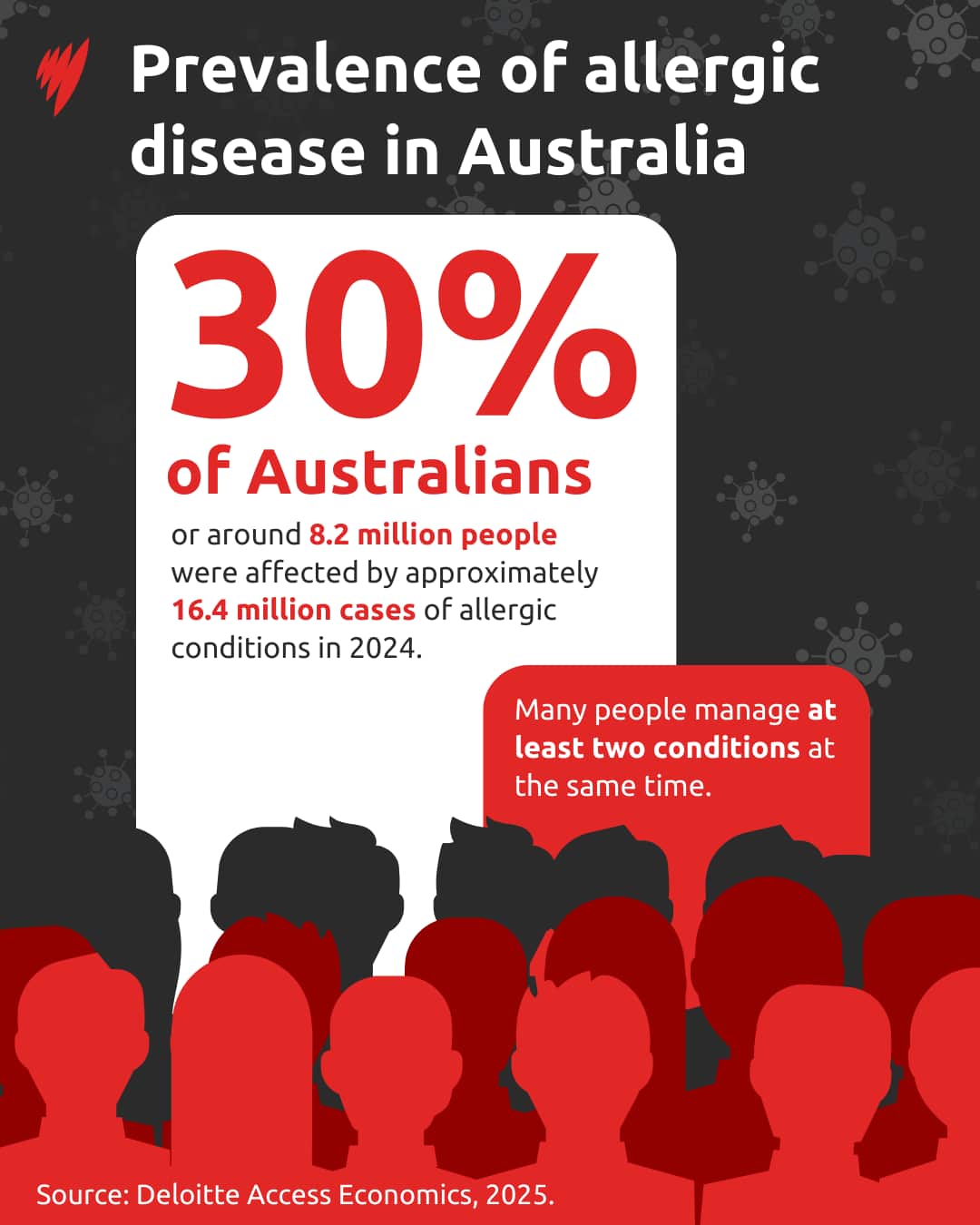
A chart showing the prevalence of allergic disease among Ausralians.

An estimated 8.2 million Australians lived with allergic disease in 2024, up from 4.1 million reported in 2007. Source: SBS News

The report estimates 30 per cent of all Australians, or 8.2 million people, had one or more allergic conditions in 2024. In total, there were an estimated 16.4 million cases.

This total number is up from 4.1 million (or 19.6 per cent of) Australians when the last national snapshot was reported in 2007, Perrett said.
“Now more than ever, we understand the prevalence of allergic disease nationally, and it’s quite a frightening figure that we have almost one in three Australians affected by allergic disease.”
For Maria Said, co-chair of the NAC and chief executive of Allergy & Anaphylaxis Australia, this prevalence is “significant” but expected.
“It’s not a surprise to those working in [the sector] because the number of people reaching out and the demand for improved care and access to care is very real,” she said.
The most common conditions include hay fever (allergic rhinitis), eczema (atopic dermatitis), asthma, food allergy and drug allergy.

Food allergy and eczema tend to be more common in young children, with hay fever and drug allergy being more common among adults.

What is behind rising allergy rates?

Perrett said environmental changes, like pollution, and modern lifestyle factors, such as sanitisation, are possible drivers — while growing awareness could be prompting earlier diagnoses.

“We know that genes and our genetic makeup are a factor. But it is the environment that has changed so significantly,” she said.

Perrett said Australia is known as the “allergy capital of the world”, which is largely based on high food allergy rates.
“We do have the highest rates of food allergy in childhood anywhere, globally, and that prevalence is about 10 per cent of all infants.”

She said the broader rise in allergic disease is not uncommon in other Western countries.

Far-reaching impacts costing billions

The report estimated the total financial cost of allergic disease in 2024 was $18.9 billion, based on health system costs, productivity and efficiency losses.
It measured a further $44.6 billion in non-financial costs, which refers to intangible losses in well-being brought about by an illness. It encompasses factors such as pain, suffering, reduced quality of life and impact on daily activities.

“It’s not just the financial burden; it’s the social costs as well that impact a person,” Said said.
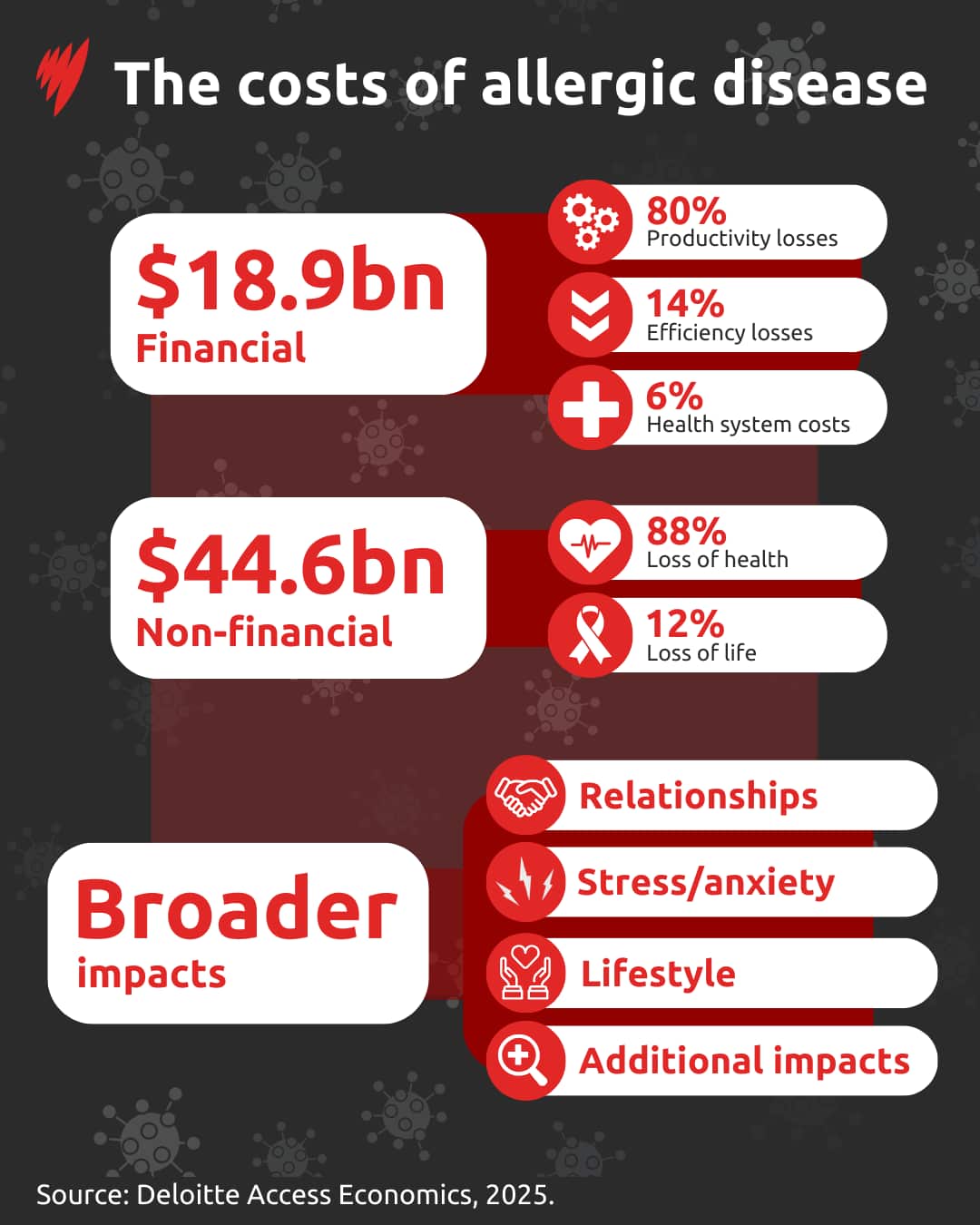
A chart showing the estimated costs of allergic disease in Australia.

The estimated financial cost of allergic disease in 2024 was $18.9 billion. Source: SBS News

She said allergic disease can “ultimately control people’s lives” and requires a multi-pronged approach to improve the health and well-being of those affected.

Perrett believes allergic disease “has not been given the attention it deserves”.
“This report shows that allergic disease is a hugely significant problem for Australians, affecting one in three. That’s almost every household.”
Perrett and Said would like to see sustained investment in the sector.
“Our hope is that they [the government] will invest in further funding of the NAC and NACE, so that we can continue to improve access to care, accelerate further research and increase safety in the community,” Said said.
A spokesperson for the federal health department told SBS News the government acknowledges the significant health, social, and economic costs associated with allergic disease, as highlighted in the report.
“The government is providing funding of $26.9 million to the National Allergy Council and National Allergy Centre of Excellence to address the significant and increasing impact of allergic disease and anaphylaxis in Australia.”

Share this @internewscast.com
You May Also Like
Several beaches south of Sydney have been closed after a dead whale washed up onto the shore.

Whale Tragedy: Dead Whale Prompts Closure of Several Sydney Beaches

Several beaches located just south of Sydney have been shut down after…
The Australian soldiers who fought epic battle in the 'forgotten war'

Heroic Australian Soldiers Recall Epic Battle in the Overlooked Korean War

Anzac Day falls 75 years after Australian soldiers fought a bloody battle…

20 Years Later: Beaconsfield Mine Tragedy Celebrates Australian Resilience and Humor

Two decades have passed since the Beaconsfield mine tragedy in Tasmania, yet…

Fluctuating Fuel Costs, Employment Trends, and a New Tax Incentive: Key Insights You Need to Know

This week has been a whirlwind of events. Global markets experienced heightened…
Treasurer Jim Chalmers handed down the Budget on Tuesday night, boasting of a $9.3 billion surplus driven by a strong labour market and increased commodity prices

Budget 2024 Unveiled: $300 Cash Boost for Australians, Student Debt Forgiveness, Tax Cuts, and New Travel Policies by Albanese Government

In a strategic move to garner voter support ahead of elections, the…

Australian Women Confront Tough Decisions Amid National Crisis

in brief Experts are warning that the cost of living crisis is…
Former New Zealand all-rounder admitted using cocaine after day one of Essex match before returning positive drug test

New Zealand Cricketer Faces Suspension for Cocaine Use During Match

Doug Bracewell, a former cricketer for New Zealand, has been given a…
Benjamin Netanyahu

Israeli Prime Minister Netanyahu Discloses Secret Cancer Treatment Amidst Political Turmoil

Israeli Prime Minister Benjamin Netanyahu quietly underwent treatment for prostate cancer, he…
James Comer is planning on investigating the Biden administration.

Shocking Twist: Congress Considers Controversial Ghislaine Maxwell Pardon

There is a growing number of US members of Congress pushing for…

Lebanon’s Pivotal Role: How Its Future May Shape Regional Conflict Dynamics

in brief World leaders have called for peace talks to take place…
Michelle Stalimeros (pictured) grew up in a 'chaotic' home where alcohol was woven into family life

Weekend Wine Habit Triggered Blackouts and Anxiety, Straining Marriage; Reflecting on Three Years of Sobriety

At first glance, Michelle Stalimeros appeared far from someone struggling with alcohol.…
Anzac soldiers

Partial Remains of Australian Soldiers from WWI Finally Laid to Rest Over a Century Later

The partial remains of eight Australian soldiers have been laid to rest…