
Share this @internewscast.com
Mammals, despite their popularity, are not the most diverse group in the animal kingdom. Currently, there are approximately 6,800 known mammal species, which pales in comparison to roughly 8,800 amphibian species, about 11,000 bird species, and a staggering 12,500 reptile species. Yet, when people think of biodiversity, iconic mammals such as pandas, orangutans, elephants, or tigers often come to mind first.
This prominence brings with it a certain level of examination. Mammals are some of the most thoroughly studied creatures on the planet and are also among the most endangered. According to international conservation assessments, over 25% of mammal species are listed as vulnerable, endangered, or critically endangered.
Given the extensive research conducted on mammals, the discovery and formal description of a new mammal species is a rare event. A case in point is the olinguito (Bassaricyon neblina), which garnered international attention as the first new carnivorous mammal discovered in the Americas in 35 years.
In 2017, DNA research led to a groundbreaking revelation that the world has not six but seven species of great ape. The identification of the Tapanuli Orangutan (Pongo tapanuliensis) as a distinct species marked the first description of a new great ape species in nearly 100 years.
Discovering a new species is thrilling, but identifying a new genus elevates the excitement to another level. In the Linnaean classification system, a genus encompasses multiple species and is ranked above a species. For instance, in the scientific name Homo sapiens, Homo represents the genus.
There are approximately 1,300 genera of living mammals globally. The discovery of a new mammal genus is a rare occurrence, happening only a handful of times each year, if at all. Noteworthy examples include the Nagasorex, a unique shrew from Nagaland, India in 2025; Paucidentomys, a rodent from Sulawesi identified in 2012; and Laonastes, a rock rat from Laos discovered in 2005.
So, creating a new genus is a rare event and a real privilege. But that is exactly what we just have done — describing a new genus of a small gliding possum in Indonesian Papua.
Finding a Lazarus species
Our story begins with a single photograph.
In 2015, a plantation worker in Indonesian Papua (the western half of the island of New Guinea) caught an unfamiliar tree-dwelling marsupial and took several pictures. We cannot name him, as the location has to be kept secret.
He was part of a citizen science-based biodiversity monitoring project which asked plantation workers to photograph or record the sounds of wildlife they encountered during their work.
The large-eyed, brownish, furry creature, with unfurred ears, superficially resembled an Australian greater glider. But there were clear differences. The photos showed an obvious patagium, or gliding membrane, and a prehensile tail, furred to the top, except for a naked area on the lower side.
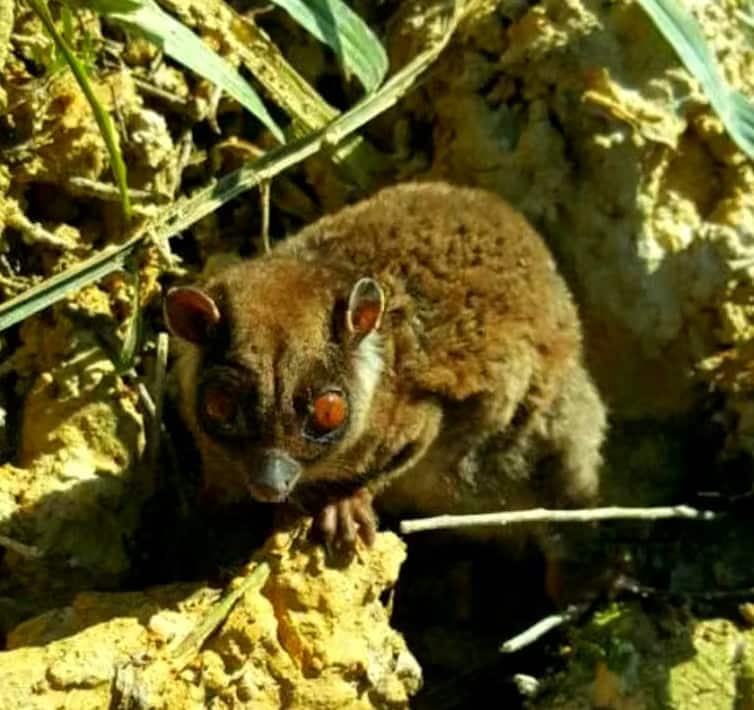
The animal did not match any known species from the island of New Guinea. When we examined the images, we realised it closely resembled a possum known only from a handful of fossil bones. These fossils, initially named Petauroides ayamaruensis, had been discovered decades earlier in archaeological sites in West Papua and more recently in Papua New Guinea.
The bones were from a small member of a group of Australian gliding possums called hemibelidines, or ringtail possums. Until recently, this lineage was thought to exist only in eastern Australia. But on the huge, biologically diverse island of New Guinea, there was no sign of its existence. Scientists presumed it had gone extinct around 6,000 years ago.
The photo was evidence this was not the case. What we were looking at appeared to be a “Lazarus species”: one that had vanished from the fossil record, only to reappear alive.
Other famous “Lazarus” examples include the Coelacanth, a large species of fish thought to be extinct for 66 million years until it was rediscovered off the South African coast in 1938.
Meet the new genus, Tous
To confirm our suspicions, we analysed the photographs and made careful comparison with the fossil teeth from Papua and new partially fossilised material from a different location in PNG. The size and shape of mammal teeth and their cusps are very important in distinguishing species. Our analysis of fossil and photographs strongly suggested these all referred to the same animal.
To confirm it, we drew on knowledge shared by local Indigenous landowners who have always known about this animal — it is sacred to some tribal groups in the region.
This confirmed the animal was not only a surviving individual of the fossilised possum, but distinct enough to require an entirely new genus, which we have named Tous.
“Tous” is a local vernacular term applied to this forest species, which is locally recognised as distinct from smaller gliders. During interviews with traditional landowners, elders identified the animal in photographs as “Tous wansai” distinguishing it from other similar arboreal marsupials.
That makes this discovery exceptionally rare. Establishing a new genus means identifying a lineage that has been evolutionarily separate for millions of years.
In this case, the evidence suggests Tous is from an ancient branch of the possum family tree, one that once extended from Australia to New Guinea, and today survives in a small, vulnerable corner of the Papuan forests. Traditional knowledge indicates Tous roots in tree hollows in the tallest rainforest trees. Like Australia’s greater glider, it is vulnerable to logging.
Protecting the new species
It is this vulnerability that concerns us most. When we formally described Tous, we did not disclose the precise location the original photograph came from. We are unfortunately not able to identify the local Indigenous landowners for similar reasons. With its large forward-facing eyes, soft fur and prehensile tail, Tous is undeniably appealing to wildlife traffickers.
In an era of social media–driven wildlife trade, that appeal can be dangerous. Newly discovered species have sometimes been pushed toward exploitation almost as soon as they are announced. There were, for example, only 22 years between the rediscovery of the Javan rhinoceros in Vietnam in 1988 and its confirmed extinction because of poaching in 2010.
Protecting Tous will not be straightforward. We still don’t know its full range, but all evidence suggests it is restricted to a small region of New Guinea where lowland forests are under pressure from logging and agricultural expansion. Even in the photos, you can see logging debris and planted oil palm in the background. Local people told us it forms a pair and is monogamous, producing a single baby in a year. This likely low reproduction rate means it is especially vulnerable to hunting and habitat loss.
The knowledge that led us to this discovery came not only from fossils and photographs, but from local communities who have known this animal for generations.
If conservation builds on that knowledge, and if communities benefit from keeping wildlife alive rather than harvesting it, then Tous may have both a past and a future.
Erik Meijaard is honorary professor of conservation at University of Kent; Kristofer M. Helgen is adjunct professor at University of Technology Sydney, and Tim Flannery is honorary fellow at Australian Museum.
Helgen is affiliated with the Bernice Pauahi Bishop Museum, Honolulu, Hawaii. Meijaard and Flannery do not work for, consult, own shares in or receive funding from any company or organisation that would benefit from this article, and have disclosed no relevant affiliations beyond their academic appointment.