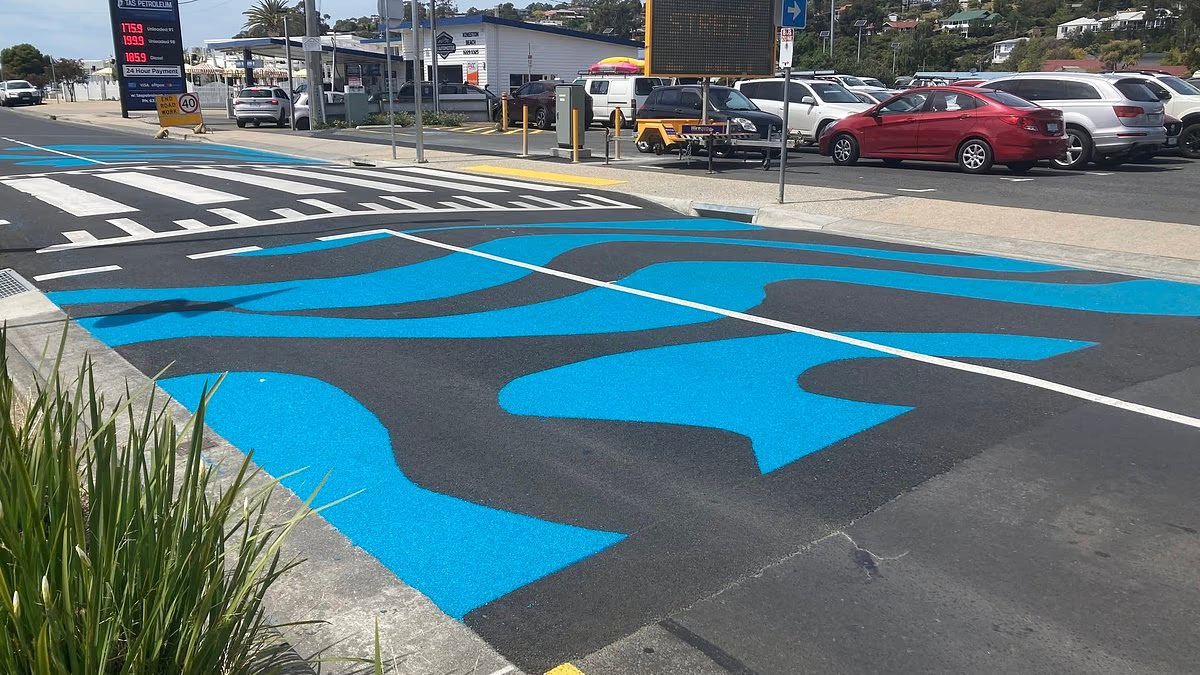
Australians have taken aim at a local council over a $52,500 taxpayer-funded road safety project, arguing the bright blue markings painted on the street have made the area more confusing rather than safer.
The distinctive blue designs, which look like waves across the roadway, appear at several points along Beach Road in Kingston Beach, a coastal suburb about 16km south of Hobart in Tasmania.
The markings were first added in December last year as part of a federally funded initiative intended to highlight pedestrian crossings and intersections for drivers and improve road safety.
The surface treatment was created with OmniGrip, a high-friction product made using recycled glass and commonly used to improve grip on road surfaces.
In a Facebook post, Kingborough councillor and deputy mayoral candidate Will Perry criticised both the price tag and the decision to spend the funding on the blue road markings.
‘Council got $50,000+ tax payer money for pedestrian safety. They painted the road blue instead,’ Perry said.
‘I couldn’t believe that more than 50 grand of public money had been absolutely squandered on this project that was meant to improve pedestrian safety.
‘Instead of investing in proven measures like vehicle-activated speed signage or better crossings, council spent it on decoration.

Road markings in Tasmania designed to improve safety have been described as a ‘complete waste’ over their $52,000 price tag

The road markings can be seen at several locations along Beach Road in Kingston Beach, 16km south of Hobart, and resemble blue waves
‘A missed opportunity. Enough of the fancy stuff while the budget’s in deficit. This was a complete waste.’
‘Everyone still raises the blue wave wastage everywhere I go.
‘The really disappointing part is council had an opportunity to make a real difference to the safety of our children and families.’
Perry also said the markings made ‘zero positive difference to safety whatsoever’.
‘That $50,000 was a pedestrian safety grant,’ he said.
‘[Locals] have seen a number of vehicles lose their wing mirrors that are parked on the side of the road here and near misses with kids and parents that pick up and drop off.
‘And let’s face it, there’s a range of proven road safety options that could be used to help address the speeding here, like vehicle activated electronic signage for instance.’
One commenter on Perry’s post argued, ‘Speed bumps would probably do a much better job.’

Markings were applied to key intersections and pedestrian crossings including the raised threshold at the entrance to Kingston Beach, both sides of the wombat crossing on Beach Road and between the kerb extensions at Balmoral Road
‘These “decorations” have actually made it more dangerous,’ another person suggested.
‘A huge missed opportunity to protect the little ones,’ they wrote.
One area where the markings were placed was near the Kingston Beach Early Learning Centre.
Despite the backlash, Kingborough Council said the markings improved public safety.
‘They highlight busy areas and encourage drivers to slow down as they approach,’ it said.
A council spokesman told Yahoo the ‘blue waves’ had already been effective in other parts of Australia, including Victoria, and that research supported the preventative measure.
‘[The markings are a] recognised road safety treatment designed to influence how drivers perceive the road environment,’ he said.
‘Research has shown that changing the visual appearance of the road can influence driver behaviour, encouraging motorists to slow down and drive more cautiously.

Candidate for councillor and deputy mayor of Kingborough, Will Perry, (pictured) said he was shocked at the hefty price tag
Join the discussion
Should councils focus on bold new road designs or proven safety measures to protect the community?
‘A study by the Monash University Accident Research Centre undertaken for the Australian Transport Safety Bureau found that visual road treatments, including perceptual countermeasures, were effective in reducing travel speeds.’
The council spokesman also said that the markings were backed by residents before they were installed.
‘The measures installed at Kingston Beach were selected following community consultation and consideration of local safety concerns, with 83 per cent of survey respondents supporting the use of perceptual countermeasures.’
Daily Mail has contacted Kingborough Council for comment.


