
As countless Americans prepare for a final summer retreat to the beaches this Labor Day weekend, officials are advising caution due to the risk of potentially hazardous bacteria in coastal waters.
States and local counties have been posting advisories all week about closures and more are still being added to the list.
At least 100 beaches across seven states, mostly on the East Coast, are now closed or have been put under advisories because of bacterial blooms.
These advisories recommend avoiding contact with the water, as ingestion or exposure through an open wound could result in stomach ailments, skin rashes, or nausea, with severe cases leading to life-threatening infections.
Some of the nation’s well-loved beaches, such as Keyes Memorial Beach in Cape Cod, Massachusetts, and Benjamin’s Beach on Long Island, New York, are currently under warning.
Many beaches around Los Angeles, California and one in Hawaii have also had warnings put in place because of the rapidly multiplying bacteria.
While the exact reason for the spike in bacteria is uncertain, it may be attributed to the recent rainfall, which could be flushing sewage or agricultural fertilizers into waterways.
Alerts have predominantly been prompted by E. coli, a bacterium commonly found in feces that can cause abdominal pain and diarrhea if ingested through tainted water. This affects both freshwater and saltwater beaches.
Officials also caution that harmful micro-organisms might be present, such as Vibrio vulnificus, a flesh-eating bacterium that infects open wounds and has a one-in-five mortality rate.
The pathogen Naegleria fowleri also lives in freshwater and can infect people if water enters their body through openings. The micro-organism attacks the brain and is nearly always fatal, killing about 97 percent of patients.
DailyMail.com pored through local news reports and state websites to establish which beaches had closures or advisories in place this weekend.
The seven states with shuttered beaches are: California, Delaware, Hawaii Massachusetts, Michigan, New York and North Carolina.
Massachusetts had the most closed beaches at 50, followed by Delaware with 28, while Michigan and California both had seven.
New York had closed four due to bacteria, while Hawaii had closed one.
Among the beaches shuttered over this weekend was Rehoboth Beach in Delaware, where people there told the Associated Press they were unconcerned about the warnings.
Yaromyr Oryshkevych, a retired dentist enjoying the Labor Day weekend, said: ‘I really don’t expect to be in any kind of danger of fecal contamination.’

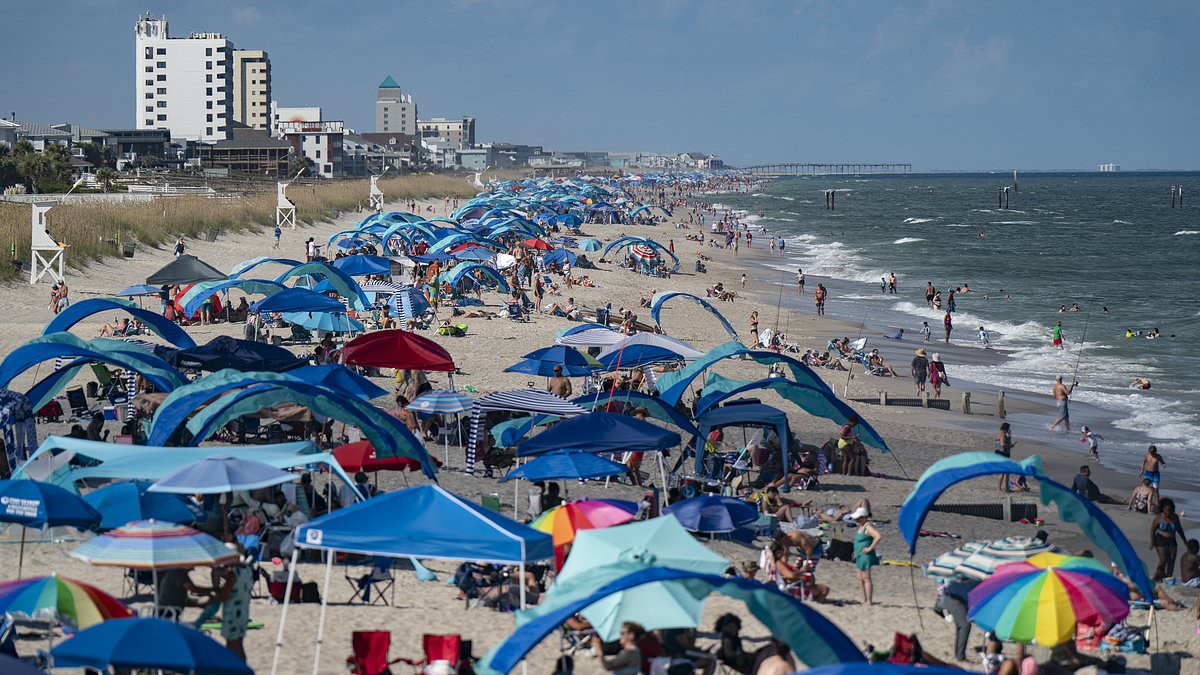
Shown above are beachgoers at Kure Beach, North Carolina, on Labor Day last year. Kure Beach does not currently have a bacteria warning in place (file photo)

Beachgoers told reporters that they were unconcerned by the warnings. The above image is from Seal Beach, California, and was taken in 2022 (file photo)
He said that he felt the beach wasn’t polluted enough for him to be worried, and he thought the current would wash the bacteria away.
Dana West, a federal worker also at the beach, said: ‘Generally, I have no concerns about the level of fecal and bacterial matter.
‘I assume the local authorities will tell us if there are higher levels than normal.’
West did recount an instance earlier this year in Isla Mujeres, Mexico, where a dozen members of a vacationing party he was with experienced a gastrointestinal illness after going on a snorkeling excursion. It was suggested that this could have been linked to swimming in contaminated water.
Advisories are triggered if E.coli levels in water exceed 235 colonies per 100 milliliters.
About 265,000 people are sickened with E. coli every year, reports suggest, although these are normally linked to contaminated food.
Early warning signs of an infection include abdominal cramps, diarrhea, which may be bloody and nausea and vomiting. In serious cases, these can become severe and patients can become dehydrated, suffering from dizziness and decreased urination.
The infections are more dangerous in old people, those who have a weaker immune system, and young children, with about 100 people dying from E. coli in the US every year.

Experts warn that the fecal matter contaminating the water can cause a bloom in bacteria, which can then make beachgoers sick
Patients are treated for the infections using fluids to keep them hydrated and, in more severe cases, antibiotics to clear the bacteria.
When E. coli is present in water, however, experts say it is likely that other more dangerous micro-organisms are also multiplying in the water, including Naegleria fowleri and Vibrio vulnificus.
Only around five people have ever survived a Naegleria fowleri infection in the US, statistics suggest, out of about 164 infections.
It comes after Environment America, an environmental action group, released a report this summer that found nearly two-thirds of beaches nationwide had at least one day of unsafe fecal contamination in 2024.
The group reviewed beaches on the coasts and Great Lakes for its report.
Overall, the Gulf Coast was worst, with 84 percent of beaches reporting at least one day where the water was unsafe every year, they said.
On the West Coast, 79 percent of beaches had at least one closure a year, while on the Great Lakes it was 71 percent and on the East Coast it was 54 percent.
The report also said that 450 beaches were potentially unsafe for swimming on at least 25 percent of the days tested.
John Rumpler, an attorney with environment action group Environment America, said: ‘These beaches are a treasure for families across New England and across the country.’
‘We need to make the investment to make sure that literally our own human waste doesn’t wind up in the places where we are swimming.’