I’m reporting from Warsaw, where Nato officials, military leaders and security experts have gathered for a major conference.
Across conversations here, one concern has surfaced again and again: Vladimir Putin may be weighing a reckless escalation. Western intelligence assessments suggest Russia is losing around 6,000 more soldiers in Ukraine each month than it is able to replace through recruitment, and officials believe that pressure could be pushing the Kremlin toward a dangerous move.
As one senior Baltic security source told me last night: “It’s a question of when, not if.”
The fear, in blunt terms, is that Putin could engineer a direct “provocation” involving a Nato member state — with Estonia, Latvia or Lithuania viewed as the most likely flashpoints.
The darkest scenario being discussed is not, thankfully, a full-scale Russian invasion that would risk igniting World War Three. Instead, officials are focused on the possibility of a so-called “false flag” operation, in which Russia could covertly target its own citizens and then use the incident to justify action against Nato.
One example raised by security figures involves drones made to appear “Ukrainian” striking civilian sites inside Kaliningrad, the Russian exclave on the Baltic Sea wedged between Lithuania and Poland. Moscow could then claim, falsely, that Ukrainian forces launched the attack from one of those Nato countries — creating a pretext to hit Ukrainian troops it says are being protected there.
The actual target would matter little. It could be an empty structure or a cluster of tents near a Nato installation.
No soldiers or civilians would necessarily have to be harmed. What would matter to the Kremlin is the narrative: Russian audiences would be told their forces had destroyed a Ukrainian unit and delivered a clear “warning” to Nato.

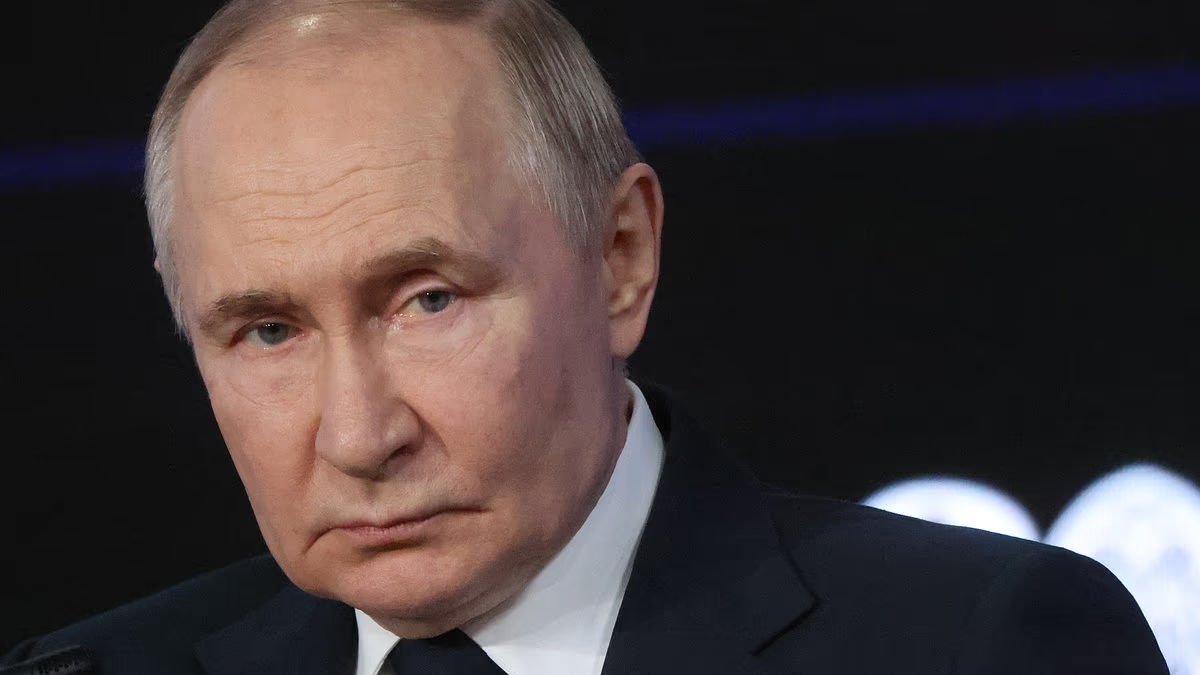
Vladimir Putin is losing 6,000 more Russian troops in Ukraine every month than he can recruit

Andy Burnham, pictured with Volodymyr Zelensky, is struggling with the defence budget
Thus, Russian military actions in and against the West would have been normalised for the first time.
For any readers thinking that killing his own people would be out of the question even for Putin, the terrible fact is that he has almost certainly done it before. In 1999, he likely ordered the planting of bombs in four apartment blocks across three Russian cities: an atrocity that killed more than 300 people.
Just as Hitler burned down the Reichstag in 1933, blaming the fire on a ‘Communist conspiracy’ and using it as a pretext to seize absolute power in Germany, so the apartment bombings paved the way for Putin to become an all-powerful tsar, launch the second Chechen War, censor the domestic media, steal the assets of his political rivals and throw his enemies in prison.
But even if Putin did not go as far as a false-flag operation, he could try something else. He might, for example, claim there was a ‘humanitarian crisis’ in Kaliningrad, fabricating a tale that Russians there were starving, while inflicting hardship on them by secretly blocking supply shipments to the exclave.
This, he would argue, could be resolved only by sending large numbers of Russian troops to help. These he might order to march into Kaliningrad from Russian-controlled Belarus.
But since Belarus does not share a land border with Kaliningrad, the troops would have to cross Lithuania via the 25-mile Suwalki Gap: the shortest path between Belarus and Kaliningrad, which crosses Lithuanian and Polish territory.
Thus, again, Russian forces would be operating for the first time directly on Nato soil.
Earlier this year, as a matter of fact, German armed forces wargamed precisely this second scenario. In that simulation, America publicly refused to step in, Germany did not act, while Poland mobilised its troops but did not send them across its borders.
The conclusion of that wargame? Putin succeeded in destroying Nato’s critical Article 5 ‘mutual defence’ clause, endangering Eastern European nations and achieving a vital victory.
Finally, there is a third option: a major non-military ‘hybrid’ strike using Russia’s well-honed cyber and sabotage capabilities. This might include, for example, targeted assassinations via hired proxies, or attacks on Western power plants, water-treatment centres, sub-sea cables, hospitals or other crucial infrastructure. The goal would be to cripple society and sow division and unrest.
Last year the Kremlin’s digital thugs hacked into Jaguar Land Rover’s computer systems. The attack closed the firm for five weeks, hit 5,000 other businesses and cost the British economy £1.9billion. Now imagine that repeated on the NHS, on banking and pensions, on food retail, for days or weeks at a time.
The next Pearl Harbor may not be an attack on our military readiness, but on our society’s resilience.
All that should be alarming enough. But as our world grows more dangerous, our new Prime Minister appears preoccupied with baubles such as cheaper buses or tiny cuts to VAT on fuel bills.
Andy Burnham is dragging his heels on the most important issue of our time: the defence of the realm.
At Prime Minister’s Questions this week, he was called out by Tan Dhesi MP, the Labour chairman of the defence select committee, who told him that ‘vibes’ wouldn’t defend our island – a dig at his boss’s incessant social-media campaigning.
Burnham may be dangerously complacent, but others in Europe have seen the light.
Poland has rapidly increased its military budget, the Baltic republics are stepping up, and even Germany is ploughing billions into re-arming. So why is Britain abandoning its military-leadership role in Europe?
We even learnt yesterday that Burnham plans to pay billions out of Britain’s shrunken defence budget to hand the Chagos Islands to Mauritius, a Chinese ally, in one of the most craven national subjugations I have witnessed in my lifetime.
The PM appears equally wedded to the hated Northern Ireland Veterans Bill, which will hound brave ex-servicemen through the courts on often spurious pretexts: a policy that Labour’s own ex-Armed Forces minister Al Carns rightly declared ‘unfit for purpose’.
Tory leader Kemi Badenoch gets it, promising to cut the bloated welfare bill, scrap the Chagos sell-out and increase our defence spending to 3 per cent of GDP by 2030.
She understands that the point of re-arming is not to fight, but to deter. Should she win the next general election, which may be far sooner than Burnham is claiming, there will be much to do.
First, we lack conventional weaponry. The dismal state of the Royal Navy shames our seafaring nation. We are desperately short of tanks, planes and troops, and we need a larger reserve.
Second, drones, especially those enabled with AI and swarm technology, are rapidly changing how modern wars are fought. Our capabilities here lag far behind those of Ukraine and Russia.
Third, the ‘hybrid’ integration of military and non-military tools, including civilian satellite intelligence and state-of-the-art software, will further dictate warfare.
As a former Tory MP, I am ashamed at the way my party cut back on defence when in power. I am delighted that Kemi is turning things around, while recognising how much needs to be done.
Deterrence is expensive – but is always cheaper, in lives and money, than fighting. Every day Burnham dawdles risks a terrible reckoning.
Dr Bob Seely MBE is the author of The New Total War