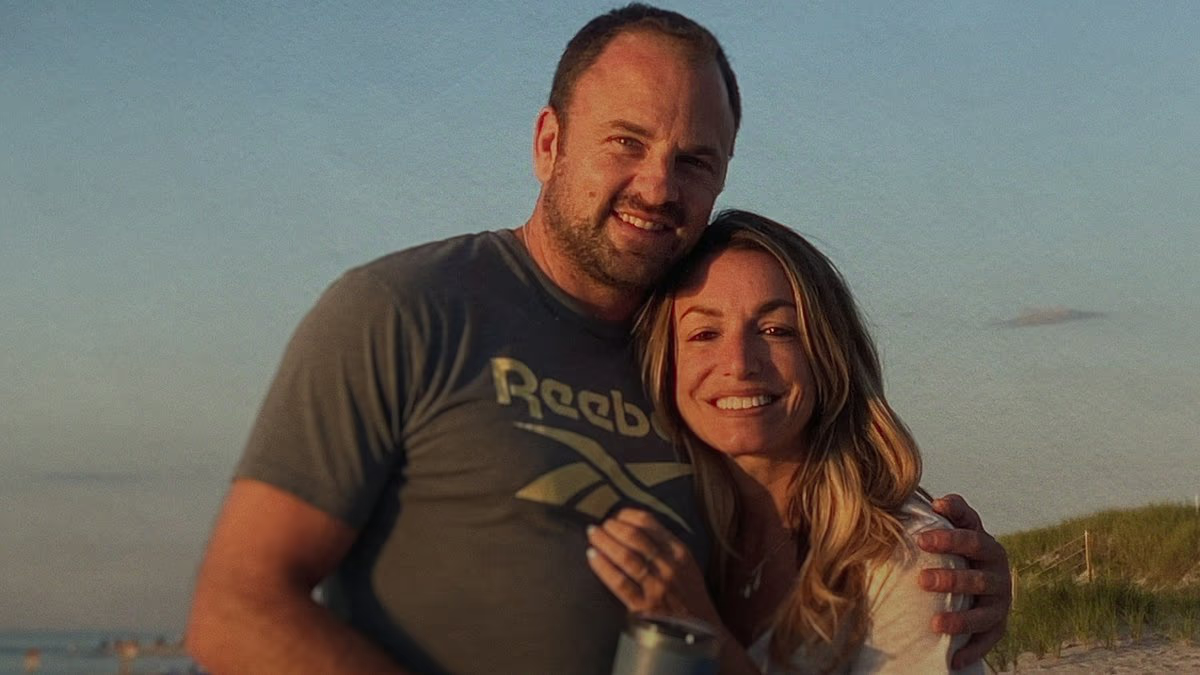

Friends of Boston police officer John O’Keefe have spoken publicly about the Karen Read case, saying allegations against them have left them frightened for their safety.
Several central figures revisit the case in Netflix’s three-part documentary, released Monday, a year after Read was acquitted at her second trial of killing her boyfriend.
Colin Albert, one of O’Keefe’s friends, said in the documentary that the fear has become part of his daily life.
‘I am scared every single day that somebody is going to come up to me, whether they try to attack me or do something horrible,’ Albert said.
‘That is something I live with every day.’
O’Keefe was found unconscious in the snow outside the Canton, Massachusetts, home of fellow Boston police officer Brian Albert during the early hours of January 29, 2022.
An autopsy determined that he died from blunt-force head injuries and hypothermia.
The previous evening, Read and O’Keefe had been drinking with friends in Canton, many of whom worked in local law enforcement. The gathering later continued at Brian Albert’s home.
Read said she dropped O’Keefe at the house before returning home, where she woke several hours later and realized he was missing. People inside the home, however, maintained that O’Keefe never came to the party.

Karen Read faced two trials over the death of her Boston police officer boyfriend, John O’Keefe

Colin Albert, whose uncle owned the home where O’Keefe was found, said he fears being targeted because of the case
Read was charged with second-degree murder, manslaughter while operating under the influence of alcohol and leaving the scene of an incident involving personal injury and death.
Prosecutors argued that Read, intoxicated at the time, struck O’Keefe with her SUV and left him in the snow during a blizzard.
Read’s defense team offered a starkly different account, claiming O’Keefe was killed inside the Albert family’s home and that his body was later placed outside. They argued Read had been framed in an elaborate police cover-up.
The prosecution divided Canton and drew large crowds of true-crime followers to the courthouse during both trials. Many supporters wore pink in connection with the ‘Free Karen Read’ movement.
Read’s first trial ended with a hung jury in 2024. At a retrial the following year, she was acquitted of second-degree murder, manslaughter and leaving the scene of a fatal collision.
In The Trials of Karen Read, several people who were present that night give their accounts in media interviews for the first time. They also describe the personal impact of accusations that they played a role in O’Keefe’s death.
Brian Albert rejects the defense theory that O’Keefe entered his home, telling Netflix that the claim makes no sense.
‘There were a lot of people in my house that night,’ he says.

O’Keefe was found unconscious in the snow outside fellow officer Brian Albert’s home in Canton, Massachusetts, on January 29, 2022

Prosecutors said Read struck O’Keefe with her SUV while drunk and left him in a blizzard, while her defense argued she had been framed in a police cover-up
‘If John had entered through either door, everyone in the middle of the kitchen would have seen him. John O’Keefe never came into my house.’
Colin Albert, Brian’s nephew, said online speculation about him grew so intense that federal agents unexpectedly arrived at his home.
‘I was completely in shock,’ he says. ‘It felt like something out of a movie.’
Albert was subpoenaed to testify before a federal grand jury, although the investigation ended without criminal charges.
Brian Higgins, an ATF agent and another friend who was at the house that night, also discusses his flirtatious exchanges with Read. He said she allegedly leaned in and kissed him several weeks before O’Keefe died.
Text messages presented during Read’s trials showed the pair exchanging flirtatious compliments and calling one another ‘hot.’
‘It certainly doesn’t make me look like a good friend,’ Higgins says in the documentary, acknowledging that the messages made him a focus of scrutiny during the second trial.

Fellow officer Brian Albert rejected the defense theory of a cover-up in the Netflix documentary

Members of the O’Keefe family, from left to right: Kristen, Paul O’Keefe, John O’Keefe Sr, Peggy O’Keefe and John O’Keefe
‘They decided to make me the bad guy,’ he says. ‘You cannot undo that. Some people will see you differently for the rest of your life.’
The documentary also includes two jurors who explain the doubts that led them to find Read not guilty at her second trial.
‘Honestly, I thought it was most likely that she did it,’ one juror says.
‘But under the standards of our legal system, she was not guilty because there were so many possible explanations.’
‘He could have entered the house, been assaulted, or been struck by a snowplow. It was doubt after doubt, and there was more than enough reasonable doubt.’
The series also features interviews with relatives, friends and others connected to the case, including O’Keefe’s niece, Kayley Furbush, and former Massachusetts State Police Trooper Michael Proctor.
Director Danielle Johnson Cutts said the filmmakers aimed to create a ‘well-rounded series’ built around multiple firsthand perspectives on the widely followed case.

Protesters gathered outside Norfolk Superior Court in Massachusetts during Read’s 2024 trial
The filmmakers contacted Read and her legal team during the early development of the project, but she chose not to participate.
Instead, the documentary uses previously unreleased audio from a 2023 interview Read gave to Boston Magazine, in which she described her account of the night.
During a 2024 interview with ABC News, Read said she would ‘never’ deliberately hit O’Keefe.
‘To tap him with my 6,000-pound, full-size SUV and hit John’s body with my car? No,’ she said.
Our News Outlet has contacted Read for comment.


