
Canada is putting its proposed expansion of medically assisted dying on indefinite hold, meaning people whose only diagnosis is a mental illness will not yet be eligible for the program.
The system, known as MAiD, was introduced in 2016 for patients with terminal conditions. Five years later, eligibility was broadened to include people with serious, incurable illnesses who were not necessarily nearing death.
A further change had been scheduled for March 2027, when MAiD access was due to extend to individuals living with severe mental illness as their sole medical condition.
However, Justice Minister Sean Fraser said Wednesday that the government would suspend those plans indefinitely.
“While there is not a perfect consensus on this issue, we believe this is the correct approach,” Fraser said.
Advocates for extending MAiD to people with mental illness alone argue that excluding them violates their constitutional rights and denies them equal access to healthcare.
Opponents, however, say medical science does not yet have a reliable enough understanding of mental illness to determine safely and consistently which patients could qualify for assisted death.
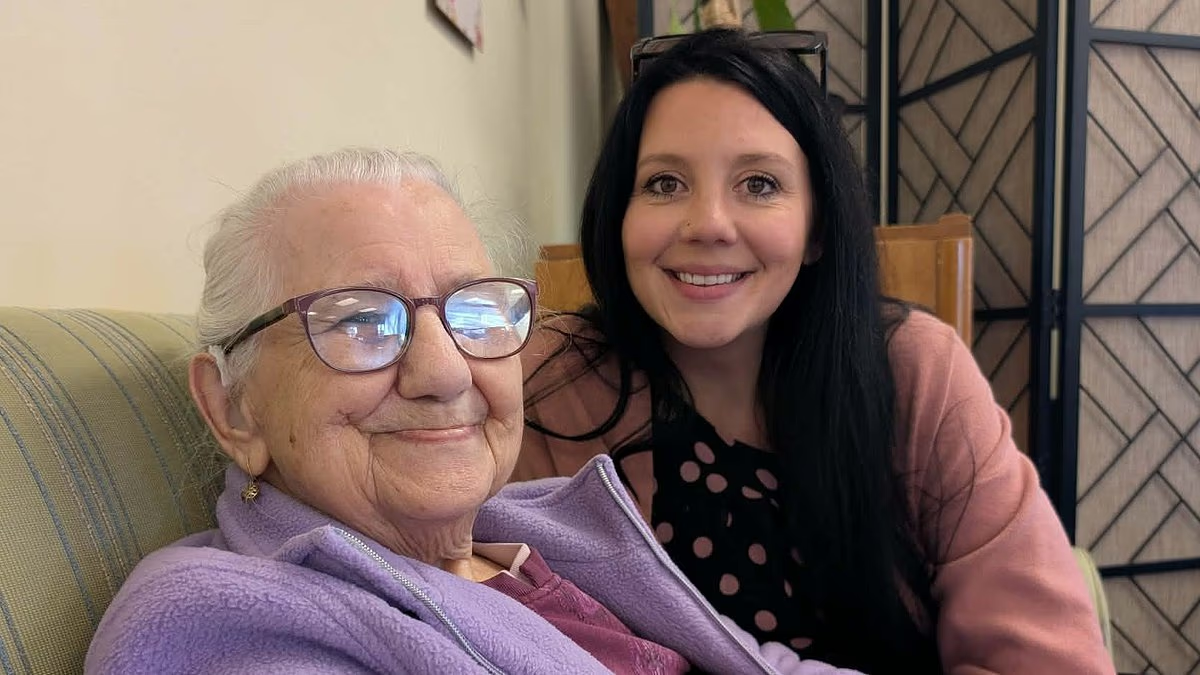
The decision came shortly after an Ontario family claimed that their 83-year-old grandmother, Brigitte Stegemann, had been euthanized without being capable of giving informed consent.

Canada has paused plans to broaden its medically assisted dying law after an Ontario family alleged that their grandmother, Brigitte Stegemann, was euthanized against her wishes

Justice Minister Sean Fraser announced the suspension, ending plans for now to give people with mental illness alone access to assisted death

Fraser confirmed the decision on Wednesday, saying: “While there is not a perfect consensus on this issue, we believe this is the correct approach”
According to her granddaughter, Brigitte Kranendonk, Stegemann failed every question in a cognitive assessment intended to establish whether she could consent to MAiD. She reportedly believed that two of her surviving siblings had already died.
Two days before the procedure, Kranendonk said she spoke directly with her grandmother to ensure that Stegemann understood what was about to take place.
“I used very frank terms. I said: ‘Do you know that you’re going to die on Friday?’”
Stegemann, who was affectionately known within the family as “GG” or “Oma,” appeared shocked and cried for about 45 minutes. “I’ve made a mistake,” she reportedly said.
“She was bawling. Inconsolable,” Kranendonk told Our News Outlet.
Kranendonk said Stegemann died roughly 48 hours after that emotional conversation, with her hands clasped in prayer. She also alleged that the first attempt to insert an IV went wrong, leaving Stegemann covered in her own blood, and claimed the nurse was not wearing gloves.
“She was a vulnerable human being, and they saw an opportunity,” Kranendonk said.
She believes the healthcare workers involved may have been driven by inappropriate ideological motives and says the circumstances surrounding the procedure should be formally investigated.

Fraser said he was concerned by “a lack of consensus in the medical community about the irremediable nature of certain mental illnesses”

Two days before Stegemman’s assisted dying procedure, she said ‘I’ve made a mistake,’ and was ‘bawling,’ her granddaughter said
It is understood that the practitioners and care home, who have not commented publicly, maintain that Stegemann had legally consented to proceed.
The suspended expansion of MAiD to people who are solely mentall ill would not have made Stegemann ineligible for the procedure, as she had been diagnosed with stage 4 stomach cancer, which qualifies as a terminal illness.
However, critics of the expansion believe that the suspension could save lives, as some individuals who may be better served by improved access to housing and healthcare would not not be able to apply to MAiD to alleviate their suffering.
Fraser also emphasized his ‘concern’ about ‘a lack of consensus in the medical community about the irremediable nature of certain mental illnesses.’
Canadian legislators said they will introduce a new law that codifies indefinitely suspending MAiD’s expansion.
But the law would also allow patients who have progressive incurable diseases to consent to assisted death before their health deteriorates so much that they are no longer able to. Advanced consent to MAiD is currently illegal.
This is a breaking news story. More to follow.