
Share this @internewscast.com
In a rare public statement, the nation’s Chief Justice, John Roberts, has firmly advised former President Donald Trump to refrain from making personal attacks on the Supreme Court. Roberts emphasized the potential dangers of such criticism, urging that it “has got to stop.”
While acknowledging that critiques of judicial rulings are part of the democratic process, Roberts made it clear that hostility directed at individual justices crosses a line. “Personally directed hostility is dangerous,” he stated, underscoring the need for civility in public discourse.
The Chief Justice highlighted that disagreements among justices are a normal aspect of their work, and he welcomed scrutiny of the Court’s decisions as a vital component of accountability. However, Roberts cautioned that shifting from “legal analysis to personalities” could lead to perilous consequences.
Roberts delivered these remarks during an appearance at Rice University’s Baker Institute for Public Policy in Houston on Tuesday.
Following Roberts’ comments, U.S. District Judge Lee Rosenthal, appointed by George H.W. Bush, expressed gratitude on behalf of trial judges. She acknowledged the support from Roberts, noting, “We always know that you have our backs, and that means a great deal.”
US District Judge Lee Rosenthal, a George HW Bush appointee, thanked Roberts on behalf of trial judges, saying ‘we always know that you have our backs, and that means a great deal.’
Trump on Sunday singled out two of his own appointees, Amy Coney Barrett and Neil Gorsuch, accusing them of having ‘gone out of their way’ to oppose him with ‘bad and wrongful rulings,’ in a Truth Social tirade.
He called the Supreme Court a ‘weaponized and unjust political organization’ that ‘routinely sides with the radical left Democrats’ and will ‘only get worse.’

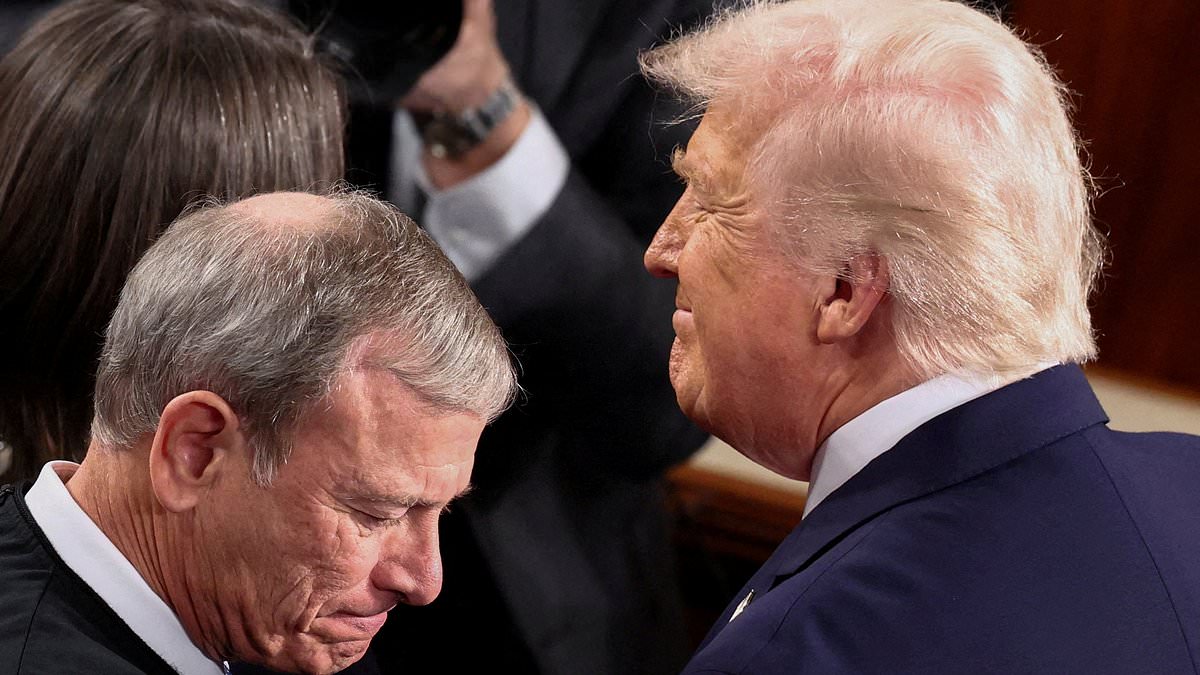
Donald Trump shakes hands with Supreme Court Chief Justice John Roberts as he arrives to deliver his State of the Union address in the House Chamber of the US Capitol in Washington, DC, on February 24

Trump greets Supreme Court Chief Justice John Roberts ahead of the State of the Union address during a Joint Session of Congress at the U.S. Capitol on February 24
Trump also vowed to call out their ‘bad behavior’ despite admitting it would cause future problems.
Roberts joined Coney Barrett and Gorsuch in the 6-3 ruling on February 20 that struck down Trump’s tariffs.
The court determined that the International Emergency Economic Powers Act did not grant the President the authority to impose his sweeping ’emergency’ tariffs.
Conservative justices Brett Kavanaugh, Clarence Thomas and Samuel Alito dissented.
The ruling wiped out the legal basis for Trump’s global tariff policy, blowing a $1.6 trillion hole in government revenue.
The Trump administration immediately pivoted to a new 10 percent baseline tariff under a separate authority.
The new tariff, announced on February 24, applies to nearly all imports, with the administration threatening to raise the rate to 15 percent later this year.
Trump’s team is scrambling to claw back the lost revenue as companies file for refunds after the previous tariff authority was voided.

Cabinet members US Secretary of the Interior Doug Burgum, Attorney General Pam Bondi, Defense Secretary Pete Hegseth, Treasury Secretary Scott Bessent, Secretary of State Marco Rubio, Supreme Court Chief Justice John Roberts, Supreme Court Justice Elena Kagan, Supreme Court Justice Brett Kavanaugh, and Supreme Court Justice Amy Coney Barrett listen as US President Donald Trump delivers the State of the Union address in the House Chamber of the US Capitol in Washington, DC, on February 24
The Daily Mail has contacted the White House for comment.
Threats against federal judges have risen sharply since Trump took office, with 400 judges targeted with ‘serious threats’ – a 78 percent spike on four years ago – according to the US Marshals Service.
Judge John Coughenour, a Ronald Reagan appointee, said earlier this month he has ‘never encountered the hostility’ toward the judiciary he has witnessed over the past year.
Coughenour told 60 Minutes he received hundreds of death threats and was subjected to swatting calls after Trump took issue with his ‘blatantly unconstitutional’ ruling against the President’s birthright citizenship executive order.