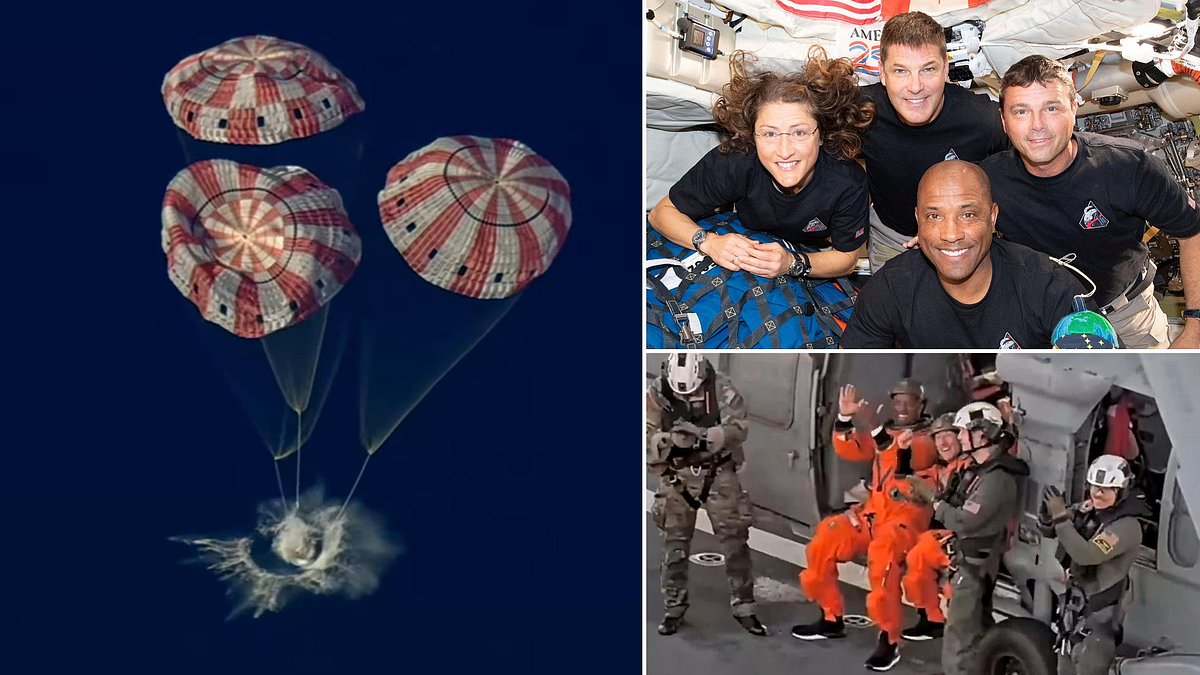

NASA’s Artemis II crew completed a landmark mission to the moon, returning safely to Earth as their Orion spacecraft navigated a dramatic re-entry through Earth’s atmosphere on Friday night.
The spacecraft traveled at astonishing speeds nearing 25,000 miles per hour before making a successful splashdown in the Pacific Ocean near San Diego, California, at 8:07 p.m. ET.
The mission featured a four-member crew: NASA astronauts Reid Wiseman, Victor Glover, Christina Koch, and Canadian astronaut Jeremy Hansen. They concluded a ten-day journey that saw them orbiting the moon and venturing farther into space than any human has ever traveled.
NASA officials hailed the Artemis II mission as a resounding success, with the spacecraft landing precisely as planned by the agency.
NASA Administrator Jared Isaacman praised the moon mission as ‘perfect’ and expressed America’s commitment to achieving a successful lunar landing and establishing a lunar base by 2028.
Isaacman stated, “We are back in the business of sending astronauts to the moon. This is just the beginning.”
Following their recovery from the Orion crew module and transfer to the naval vessel John P Murtha, the astronauts were seen in good spirits, waving to cameras and hugging Isaacman before heading for a standard medical checkup after the flight.
All four astronauts were also able to walk under their own power. Previous space flights, including the ten-month saga of stranded astronauts Butch Wilmore and Suni Williams, required medical personnel to carry the astronauts because they were unable to walk well from their time in microgravity.

Artemis II’s Orion spacecraft splashed down in the Pacific Ocean on April 10 after a ‘perfect’ reentry, according to NASA officials

Astronauts Victor Glover and Christina Koch were seen waving and hugging NASA chief Jared Isaacman after being pulled from the water
The voyage home started just after 7.30pm ET Friday night, with the Orion crew module blasting away from the spacecraft’s service module.
The separation exposed the craft’s heat shield, which protected the four-member crew as they plunged through Earth’s atmosphere, experiencing temperatures of up to 3,000 degrees Fahrenheit.
As the capsule angled in for the perfect trajectory into the atmosphere, NASA lost contact with the spacecraft for six minutes just before 8pm as Orion collided with the upper atmosphere, causing what scientists called a ‘plasma buildup.’
Once the radio blackout cleared as planned, Orion successfully deployed its parachutes and safely landed in the Pacific without incident.
A slight communications glitch between the astronauts waiting in the water and the US Navy recovery teams delayed the crew’s exit from the craft, but once flight surgeons were able to board the capsule, they were able to give all four astronauts a clean bill of health.
Dr Lori Glaze, NASA’s deputy administrator, said her team was ‘thrilled’ to have the four astronauts home safely.
‘We accomplished what we set out to do,’ added Shawn Quinn, manager of NASA’s Exploration Ground Systems Program. ‘It’s good to be NASA, and it’s good to be an American today.’
President Donald Trump added his congratulations Friday night and invited the crew to the White House, posting on Truth Social: ‘I look forward to seeing you all at the White House soon. We’ll be doing it again and then, next step, Mars!’

Pictured: US Navy recovery crews arrived at the Orion space capsule minutes after the pod landed in the Pacific at 8.07pm ET

Pictured: The NASA Artemis II crew, Mission Specialist Christina Koch, Mission Specialist Jeremy Hansen, Commander Reid Wiseman, and Pilot Victor Glover
The Artemis II mission began back on April 1 with a successful launch from the Kennedy Space Center in Florida.
A day later, the crew set off on a four-day trip to the moon, where they would travel around the dark side and break the decades-old record of Apollo 13 for the farthest distance from Earth humans have ever traveled.
While the Apollo crew travelled 248,655 miles from Earth in 1970, Artemis II reached a maximum distance of 252,756 miles on day six of their mission.
While conducting their lunar flyby, the astronauts also named two new craters discovered on the lunar surface, including naming one after the late wife of Artemis II mission commander Reid Wiseman, Carroll.
Amit Kshatriya, the associate administrator of NASA, said Artemis II was the ‘most important human space exploration mission in decades.’
‘Hopefully, history is kind to us,’ he added.

Pictured: The Artemis II spacecraft seen returning to Earth from its ten-day mission to circle the moon and break the distance record for human space flight
NASA administrators confirmed that the Artemis II flight crew was ‘happy and healthy’ Friday night. They added that the astronauts would be headed to the NASA space center in Houston on Saturday before spending time with their families.
The space agency’s focus will now turn to reviewing the data from Artemis II before beginning on the plans for Artemis III, which will also involve a lunar flyby but no landing.
Currently, NASA’s revamped plan for the moon includes sending an additional space flight, Artemis IV, as soon as 2028. That mission is expected to land on the lunar surface for the first time since Apollo 17 in 1972.
According to Isaacman, that mission will also begin the work of building a permanent US moon base which will facilitate future human space travel and a manned mission to Mars.