Iam two mouthfuls into my avocado toast when I realise what it is about Nicôle Lecky, the actor, writer and singer-songwriter at the centre of BBC Three’s new musical drama Mood, that has her so tipped for stardom. She’s cool. Not just in the conventional, strong-looks-and-swagger way, or because her affable yet direct personality makes her uniquely easy to connect with (“Nobody is too old for Ibiza,” she offers when I share my latest holiday anxiety). But it’s in the forensic way she talks about her work, detailed but never dispassionate – the sign of an artist in full control of their vision.
For Mood – based on Superhoe, her 2019 one-woman stage play – Lecky is very much in charge. She plays the lead. The script is hers. Many of the lyrics are hers (and usually sung by her, too). It’s executive produced by her, and nearly every character is one she has performed in the stage version. When we meet for breakfast in London, she’s on her way to the editing suite. “We started shooting in March. The cast and choreographer have all finished and moved on,” she says. “But I’m still here.”
Mood joins a stellar roster of television shows adapted from plays whose inspiration comes from their creator’s life: Michaela Coel’s Chewing Gum, Phoebe Waller-Bridge’s Fleabag, Sophie Willan’s Alma’s Not Normal. It’s set in the diverse, working-class communities of east London where Lecky grew up. “But I always say [Mood] is more observational than autobiographical,” she says.
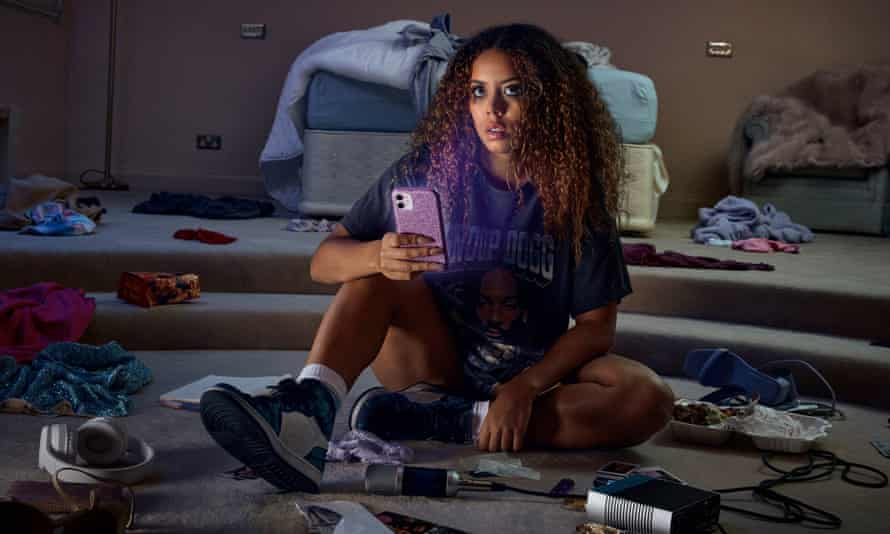
Lecky plays Sasha, a 25-year-old mixed-race singer and rapper who is going nowhere. She can’t get over her ex, and spends most of her day smoking weed and scrolling through his Instagram. When her mum eventually throws her out, she has to find a way to fend for herself. She meets Carly, a glamorous influencer who promises to show her how to make it big. But the online game is far more complex than she could have imagined, taking her on an exploration of sex work, self-expression and the weighty impact of social media on young women.
Unlike Fleabag, Chewing Gum et al, Mood is not a comedy. You might smile at the witty one-liners that she rhymes atop a rich soundtrack drawn from genres from disco to grime (“Cancel culture in my own home!” she raps, when her family kicks her out). But in the first two episodes there’s drugs, poverty, unemployment, racism and sex work – all dealt with without veering into moral panic, judgement or glamorisation.
Unlike Sasha, who is surrounded by people who don’t take her talent seriously, Lecky says she’s “had many great mentors and supporters” throughout her career. As a child, she was “into everything artsy. I wanted to dance, I wanted to sing, I wanted to do drama. I was drawing a lot.” She excelled in choir and singing lessons, and was signed by a theatrical agent by 18, around the time she joined a youth theatre. Her bright academic record meant she was accepted to King’s College for war studies, but the demands of the course meant she couldn’t act on the side. She dropped out, heading to drama school instead.
She was writing throughout – short stories, plays, poems. She won a place on a BBC scheme and ended up writing for the EastEnders spin-off E20 as a teenager. “But I had no notion of how somebody like myself would become a writer. I knew I was always writing, but I just didn’t think I could make money from it.”
It was only after she left drama school that Lecky’s focus turned back to writing. “When I got my writing agent, I was like: ‘Here are all these scripts I’ve written.’ There was a body of work that was unseen, because it’s what I loved to do.”
Happily, Lecky says her family have always been supportive, which she recognises is not always the case for working-class creatives, and that she no longer needs to pick between her passions. “I feel more empowered now, much more than when I was trying to pay my rent. A lot of the time you audition for stuff and you don’t even fucking want it, but you’re just like: ‘I need to eat.’”
The realities of money and identity are at the heart of Mood. We see how characters experience similar things differently due to race, economics or mental health. In one scene, Sasha visits her friend – who is Black – and is joined by her white roommate as she laughs about the “free the nipple” movement on Instagram: “You posh girls,” says Sasha’s pal. “If we did that, everyone would be chatting shit.”
To create the script, Lecky interviewed dozens of women involved in online sex work. She has consistently said in interviews that she is pro-sex work and sex-worker rights. But the real-life stories she heard didn’t fall neatly into either side of the debate. “I think that’s why, with this show, I’ve tried to look at the nuance,” she says. “I met one woman who came across very happy, and acted like she loved all of it. But later she levelled with me that there were things about it that bothered her. She makes shitloads of money, though.”
There were other stories she came across, which she found herself disturbed by. “I formed connections with people I was talking to, particularly the younger girls. I was really fearful for one because she was doing it in secret.
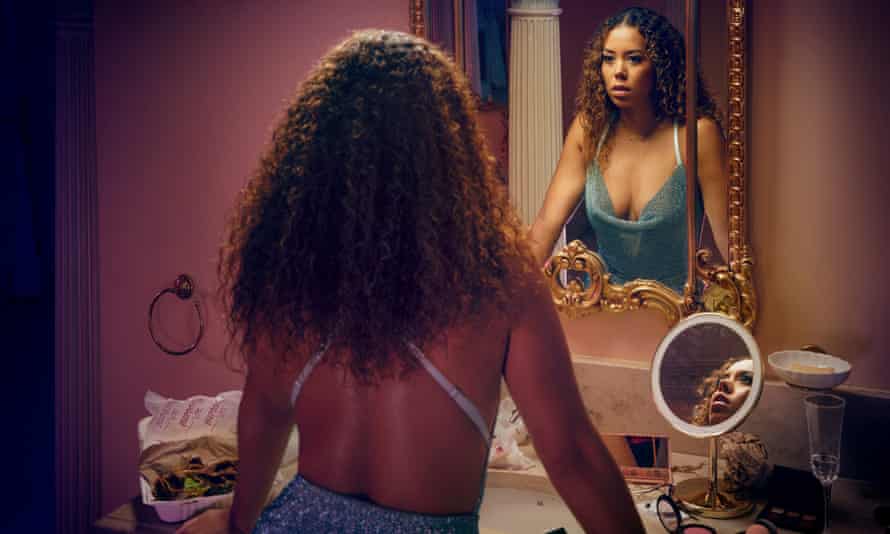
“I said to her the first time she did it: ‘What did you buy?’ She said: ‘I bought weave bundles.’ That sent me. I thought there was something quite innocent about it. Her Instagram was flawless, stunted out. I just thought: “At that age, I don’t remember being 18 and feeling a pressure that I had to look like I had all this money. Why would you have that much money?”
Did she find there was a split in how women perceived sex work, along generational, class or even racial lines? “Not generationally, as everyone I spoke to was under 35. But there can be a split, culturally, in terms of what your upbringing is and what you’re exposed to sexually and politically. Where I grew up in east London, there was a lot of sex-shaming in secondary schools. I think back to school years and think how fucking hard you have it as a teenage girl.”
Lecky was wary of passing judgment on any of the stories her interviewees shared with her. “If somebody tells me something, I take them at their word because how can I tell a grown woman that she isn’t empowered? Who am I to define somebody else’s liberation? Even that 18-year-old girl, in my head, I’m going: ‘When she’s my age [Lecky is 31], she’s going to regret this.’ But maybe she won’t, maybe that’s my internalised [misogyny]. There are a lot of people grinding for their jobs and getting far less money – so who’s happier?”
I tell Lecky that we share some background – I grew up in a neighbouring working-class, ethnically diverse borough – and I recognised many of the small details, from the slang to the shots of the Docklands Light Railway (most shows opt for the tube). She smiles. “Specificity is my thing. I didn’t want [Mood to feel] general, because I’d done so much research.”
Does she feel the burden of representation when she writes about these marginalised groups, especially ones so close to home? “I don’t actually feel that pressure, interestingly. These are people from my experience and I love my community. I see it more as a positive, as inspiration. I can’t get everything right. I’m OK with that.”
Lecky says getting to this point has been a journey. She recalls coming off stage after performances of Superhoe and meeting audience members in tears. “They would come up to me afterwards and tell me secrets, maybe they’d sofa-surfed and slept with the guy whose sofa it was for free rent. It was really sad because it was like they were carrying this shame. I’m like: “That’s not your shame to bear. Someone’s been exploiting you.”
When adapting the show into the scripts needed for Mood, Lecky would feel bad for having to cut those stories. But soon enough she learned it simply wasn’t possible for one writer to do it all. “You are one person. You can’t represent your whole community. I’m like: ‘You lot who are commissioners, commission more people from the community who have different experiences.’ It’s not for me to do that. That’s not me resisting, that’s me going: ‘I want to inspire everybody around me. Everybody should feel like they can tell whatever story, and equally people going: ‘It’s autobiographical, it’s your story,’ I say: “No, it’s not, it’s just one story I want to tell.”
As she packs her bag to leave we discuss the upcoming premiere for Mood. Perhaps it’s local pride but I suddenly have a great desire for her to have the best time. “I hope you’re going to buy a new outfit,” I say, imagining the fun of shopping. She replies, laughing: “Why, do you not like what I’m wearing?” She departs, smiling at the parting banter. “Yep,” I think, “she’s cool.”
Mood begins 1 March on BBC Three
Source: This post first appeared on The Guardian