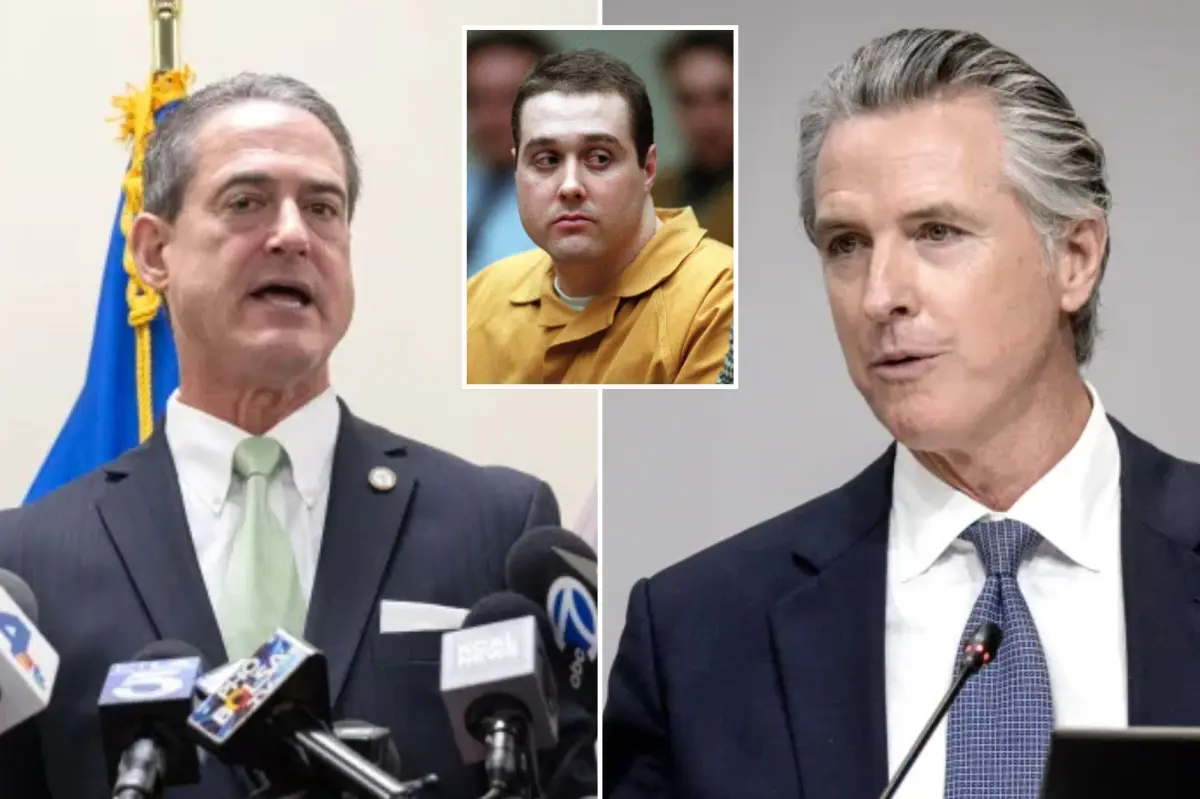
A prominent California district attorney is challenging Gov. Gavin Newsom’s sweeping commutations of death sentences, targeting 18 Orange County inmates convicted of murder, including a notorious serial killer and the man who killed a 5-year-old girl.
Orange County District Attorney Todd Spitzer filed a petition with the California Supreme Court Friday, asking the justices to review Newsom’s decision to spare the 18 prisoners from execution.
The filing centers on inmates who had no previous felony convictions before committing the murders that sent them to death row. Unlike prisoners with multiple felony convictions, their sentence commutations do not automatically require review by the state’s highest court.
Spitzer’s office said 584 condemned inmates statewide received clemency from Newsom. Of those, 202 are expected to have their death sentences commuted without further court approval.
In his filing, Spitzer contended that the governor’s mass commutations reflected a personal opposition to capital punishment rather than an individualized legal review of each case.
Spitzer argued that Newsom acted because he “disagrees with the law,” pointing out that California voters have rejected ballot measures to abolish the death penalty twice.
“Our criminal justice system does not bend with the political winds, and one man – even if he is the
governor – does not get to put his thumb on the scales of justice simply because he does not like the law,” Spitzer said in a statement.
“I refuse to allow one man to dismantle our criminal justice system brick by brick and sentence by sentence until there is not a shred of accountability left.”
Spitzer also accused Newsom of failing to “faithfully execute” the law by issuing broad clemency rather than weighing each inmate’s case separately.
The 18 Orange County prisoners sentenced to death without prior felony convictions are Maria del Rosio Alfaro, Ika Amulu, Alejandro Avila, Eric Wayne Bennett, Richard Delmer Boyer, Shaun Kareem Burney, Edward Charles III, Richard Lucio DeHoyos, John Joseph Famalaro, Randy Steven Kraft, Waymon Livingston, Victor Mirando Miranda-Guerrero, Christian Antonio Monterroso,
Iftekhar Murtaza, Tanya Jaime Nelson, Ignacio Arriola Tafoya, Eduardo David Vargas and Daniel Patrick Wozniak.
Several of those inmates were convicted in especially brutal cases.
Bennett received a death sentence in 1997 for the 1994 rape and murder of 50-year-old Marie Evans Powell.
YOU MIGHT ALSO LIKE: Nancy Pelosi Calls Trump a ‘Villain’ During New Interview
Bennett had installed flooring or carpet at Powell’s Laguna Hills townhouse two weeks before breaking into the home. He raped Powell and beat her to death, and was also convicted of raping and robbing another woman at knifepoint in Costa Mesa.
Kraft is a notorious serial killer convicted of raping, torturing and murdering at least 16 young men across Southern California between 1972 and 1983. Investigators have connected him, or suspected him, to dozens of other killings, with estimates of as many as 67 victims across three states.
Avila was convicted of kidnapping, sexually assaulting and killing 5-year-old Samantha Runnion in Stanton, California, in 2002. He abducted the girl while she was playing outside her home. Her body was discovered the next day roughly 50 miles away in Riverside County.
Still, the challenge may hinge on whether the California Constitution clearly authorizes Newsom to commute the sentences of inmates who had no prior felony convictions.
Scott Sanders, the attorney for Wozniak, questioned the purpose of Spitzer’s petition. Speaking to City News Service, Sanders said: “I’m not exactly sure what the goal is in filing the brief. The law appears to be completely settled on this issue in terms of a governor’s right to commute.”
Newsom has defended the sweeping commutations as an act of conscience, saying he felt morally compelled to spare the inmates from execution.
In a letter announcing the decisions, Newsom said the state constitution gives the governor authority to grant clemency.
“But the constitution also gave every governor clemency authority, and that power exists for moments when law as applied cannot be squared with justice. For me, this is that moment,” Newsom wrote.
Spitzer is not the only official challenging Newsom’s decision. The Criminal Justice Legal Foundation and several district attorneys have also filed a lawsuit seeking to stop the commutations.
Victim advocacy organizations have separately asked the state Supreme Court to intervene as it prepares to review commutations involving inmates with multiple felony convictions.
Crime Victims United on Friday asked Associate Justice Kelli Evans to recuse herself from that review. The group cited her former work for Newsom and reports that she helped develop his 2019 executive order imposing a moratorium on executions, which remains in effect.
Evans quickly rejected the request, prompting advocates to demand an explanation. The Post contacted the state Supreme Court for comment.


