
Only two Cornell University students found responsible for sexual assault in the years before seven fraternity members were accused of gang-raping a woman were expelled. Another student was assigned a “reflection paper” as part of the disciplinary response.
From mid-2020 through mid-2024, Cornell reviewed 51 formal sexual assault complaints. Title IX proceedings determined that students were responsible in 16 of those cases, according to CNN.
Despite those findings, just two students were removed from the university. Six others received reprimands, while seven faced measures including written warnings, disciplinary probation, directed study assignments or no-contact orders.
Cornell’s Office of Civil Rights describes directed study as an assignment requiring students to read or watch “relevant materials,” then discuss those materials and explain how they relate to the case.
The materials can include an impact statement written by the person who filed the complaint, according to the university’s guidance.
In other cases, complaints were withdrawn before a Title IX hearing occurred. Even then, some accused students were assigned sanctions such as an “Accountability Reflection Paper” or an “Apology Letter.”
Cornell has not released figures for the academic year that began in fall 2024—the period when a woman known as Jane Doe says she was raped by seven students at the Chi Phi fraternity—or for the years that followed.
The number of cases that also led to criminal investigations is unknown. Police inquiries, when opened, would take place separately from the university’s internal Title IX process.

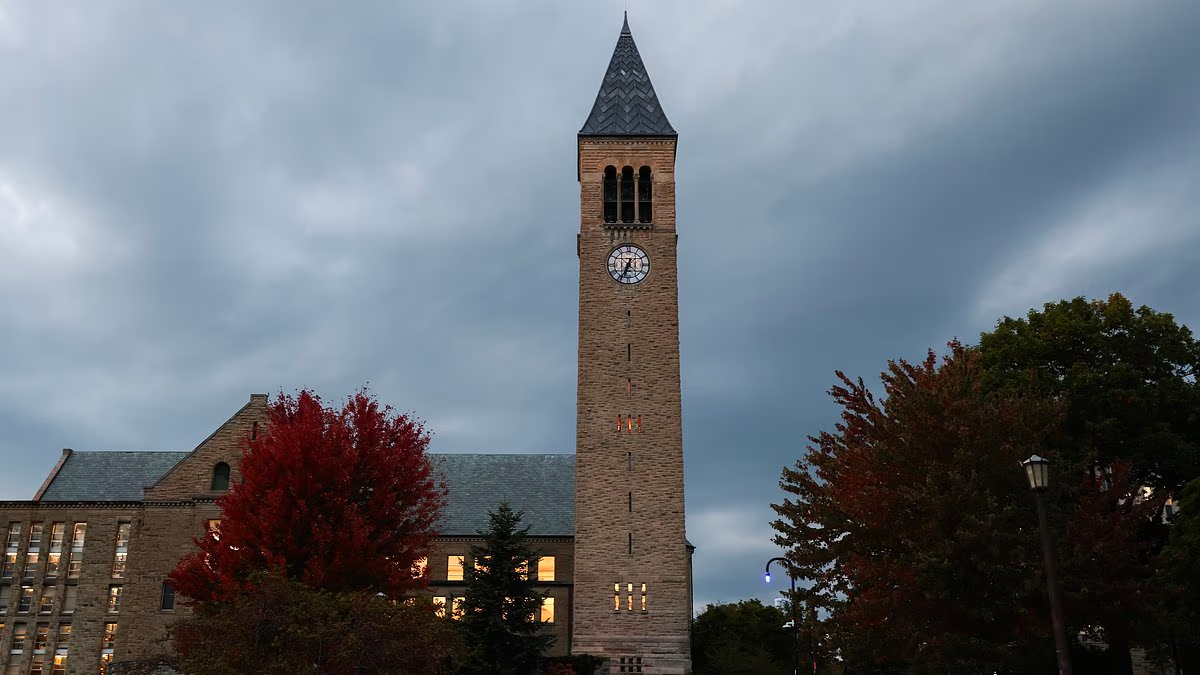
A report found that only two students Cornell officials determined were responsible for sexual assault between mid-2020 and mid-2024 were expelled from the New York campus, pictured.
Cornell’s handling of sexual assault cases and what critics describe as lenient discipline have prompted criticism from members of the surrounding community for years.
Jennifer Brownell, executive director of the Advocacy Center of Tompkins County, said the sanctions were “infuriating.” Cornell directs students to the nonprofit for counseling and support related to sexual violence.
“Should they be expelled? I don’t know. But should there be harsher punishments? Yes,” Brownell said.
Kacey Lee, a former Cornell student, told CNN she felt “betrayed” after university officials found the student she said assaulted her responsible in 2023. His punishment included disciplinary probation, a no-contact order and directed study requiring a “reflection paper,” but he was not expelled.
The Title IX panel, made up of Cornell faculty and staff, concluded that the student’s conduct had “caused significant harm” but was not carried out with malicious intent. The panel also determined that education about affirmative consent and related issues would likely prevent him from committing similar misconduct again.
After reading the decision, Lee said the punishment felt less like meaningful accountability and more like assigning her alleged assailant “an extra homework assignment.”
“In a way, they were telling me it just wasn’t bad enough,” she said. “Why is my pain worth an essay?”
Lee said the experience has left her regretting that she reported the matter to Cornell’s Title IX Office.
“To know that I went through it all for this illusion of accountability felt even worse,” she said.

Kacey Lee, a former Cornell University student, told CNN she was deeply disappointed after the student found responsible for sexually assaulting her received a “reflection paper” and other disciplinary measures in 2023.

Cornell’s disciplinary record in sexual assault cases has fueled criticism from community members who say students found responsible should face tougher consequences.

Protesters are pictured at a rally in support of a former Cornell University student known as Jane Doe on Tuesday
Others claimed the university’s Title IX Office ignored significant evidence that allowed attackers to evade responsibility – and sometimes attack again, with one former student saying a colleague assaulted her multiple times and once made her bleed before he allegedly struck again a year later.
Jane Doe, meanwhile, has claimed she was coerced into taking drugs and sexually assaulted by seven members of the Chi Phi fraternity at an off-campus house on October 19, 2024.
The three-member disciplinary panel ultimately concluded that Jane Doe was not sexually assaulted by all of the men she had accused, according to records obtained by The New York Times.
Instead, the panel found that only Matthew Ingalls, who had invited Jane Doe to the fraternity house, and Jonathan Newell, who engaged in a threesome with Jane Doe and Ingalls, were responsible for sexual assault.
The two men were then expelled from the school.
EXPLORE MORE: Leaked Audio Reveals Kimberly Guilfoyle’s Tycoon-Funded Lifestyle
But five other men named in Doe’s civil lawsuit received lighter punishments, with Winston Lee and Gillio Lopes receiving suspension and disciplinary probation orders and a third former fraternity member, Diego Sarabia, barred from campus for three years. He had already graduated from the school by the time the disciplinary measures were handed down.
The other two men, Scott Norris and Scott Kretzschmar, were ordered not to contact Jane Doe, to study sexual harassment, social media use and bystander intervention and to write ‘reflection papers.’
They were not part of the alleged attack but were accused of entering the room after Newell allegedly posted in a fraternity Snapchat group that there was ‘free p***y’ upstairs.
The Chi Phi fraternity was also shut down in the aftermath.


Umar Matthew Ingalls and Jonathan Newell were expelled from the school after Jane Doe accused seven fraternity members of gang raping her in October 2024

One of the men allegedly posted to the fraternity’s active-members Snapchat group saying that there was ‘free p***y’ upstairs, referring to Doe, according to the filing, which included an image of the purported chat
All of the accused men have denied any wrongdoing, and were never charged with any crimes after prosecutors ruled there was insufficient evidence to bring criminal charges.
But the Tompkins County District Attorney’s Office has since reopened the case, and the school officials have hired Sally Yates, a former Obama-appointed justice official who was infamously fired by President Donald Trump, to investigate its response to gang rape allegations.
In a statement to CNN, a spokesperson for the school said the university takes sexual misconduct allegations ‘extremely seriously.’
He said the university ‘investigates reports through established processes, providing support and resources to those who come forward.’
The statement also noted that the university expanded in-person sexual violence prevention education this year to all first-year students, and in a separate interview with The New York Times, University President Michael Kotlikoff claimed his creation of a presidential task force in February 2025 to address sexual assault on campus was a sign his administration took the issue seriously.
‘We don’t set up a presidential task force for minor issues,’ he said, adding that the school’s steps were meant to reassure parents worried about their children on campus.
‘I’ve had a number of conversations with parents. I think this is a difficult conversation, particularly with the public that’s gotten so much different information about what actually went on and aren’t aware of these processes, and the complexity of a Title IX process,’ Kotlikoff said.
‘We take the issue seriously, that we respond, that we heard the concerns, and we’re responding in specific ways that address those concerns.’

Cornell University President Michael Kotlikoff claimed his creation of a presidential task force in February 2025 to address sexual assault on campus was a sign his administration took the issue seriously
Kotlikoff also told The New York Times that the heavy use of ketamine and alcohol by students discovered during the Title IX investigation is not unique to Cornell.
‘I think that this is a problem that relates to 20-year-olds, 21-year-olds leaving home for the first time, coming into an environment where there’s access to alcohol, where there is, unfortunately, in some cases, access to drugs,’ he said.
Cornell has since banned all fraternity parties for the rest of the year.
Meanwhile, the Cornell faculty senate has said it plans to vote on a no-confidence resolution against the school’s administrators, including Kotlikoff, later this month.
But in his interview with the Times, Kotlikoff said: ‘The fact that Jane Doe experienced what she experienced at Cornell is something that I am personally sorry for. And I think this entire campus is sorry that occurred.’
‘I’ve heard enough from the community that there is a loss of trust. People are angry. I understand that anger.’
He also announced on Tuesday a suspension of all parties and social events at Interfraternity Council houses through the end of the 2026-27 academic year, along with a new ‘zero tolerance’ policy that would immediately suspend chapters for violations.
‘These measures will provide time for a thorough review of fraternity life at Cornell to determine whether and how it can safely continue,’ Kotlikoff wrote in a letter to the campus community.
Additionally, Cornell administrators announced that the school will be adding experienced sexual assault investigators to its police force.
Our News Outlet has reached out to Cornell University for comment.


