The German Foreign Ministry has produced a report for the European Union (E.U.) found China was responsible for approximately 80 percent of attempts to circumvent sanctions against Russia.
The classified report has not been formally released to the public yet, but German newspapers and TV networks were able to see copies of it on Tuesday. They described the report as a summary of information that was presented to the E.U. Foreign Affairs Council at a meeting in Brussels on May 20.
The report found sanctions have damaged the Russian economy, and found “some success” at blocking exports of war material to Russia through a variety of third countries, including Armenia, Serbia, Uzbekistan, and India.
On the other hand, countries such as Kazakhstan, the United Arab Emirates (UAE), and Turkey are allegedly still allowing some banned materials to pass through to Russia.
The report complained about the United States not providing enough assistance to the EU on policing the sanctions, and also faulted the other nations of the G7 community (Canada, France, Germany, Italy, Japan, and the United Kingdom) for not coordinating their sanctions enforcement efforts closely enough.
China and Russia declared an “unlimited partnership” shortly before Russia invaded Ukraine in February 2022. Last month, Chinese Foreign Minister Wang Yi declared Beijing and Moscow are “friends forever, never enemies.”
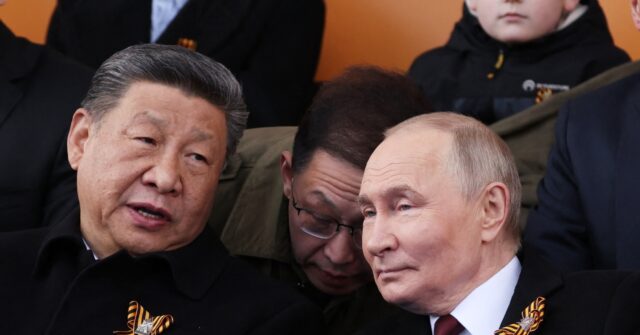
Although China frequently attempts to present itself as an impartial peacemaker, it has never condemned Russia for the invasion. In early May, Chinese dictator Xi Jinping emerged from a meeting with Russian President Vlaidmir Putin in Moscow and declared the two countries would form a new alliance to “safeguard the global multilateral trading system.”
Last July, the North Atlantic Treaty Organization (NATO) accused China of being a “decisive enabler” of Russia’s aggression in Ukraine. NATO expressed “profound concern” over China’s willingness to help Russia continue its war.
“China is fueling the largest armed conflict in Europe since World War II, and, at the same time, it wants to maintain good relations with the West. At some point – and unless China changes course – allies need to impose a cost. There should be consequences,” said then-NATO chief Jens Stoltenberg.
China’s most valuable assistance to Russia, and Iran, has involved buying up large quantities of oil the sanctioned regimes could not sell anywhere else. The EU report touted some success at cracking down on the “dark fleet” of tankers that make covert voyages to ship Russian oil. The Chinese landscape is dotted with small “teapot” refineries that purchase banned oil with Chinese currency.
The Biden administration accused China of providing Russia with 70 percent of its machine tools and 90 percent of its microelectronic imports, including vital components for drone warfare. Independent analysts said China was shipping hundreds of millions of dollars’ worth of dual-use items – nominally civilian goods that have military applications – to their Russian partners.
In January, the U.S. Treasury Department announced it had disrupted some “regional clearing platforms” created by China and Russia to “allow for cross-border payments for sensitive goods.” In essence, China helped to create alternative payment systems that would enable third parties to avoid sanctions against Russia by giving them an untraceable means of paying for goods and services.
Secretary of State Marco Rubio told – News in February that the Russians “have become increasingly dependent on China,” and were well on their way to becoming a “permanent junior partner” to Beijing.
Rubio said attempting to “peel off” Russia from China would help increase the pressure on Russia to end its war in Ukraine, but he doubted such an effort would be completely successful.
The Chinese Foreign Ministry responded to Rubio’s comments to – News by saying it was “totally futile” for the U.S. to “sow discord” between Beijing and Moscow.
On Tuesday, Ukrainian Foreign Intelligence Service chief Oleh Ivashchenko accused China of furnishing critical materials to Russian factories, blunting the effect of sanctions and helping Russia sustain its invasion.