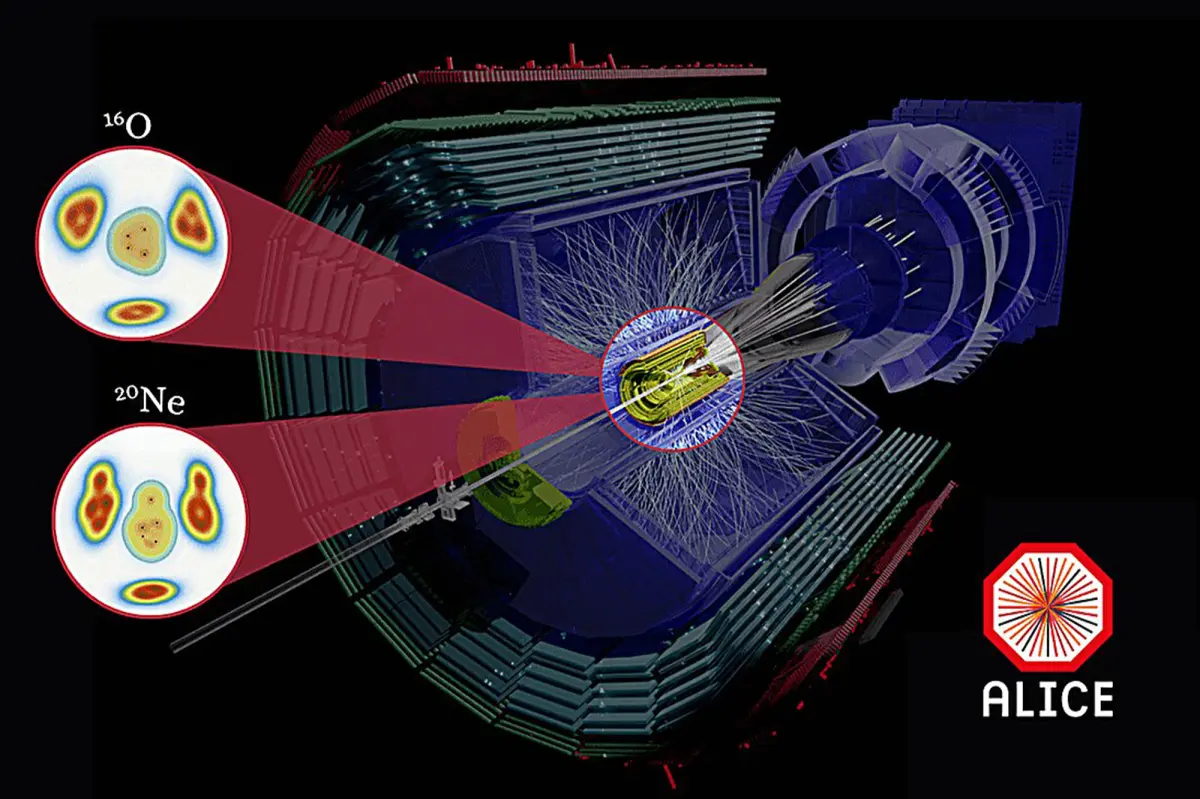

European scientists say they have produced a miniature version of the universe’s earliest moments, recreating conditions thought to have existed just after the Big Bang by colliding some of the lightest atomic nuclei ever used in such an experiment.
In the first instants after the Big Bang, the cosmos is believed to have been a fiercely hot, dense “soup” of elementary particles known as quarks and gluons. Until recently, physicists thought generating this state — called quark-gluon plasma — required high-energy collisions between heavy atoms such as lead.
Now, researchers at the Niels Bohr Institute have shown that the same exotic form of matter can emerge from much smaller nuclei, using oxygen-16 and neon-20, both far lighter than lead, and smashing them together at nearly the speed of light.
“We have pushed the boundary for how small the atomic nuclei can be while still re-creating this primordial matter — what you could call a ‘little big bang,’” said You Zhou, the researcher who led the study.
“We now know more about the fundamental conditions required for matter to transition into this extreme state,” Zhou added, underscoring the experiment’s importance for understanding how matter behaved in the universe’s infancy.
The process hinges on forcing oxygen and neon nuclei into violent, ultra-fast collisions, briefly forming a tiny droplet of quark-gluon plasma — the same superheated material scientists believe filled the newborn universe.
That droplet expands and cools almost immediately, disappearing too quickly to be viewed directly. Instead, researchers analyzed the particles produced in the aftermath, and those traces revealed a surprising signature, Zhou said.
According to the study, collisions between two oxygen nuclei sent particles outward in a more rounded pattern. Neon-on-neon collisions, however, produced a spray shaped more like a bowling pin — a pattern that reflects the actual geometry of the neon nucleus.

This gave researchers an unexpected way to see the shape of an atom with the naked human eye that they could never actually observe directly.
“Hopefully, this will help us better understand how the plasma behaved during the first moments of the universe — and how it later evolved into the forms of matter that everything around us is made of,” said Zhou.
“By studying how the particles move after the collision, we can gain insights into atomic nuclei that are otherwise difficult for physicists to obtain,” added Emil Gorm Dahlbæk Nielsen, a postdoctoral researcher at the Niels Bohr Institute and coauthor of the experiment.
The research findings have been published in the journal Physical Review Letters.
The results add fresh evidence for the standard Big Bang theory — though not all of the science community is convinced anymore that there was a “bang” at all.
A separate theory by another group of scientists, dubbed the “Big Bounce” and reported by The Post in April, theorizes that the universe actually rebounded out of a collapsing black hole, like a basketball bouncing off a rim, and left behind detectable traces of so in black holes today.