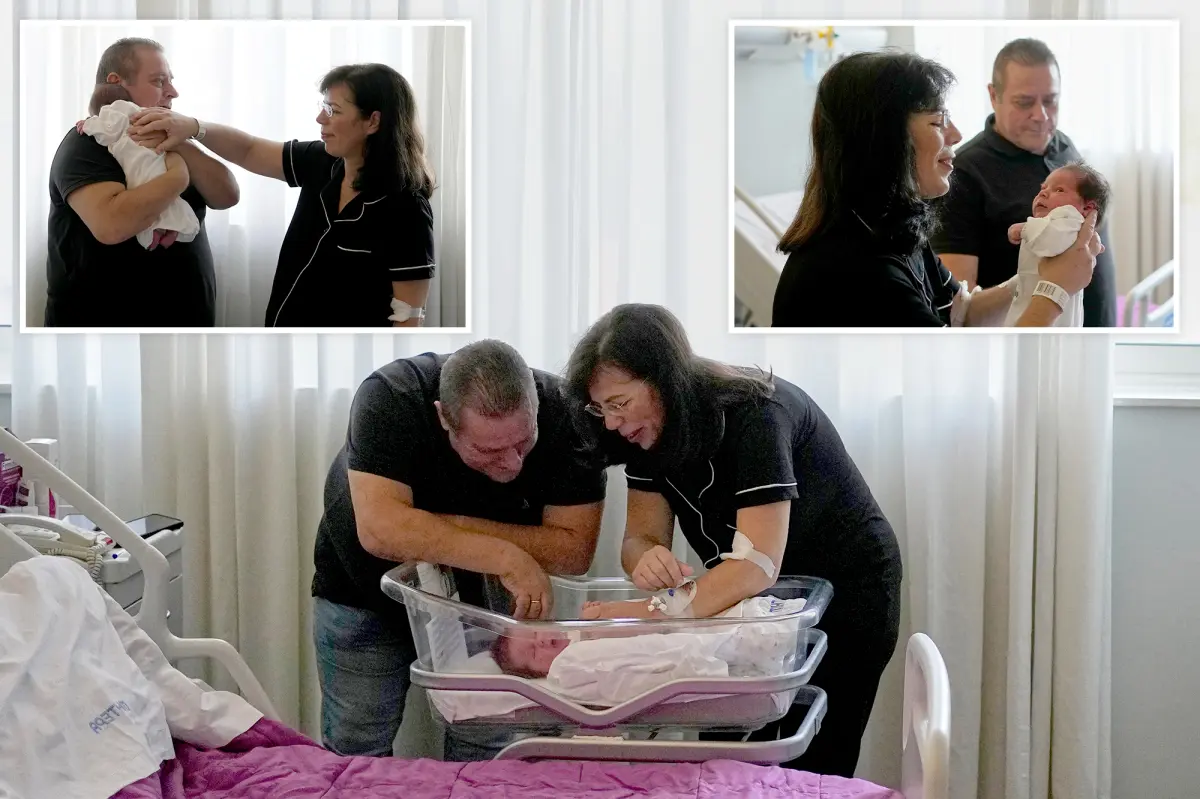

From the depths of grief, a Greek couple has begun again, welcoming a baby girl this week after turning to one of Cristina Rapti‑Tzelepi’s embryos that had been frozen for decades — and moving quickly to meet a looming government deadline.
Rapti‑Tzelepi, 54, and her husband made the decision only months after their 21-year-old son was killed in a road crash in October. Their hope centered on an embryo that had been preserved for 22 years.
The timing was critical. Under Greek law, women must complete in vitro fertilization procedures and obtain approval from a national authority before reaching the age limit of 54. By the time Rapti‑Tzelepi began the process, the clock was already ticking.
“I only had a 2½-month window,” she said. “It was stressful, but with inner strength and our doctor and his whole team by our side, we got through every obstacle.”
On Wednesday, she gave birth in Athens, the Greek capital, to a baby girl weighing 7 pounds, 11 ounces.
By Friday, the hospital room was filled with pink balloons and flowers, as the new parents tried to take in the enormity of the moment.
“We decided to give life a second chance, to make a new start, bring new life into our home and keep our family’s story going,” Rapti‑Tzelepi said, seated on her bed in black pajamas. “My wish for her is to grow up healthy and happy, full of joy like our first child, who filled our home with laughter.”
The newborn was conceived from Rapti‑Tzelepi’s own embryo, which had been frozen for more than 22 years — an exceptionally long period for a fertilized egg to remain frozen before resulting in a pregnancy.
In another notable case last year, a couple in Ohio welcomed a baby boy from an embryo that had been frozen for more than 30 years through a process known as embryo adoption, a birth recognized by Guinness World Records.
Dr. Kostas Pantos, Rapti‑Tzelepi’s gynecologist and the head of the Hellenic Society of Reproductive Medicine, said Greece should reconsider its age limits for fertility treatment, especially as the country faces a sharp decline in births.
“The law is very strict: 54 plus one day is not allowed. Maybe it’s time for it to change,” said Pantos, who was born in Melbourne, Australia. “I think it’s a right (parents) should not be deprived of.”
The baby’s father, 60-year-old Constantinos Raptis, cradled his sleeping daughter on his shoulder as she rested in a white bodysuit.
He said that he was deeply grateful to the doctor for restoring hope to his family.
“He took us by the hand and pulled us out of our deepest darkness,” Raptis said. “We escaped from that darkness, and I believe we have a lot to live for now.”
The couple named their daughter Georgia in honor of their late son, Giorgos, also born thanks to IVF. They haven’t ruled out trying for another child — possibly by traveling abroad.


